What Is ASEAN? The Manila Summit, Its 11 Members and What It Actually Does Explained
By The Daily Byte
·17 Nov 2026
·7 min read
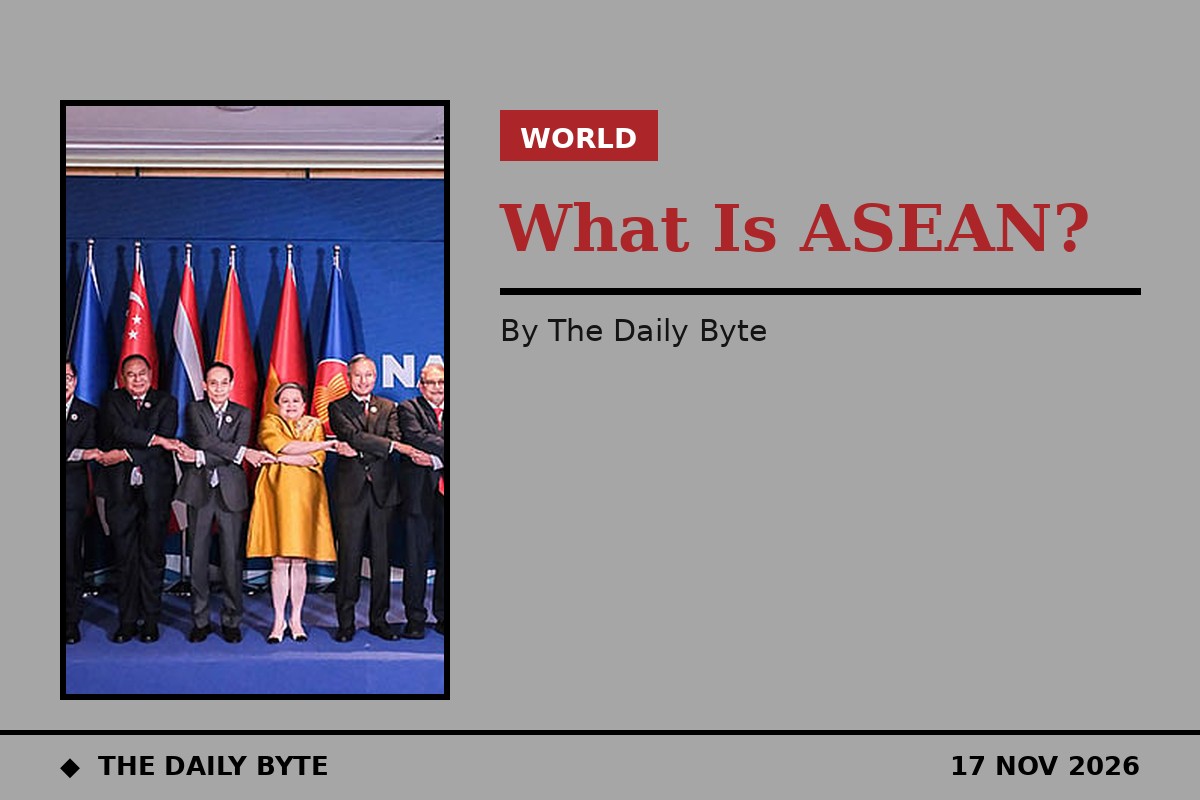
ASEAN, the Association of Southeast Asian Nations, has just closed its 49th summit in Manila. The meeting ran from 15 to 17 November 2026 under the chairmanship of the Philippines, and ended with the chair passing to Singapore. This explainer answers the question people search when a summit like this is in the news: what is ASEAN, who belongs to it, what does it actually do, and what came out of Manila?
The direct answer is that ASEAN is a regional organisation of 11 Southeast Asian states, founded in 1967, that works by consensus. It is not a military alliance and it is not a single market like the European Union. Its members cooperate on trade, security and diplomacy, but each country keeps its sovereignty, and decisions need the agreement of all members.
## What is ASEAN and when was it founded?
ASEAN was founded on 8 August 1967, when the foreign ministers of Indonesia, Malaysia, the Philippines, Singapore and Thailand signed the Bangkok Declaration. The declaration set aims that included speeding up economic growth, social progress and cultural development, and promoting regional peace and stability through respect for justice, the rule of law and the principles of the United Nations Charter.
The organisation's founding came at a tense time in Southeast Asia, and its original purpose was as much about preventing conflict between neighbours as about trade. That dual purpose — peace and prosperity — still shapes what ASEAN does today. The ASEAN Charter, which gave the organisation a formal legal basis, entered into force on 15 December 2008.
## Who are the 11 members?
ASEAN now has 11 members. The five founders were Indonesia, Malaysia, the Philippines, Singapore and Thailand. Brunei joined in 1984, Vietnam in 1995, Laos and Myanmar in 1997, and Cambodia in 1999. Timor-Leste became the 11th member in October 2025, after applying to join in 2011 and holding observer status from 2022. Its admission was formalised at the 47th ASEAN Summit in Kuala Lumpur on 26 October 2025.
The bloc's combined population was 693.2 million in 2025, accounting for 8.4% of the world's population. Its members range from Indonesia, one of the world's most populous countries, to Brunei and Singapore, two of its smallest. They also range widely in wealth, political systems and levels of development, which is one reason ASEAN works by consensus rather than majority vote: a decision that one member opposes does not pass.
## How does ASEAN make decisions?
ASEAN's summits bring together the leaders of the member states, usually twice a year, under a rotating chairmanship that changes each year. The chair sets the agenda and hosts the meetings. The Philippines held the chair in 2026 under the theme "Navigating Our Future, Together", and Singapore takes over from 1 January 2027.
Alongside the leaders' summit, ASEAN holds meetings of foreign ministers, economic ministers and officials, and summits with dialogue partners including the United States, China, Japan, India, South Korea, Australia and the European Union. Those partner meetings are often where the most consequential diplomacy happens, because ASEAN's members sit between the great powers — above all the US and China — and try to keep relations open with both.
## What was on the agenda in Manila?
The Philippines identified three priorities for its chairmanship: peace and security, prosperity through connectivity, and empowering people. In practice, the Manila summit dealt with four big issues.
First, the digital economy. On Saturday 14 November, ASEAN's economic ministers signed the ASEAN Digital Economy Framework Agreement, known as DEFA. It is the first legally binding region-wide digital economy agreement, covering digital trade, cross-border payments, e-commerce, cybersecurity and artificial intelligence. The Philippine government projects it could double the region's digital economy from about $1 trillion to $2 trillion by 2030. It is expected to enter into force in early 2027, but ratification and detailed rules are still to come, and Singapore's Prime Minister Lawrence Wong told leaders on 15 November that DEFA was only a first step.
Second, energy security. Leaders discussed the ASEAN Power Grid, a long-running project to connect Southeast Asia's electricity networks, and the ASEAN Petroleum Security Agreement, an oil-sharing arrangement that Singapore urged members to ratify swiftly. The Asian Development Bank announced a target of mobilising $13 billion in public and private financing for the region's rivers and digital economy by 2030.
Third, Myanmar. ASEAN has barred Myanmar's political leaders from its summits and foreign ministers' meetings since the military coup of 2021, and that ban was kept in Manila. Leaders agreed to continue what President Ferdinand Marcos Jr called "constructive and principled engagement" with Myanmar, and to consider a phased return to high-level meetings tied to progress on ASEAN's Five-Point Consensus, the bloc's peace plan for the country. Thailand had proposed allowing Myanmar's foreign minister back to meetings; the bloc did not agree to ease the restrictions.
Fourth, the South China Sea. ASEAN and China have been negotiating a code of conduct for the disputed waters for years. At the close of the summit on Tuesday 17 November, President Marcos said ASEAN and China had reaffirmed their commitment to complete negotiations on a substantive and effective code of conduct, and that both sides would keep following the existing Declaration on the Conduct of Parties until the code is finalised. The code was not concluded during the Philippines' chairmanship, and the issue passes to Singapore.
## Why does ASEAN matter to the rest of the world?
ASEAN matters for three reasons. The first is scale: nearly 700 million people, and an economy that is one of the world's largest when its members are counted together. The second is geography: Southeast Asia sits on some of the world's busiest shipping lanes, including the South China Sea and the Strait of Malacca, through which a large share of global trade passes. The third is diplomacy: ASEAN is the main forum in which Southeast Asian countries manage their relationships with the US, China, Japan and India without being forced to choose between them.
That balancing act was visible in Manila. The summit took place against a difficult backdrop: the war involving Iran, which has battered economies through energy prices, the growing rivalry between the US and China, and conflict between Thailand and Cambodia. ASEAN's answer, as set out in its theme, is to keep every door open — deepening digital and energy cooperation among its own members while refusing to take sides in great-power rivalry.
## What did the summit not settle?
A summit that produces more than 100 outcome documents, as the Philippines said Manila would, still leaves a great deal unfinished. The South China Sea code of conduct was not concluded. The digital economy agreement is signed but not yet in force, and its detailed rules have yet to be written. The petroleum security agreement still needs ratification. Myanmar's political leaders remain barred, with no date for their return. And the ASEAN Power Grid, discussed for years, still has no public timetable for when the first electricity will flow between national grids, or who will pay for the cross-border links.
That is typical of ASEAN. The organisation moves slowly because it moves by consensus, and its members have very different interests. Its supporters argue that this is a strength: agreements, once reached, hold, because no member was overruled. Its critics argue that it is too slow for crises, above all in Myanmar and the South China Sea. Both arguments were on display in Manila this week.
## Frequently asked questions
**What does ASEAN stand for?** The Association of Southeast Asian Nations.
**How many countries are in ASEAN?** Eleven: Brunei, Cambodia, Indonesia, Laos, Malaysia, Myanmar, the Philippines, Singapore, Thailand, Timor-Leste and Vietnam.
**When was ASEAN founded?** On 8 August 1967, with the Bangkok Declaration signed by Indonesia, Malaysia, the Philippines, Singapore and Thailand.
**Is ASEAN like the EU?** No. ASEAN is not a single market and has no parliament, no common currency and no power to overrule its members. It works by consensus.
**Who chairs ASEAN in 2027?** Singapore, which takes over from the Philippines at the close of the Manila summit, with the chairmanship beginning on 1 January 2027.
**What is DEFA?** The ASEAN Digital Economy Framework Agreement, signed in Manila on 14 November 2026. It is the first legally binding region-wide digital economy agreement, and it is projected to double the region's digital economy to $2 trillion by 2030.
Sources: Reuters explainer "What is ASEAN and why does the bloc matter?" (12 November 2026); Reuters on the close of the Manila summit (17 November 2026); reporting on the DEFA signing and summit outcomes.