What Is the Bank of England Base Rate? Explained
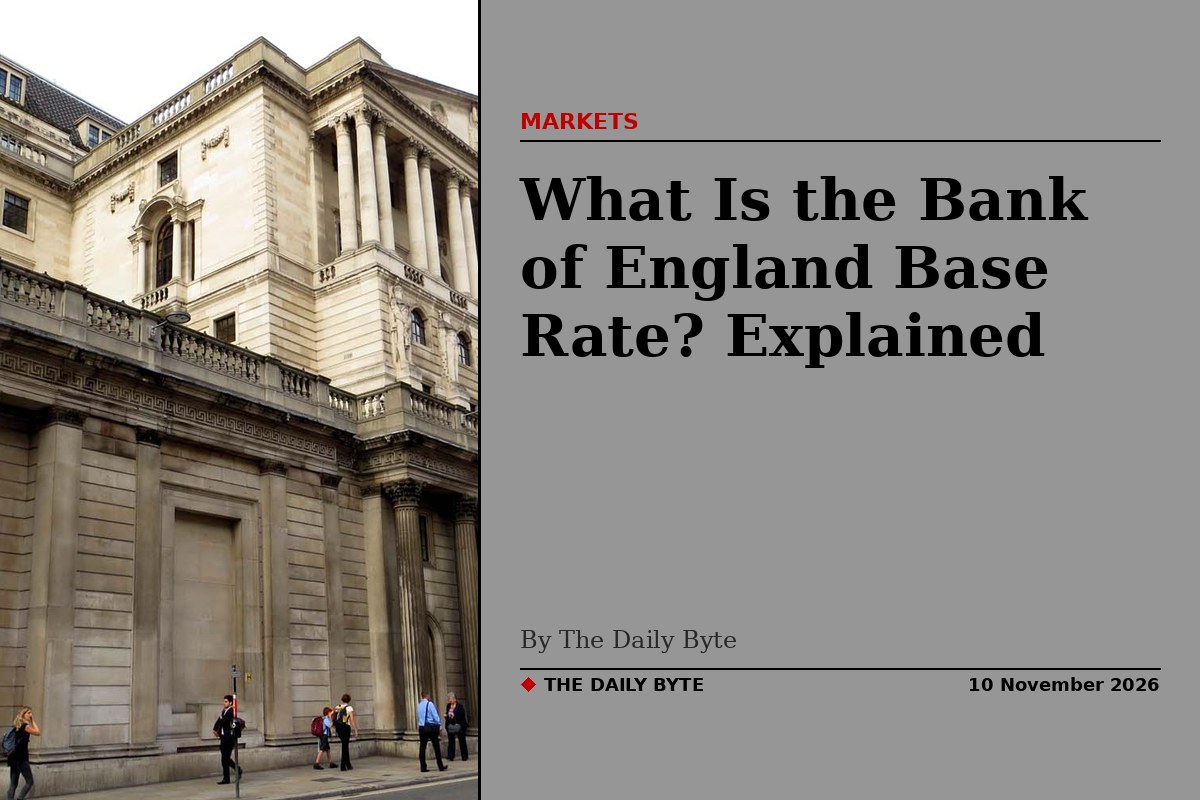
Bank Rate is 4%. The Bank of England raised it by a quarter of a percentage point on 5 November 2026, the first increase in more than three years, and it is the single most important interest rate in the UK economy. Bank Rate is the rate the Bank of England charges banks and building societies when they borrow from it, and it ripples through to the interest paid on mortgages, savings accounts, loans and credit cards. If you have a tracker mortgage, a variable-rate mortgage or money in a savings account, this is the rate that shapes what you pay or earn.
The decision was not close in one sense and not unanimous in another: eight of the nine members of the Bank's Monetary Policy Committee voted for the quarter-point rise, while one, Catherine L Mann, wanted a bigger half-point rise to 4.25%. The Bank acted because inflation, at 3.5% in September, is well above its 2% target, and it expects inflation to reach around 5% by the middle of next year as high energy prices feed through. This guide explains what Bank Rate is, why it has gone up, what it means for your mortgage and your savings, and when it might change again.
What is Bank Rate?
Bank Rate is the interest rate set by the Bank of England's Monetary Policy Committee, usually shortened to the MPC. It is the rate the Bank charges commercial banks when they lend to each other overnight or borrow from the Bank, and because banks pass their own costs on, it sets the floor for interest rates across the economy. When Bank Rate rises, borrowing generally gets more expensive and saving generally becomes more rewarding. When it falls, the opposite happens.
The Bank of England was given operational responsibility for setting interest rates by the Bank of England Act 1998. The government sets the target, and the Bank decides how to meet it. That target is for Consumer Prices Index inflation of 2%, and it applies at all times. The MPC has nine members, including the Governor, Andrew Bailey, and it meets eight times a year to decide the level of Bank Rate. Each decision is announced at noon, with a summary and minutes published alongside it, and the Bank also publishes a Monetary Policy Report four times a year setting out its view of the economy.
Bank Rate is sometimes called the base rate or the Bank of England base rate. The three terms mean the same thing. It is not the rate you will be offered on a mortgage or a savings account: lenders add their own margin on top for borrowers, and pay savers a rate that reflects their own funding needs. But Bank Rate is the anchor those rates move around, and a change in Bank Rate usually moves tracker mortgages immediately and feeds through to other rates over weeks and months.
Why did Bank Rate rise to 4%?
At its meeting ending on 4 November 2026, the Monetary Policy Committee voted by a majority of eight to one to increase Bank Rate by 0.25 percentage points, to 4%. The decision was announced on 5 November 2026. Bank Rate had sat at 3.75% since December 2025, unchanged through six consecutive meetings in 2026, and the rise was the first since August 2023. The eight members who voted for the quarter-point rise were Andrew Bailey, Sarah Breeden, Swati Dhingra, Megan Greene, Clare Lombardelli, Huw Pill, Dave Ramsden and Alan Taylor. Catherine L Mann voted against, preferring a half-point rise to 4.25%.
The reason, in the Bank's own words, is energy. The conflict in the Middle East is now in its ninth month, and global energy prices have continued to rise from an already elevated level. UK Consumer Prices Index inflation increased to 3.5% in September, up from 3.1% in August, and the Bank now expects it to rise to around 5% by the middle of next year. The Bank said that, despite limited evidence so far of higher energy prices feeding through into other prices and wages, the degree of inflationary pressure in the pipeline was now sufficient to warrant an increase in Bank Rate.
The Bank's aim is to stop higher energy prices becoming embedded in the wider economy, so that inflation returns to the 2% target and stays there. Raising Bank Rate is designed to cool spending and borrowing, which in turn eases pressure on prices. The Bank was careful to say that policy is not on a pre-set path: it will judge each meeting on the evidence. But Governor Andrew Bailey also said the rise should not be seen as the first in an inevitable long sequence of hikes, while adding that, unless the conflict is resolved, neither does it seem likely to be the last increase.
How does Bank Rate affect your mortgage?
The effect depends on the type of mortgage you have. If you have a tracker mortgage, your rate follows Bank Rate directly, so a 0.25 percentage point rise usually adds 0.25 points to your rate within days, and your monthly payment goes up. The same is broadly true if you are on your lender's standard variable rate, although lenders decide their own variable rates and are not obliged to pass on the full change, or to pass it on at all.
If you have a fixed-rate mortgage, your rate does not change until your fixed deal ends. That is why fixed deals are popular when rates are rising: they shield you from each increase while the deal runs. The catch comes at the end of the deal, when you remortgage onto whatever rates are available then. With Bank Rate at 4% and markets pricing in further rises, borrowers coming off cheap fixed deals agreed in earlier years are likely to face higher payments when they remortgage, even if their current deal has protected them so far.
For someone weighing a new mortgage, the November rise is a reminder to compare the whole deal, not just the headline rate. A tracker follows Bank Rate up and down, so it could fall as well as rise. A fixed rate gives certainty for two, three or five years, but you pay for that certainty, and you may face an early repayment charge if you leave the deal early. The Bank's own figures show the market expects Bank Rate to reach 4.25% in February, so fixed deals are currently priced with further rises in mind.
What does the rise mean for savers?
Higher Bank Rate is generally good news for savers, but the benefit is not automatic and not one-for-one. Banks earn more on the money they hold, and competition usually pushes savings rates up after a Bank Rate rise, but each bank decides its own rates, and some move faster than others. Easy-access accounts tend to respond first, while fixed-rate savings accounts are priced on what the market expects Bank Rate to do over the term of the deal, so they may already reflect expected future rises.
If your savings rate has not moved since the November rise, it is worth checking what your account pays now and comparing it with the best rates available. Cash ISAs follow the same pattern: rates tend to rise after a Bank Rate increase, but the best deals change quickly, and an account that was competitive a month ago may no longer be. Savers should also remember that inflation matters as much as the interest rate. With inflation at 3.5% and expected to rise towards 5%, a savings account paying 4% still loses purchasing power in real terms, which is why the Bank is raising rates in the first place.
What does it mean for loans, credit cards and businesses?
Bank Rate feeds through to most forms of borrowing, but not always immediately. Personal loan rates are generally fixed when you take the loan out, so existing borrowers are unaffected, but new loans are priced off the rates lenders expect, and those have risen. Credit card rates move more slowly and are set mainly by the lender's view of risk, although the Bank Rate rise adds to the cost of funding those balances. Overdraft rates, which are often linked to Bank Rate, tend to move more quickly.
For businesses, the rise increases the cost of borrowing to invest, hold stock or manage cash flow. Smaller firms, which often borrow at variable rates or rely on overdrafts, feel the change first. The Bank's November Monetary Policy Report noted that the economy has proved more resilient than expected, with annual GDP growth expected to reach over 2% by the end of the year, but higher borrowing costs will weigh on investment decisions. That is, in part, the point of raising rates: to cool demand enough to bring inflation down without tipping the economy into a sharp slowdown.
Bank Rate and the pound
Interest rates also affect the pound. All else being equal, higher UK rates make sterling more attractive to international investors, because they can earn a better return on UK assets, and that tends to support the currency. Sterling strengthened after the November decision, which is the usual pattern when a central bank raises rates by more than markets expected, or signals that more rises may follow.
A stronger pound has mixed effects. It makes imports cheaper, which helps to bring inflation down, and it makes holidays and goods bought from abroad less expensive. But it makes UK exports more expensive for overseas buyers, which can hurt exporters. The Bank does not set interest rates to target the exchange rate, and the pound moves for many reasons, including the outlook for growth and for government borrowing. But the exchange rate is one of the channels through which Bank Rate affects the economy, and the Bank watches it closely.
Bank Rate and energy bills
The November rise is closely tied to energy. The Bank said the Ofgem price cap rose to 1,723 pounds in the final quarter of 2026 and is expected to increase to around 2,150 pounds in the first quarter of 2027. That expected rise in household energy bills is the main reason the Bank expects inflation to climb towards 5% by the middle of next year. The government has announced a one-off 100 pound payment towards energy bills for households in council tax bands A to D in England, and the removal of standing charges from gas bills, but those measures do not change the wholesale energy prices that drive the cap.
This is the dilemma the Bank faces. It cannot influence global energy prices, which are driven by the conflict in the Middle East and by world supply and demand. What it can do is try to stop those higher prices feeding into wages and into the prices of everything else, a process economists call second-round effects. That is why the Bank raised rates even though it acknowledged there is still limited evidence of such knock-on effects so far: it is acting on the inflationary pressure it sees in the pipeline, not only on the inflation already recorded.
When will Bank Rate change again?
The next decision is due on Thursday 17 December 2026, the last of the year, with the minutes published the same day. The MPC meets eight times a year, and the following decision after December falls on 4 February 2027, alongside the next Monetary Policy Report. The Bank's own Market Participants Survey found that the median expectation was for Bank Rate to reach 4.25% in February, and to be 3.5% two and three years ahead, but the Bank stresses that policy is not on a pre-set path and that each decision will depend on the data.
What happens next depends above all on energy prices and on whether higher costs start feeding into wages and other prices. If the conflict in the Middle East eases and energy prices fall, the pressure for further rises would fade, and the Bank could hold or even cut. If energy prices stay high and inflation climbs towards 5% as the Bank expects, further rises are likely. Governor Bailey has said a further increase may be warranted unless there is progress towards resolving the conflict or other news that softens the risks to inflation. For households, the practical message is that borrowing is likely to stay expensive for a while, and that the era of very low interest rates is not coming back soon.
Frequently asked questions
What is the Bank of England base rate now? Bank Rate is 4%, after the Monetary Policy Committee voted eight to one to raise it by 0.25 percentage points on 5 November 2026. It had been 3.75% since December 2025.
What is the difference between Bank Rate and the base rate? There is none. Bank Rate, the base rate and the Bank of England base rate are three names for the same rate, set by the Monetary Policy Committee.
When is the next interest rate decision? Thursday 17 December 2026. The Monetary Policy Committee meets eight times a year, and the next decision after that is due on 4 February 2027.
Will my mortgage go up when Bank Rate rises? If you have a tracker mortgage, usually yes, and quickly. If you are on a standard variable rate, probably, but your lender decides. If you have a fixed-rate deal, your rate stays the same until the deal ends.
Why is the Bank raising rates when energy bills are already high? Because it is trying to stop high energy prices feeding into wages and other prices. Its target is CPI inflation of 2%, and inflation was 3.5% in September, with the Bank expecting it to reach around 5% by the middle of next year.
Interest rates and inflation forecasts change frequently. Check the Bank of England's website for the current Bank Rate before making any financial decision. This article is general information, not personal financial advice.