What Is Bank Rate? What the Rise to 4% Means for You
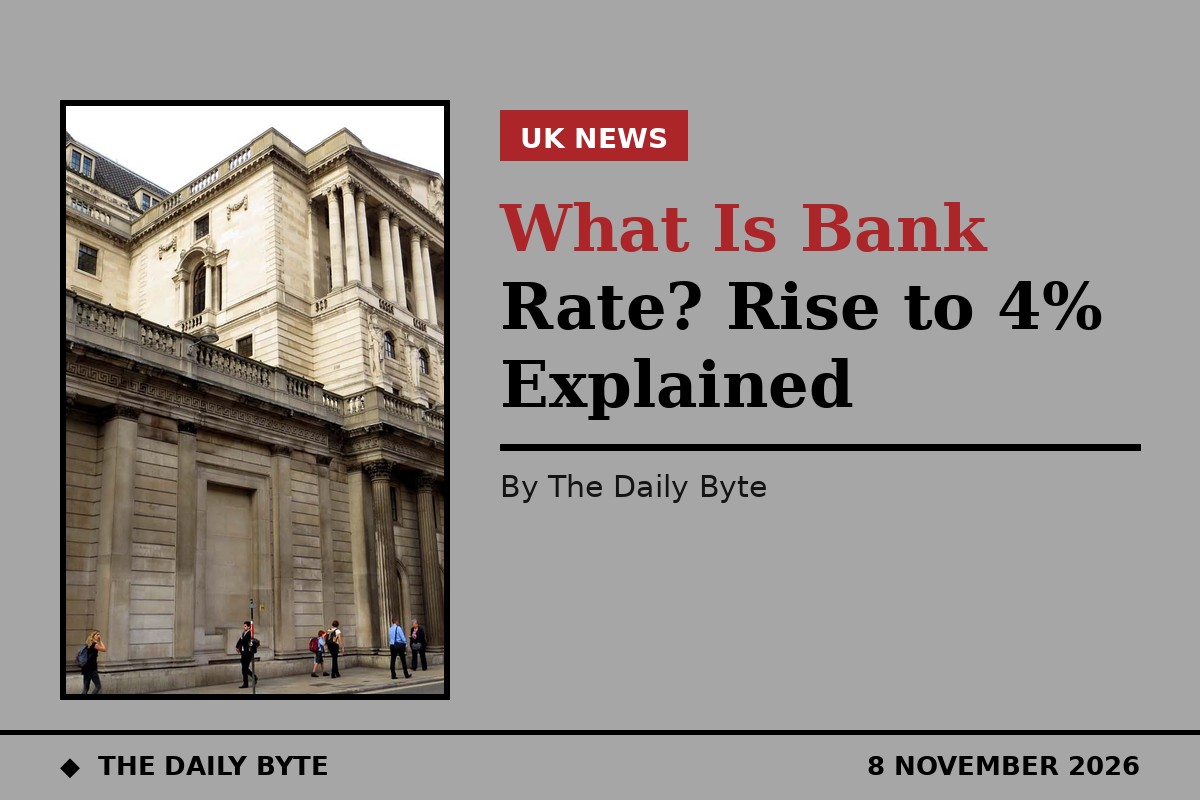
The Bank of England has raised Bank Rate to 4%, up from 3.75%. The decision was announced on 5 November 2026, after the Monetary Policy Committee (MPC) voted 8-1 in favour of a quarter-point rise at its meeting ending 4 November. It is the first increase in Bank Rate since August 2023. In short: borrowing is about to get a little more expensive for some households, savers may see slightly better returns, and the Bank is acting because inflation is rising again.
Bank Rate is the interest rate the Bank of England pays on reserves held by commercial banks, and it is the single most important interest rate in the UK economy. When it moves, it ripples through mortgages, loans, credit cards and savings accounts, because banks use it as a benchmark for what they charge borrowers and pay savers. The Bank uses it as its main tool for keeping inflation at its target of 2% a year.
Why did Bank Rate go up?
The Bank said the rise was needed because inflationary pressure is building. Consumer price inflation reached 3.5% in the year to September 2026, well above the 2% target, and the Bank expects it to rise to around 5% by the middle of next year. The main driver is energy: the conflict in the Middle East is now in its ninth month, global energy prices have kept rising, and that is pushing up fuel costs and household energy bills. The Bank's November Monetary Policy Report notes that the Ofgem price cap rose to £1,723 in the final quarter of 2026 and is expected to reach around £2,150 in the first quarter of 2027.
Eight of the nine MPC members backed the quarter-point rise. Catherine L Mann voted against, preferring a bigger half-point increase to 4.25%. Governor Andrew Bailey said the decision should not be seen as the start of an inevitable sequence of rises, but warned that unless the conflict in the Middle East is resolved, another increase may be warranted. The next decision is due on 17 December 2026.
What does the rise mean for mortgages?
It depends on the type of mortgage. Around 510,000 homeowners have tracker mortgages that follow Bank Rate directly, and UK Finance estimates a typical tracker holder will pay roughly £31 more a month after a 0.25 percentage point rise. A similar number of borrowers are on their lender's standard variable rate, where the lender decides whether to pass the increase on; a typical rise there is around £14 a month. Most mortgage holders, about 87%, are on fixed-rate deals, so their monthly payments do not change until the fix ends. But new fixed deals are priced by financial markets, not by Bank Rate alone, so some lenders have even cut selected fixed rates this week while Bank Rate rose.
What does it mean for savers?
Higher rates are generally good news for savers, but banks do not always pass the full increase on. The average easy-access account still pays only around 2.58%, while the best easy-access cash ISAs pay close to 4.87% and one-year fixed cash ISAs up to about 5.02%, according to Boring Money. The gap between the best deals and what most people earn remains wide, so checking your rate matters more than the Bank's announcement itself. From April 2027, tax on savings interest outside an ISA rises by four percentage points, to 24% for basic-rate taxpayers, which makes ISAs more valuable for many savers.
What happens next?
Financial markets expect Bank Rate could reach 4.25% in February 2027, according to the Bank's own survey of market participants, before easing back to around 3.5% over the following two to three years. The Bank stresses that policy is not on a pre-set path: each decision will depend on the evidence, especially whether high energy prices feed through into wages and other prices. Inflation is expected to peak at around 5% in the middle of next year and then fall back towards the 2% target as the energy shock fades.
| Key fact | Detail |
|---|---|
| Bank Rate now | 4%, up from 3.75% |
| Decision announced | 5 November 2026 |
| MPC vote | 8-1 for a 0.25 point rise; Catherine L Mann wanted 0.5 points |
| Previous rise | August 2023 |
| UK inflation (September 2026) | 3.5%, target 2% |
| Inflation forecast | Around 5% by mid-2027 |
| Next decision | 17 December 2026 |
Frequently asked questions
What is Bank Rate? Bank Rate is the interest rate the Bank of England pays commercial banks on the money they hold with it. It is the UK's benchmark interest rate and influences mortgage, loan and savings rates across the economy.
Why is Bank Rate rising now? Because inflation is climbing, driven mainly by higher energy prices linked to the conflict in the Middle East. The Bank raises rates to cool spending and stop higher prices becoming embedded in the economy.
Will my mortgage go up? Only if you have a tracker mortgage or a standard variable rate. Fixed-rate payments stay the same until the deal ends, though your next deal may cost more.
Is 4% high by historical standards? No. Bank Rate was above 5% as recently as 2008 and 2023-2024, and it stood at 0.1% during the pandemic. At 4% it is high compared with the last decade, but not by longer-term standards.
Sources: Bank of England, Monetary Policy Report, November 2026; Boring Money. This is general information, not financial advice.