What is Brent crude oil and why does its price matter?
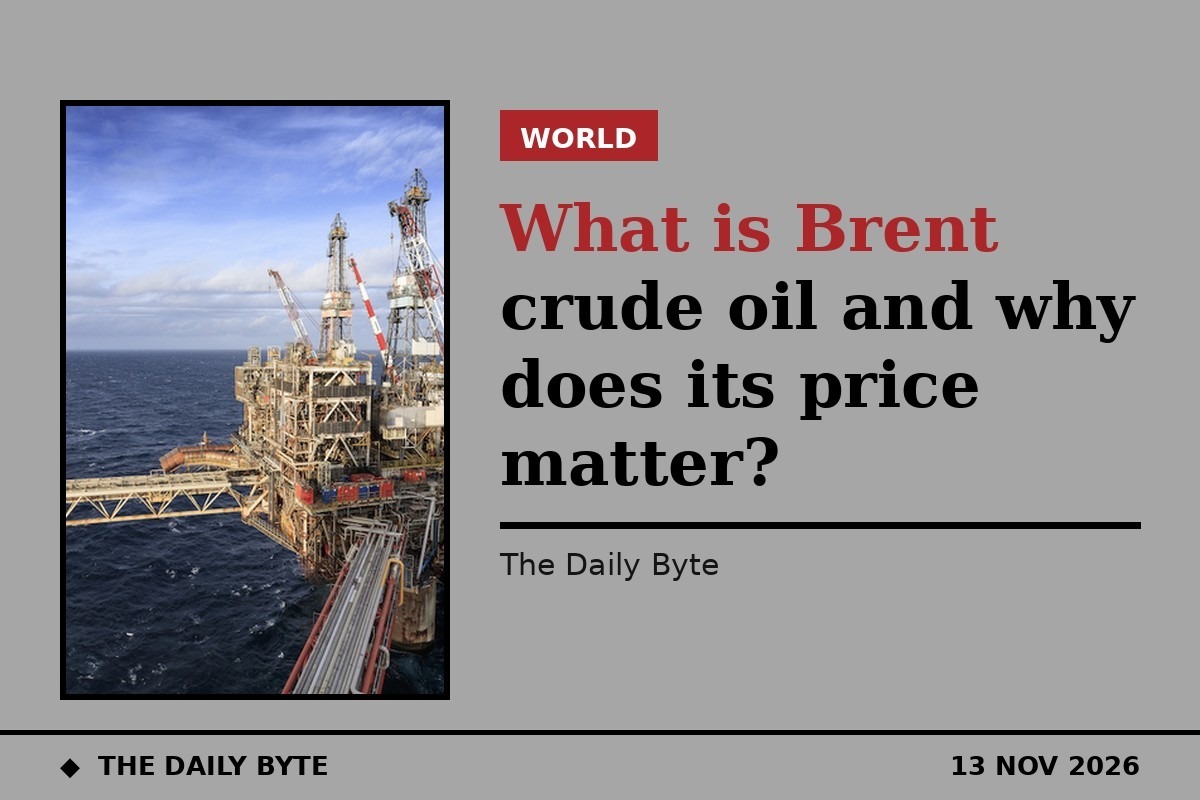
Brent crude oil is a light, sweet crude oil from the North Sea that acts as the world’s main benchmark for the price of oil. It is the reference price for roughly two-thirds of all crude oil traded internationally, so when Brent rises or falls, petrol prices, heating costs and inflation in dozens of countries tend to follow. On 13 November 2026 Brent was trading at about $95.52 a barrel, after a volatile autumn shaped by the war involving Iran and disruption in the Strait of Hormuz.
This explainer sets out what Brent crude actually is, where the name comes from, how its price is set on the London futures market, what moved it in 2026, and why a barrel of North Sea oil matters to a household that never buys oil directly.
What is Brent crude oil?
Brent is not a single oilfield, and it is not a brand of petrol. It is a blend of crude oils produced from fields in the North Sea, between the United Kingdom and Norway, and it is used as a yardstick against which other crudes are priced. A seller in West Africa, the Middle East or the Mediterranean will typically agree a price for a cargo as Brent plus or minus an agreed difference, known as a differential, reflecting the quality of that particular oil and the cost of moving it. That is what makes Brent a benchmark rather than just another type of oil.
Crude oils are described by two qualities: how heavy they are and how much sulphur they contain. Brent is classed as light, because it flows easily and yields a relatively high share of petrol and diesel when refined, and sweet, because it is low in sulphur. Its API gravity is about 38 degrees and its sulphur content is below 0.4%, according to market data published by OilPriceAPI. Light, sweet crudes are generally more valuable than heavy, sour crudes because they are cheaper and easier to refine into the fuels people use most.
The U.S. Energy Information Administration (EIA) describes Brent as the most widely used global crude oil benchmark, and notes that its price is used by traders, financial market participants and economists to assess changes in world petroleum prices more broadly. In other words, Brent is the number the world watches first when it wants to know whether oil is getting more or less expensive.
Where does the name Brent come from?
Brent takes its name from the Brent oilfield in the UK sector of the North Sea, between the Shetland Islands and Norway. The field was discovered by Shell in 1971 and gave its name to the crude produced there. As production from the original Brent field declined, the benchmark had to change so that it would not depend on a single shrinking field.
Today Brent refers to a basket of North Sea grades known as BFOET. The EIA explains that Brent crude oil prices primarily refer to a basket of North Sea crude oil grades, including Brent, Forties, Oseberg, Ekofisk and Troll, and that in 2023 most price assessments began incorporating West Texas Intermediate crude, priced at Midland in the United States, into the basket as North Sea output continued to fall. The five North Sea grades are:
| Grade | Where it is produced |
|---|---|
| Brent | UK North Sea |
| Forties | UK North Sea |
| Oseberg | Norwegian North Sea |
| Ekofisk | Norwegian North Sea |
| Troll | Norwegian North Sea |
The basket was built up over time. Platts, the price reporting agency, began using Brent cargoes as its physical benchmark in the 1980s, added Forties and Oseberg in 2002, added Ekofisk in 2007, and added Troll in 2018. The physical Brent market became the basis for the Intercontinental Exchange (ICE) Brent futures contract in 1988, and that futures contract is now the price most people mean when they say “the Brent price”.
Brent vs WTI: what is the difference?
The other benchmark most people hear about is WTI, or West Texas Intermediate. WTI is the benchmark for oil produced in the United States, priced at the storage hub of Cushing, Oklahoma, and traded on the New York Mercantile Exchange. Brent is the international benchmark; WTI is the American one.
| Brent | WTI | |
|---|---|---|
| Origin | North Sea, UK and Norway | United States, priced at Cushing, Oklahoma |
| Traded on | Intercontinental Exchange (ICE), London | New York Mercantile Exchange (NYMEX) |
| Delivery | Seaborne cargoes, shipped worldwide | Landlocked, moved by pipeline |
| Quality | Light, sweet, about 38° API | Light, sweet, slightly lighter than Brent |
| Used to price | About two-thirds of internationally traded crude | Mostly US domestic crude |
Brent usually trades at a premium to WTI, often by a few dollars a barrel, because it can be loaded onto a tanker and shipped anywhere, while WTI is tied to inland pipeline logistics. On 13 November 2026, for example, Brent was at about $95.52 a barrel while WTI was at about $88.37, according to Trading Economics, a gap of roughly $7. The gap widens when seaborne supply is disrupted, as it was during the Hormuz crisis, and narrows when US supply is plentiful.
How is the Brent price set?
There is no single committee that decides the Brent price. It is set by trading, in two linked markets. The first is the futures market: contracts for Brent crude traded on ICE in London, where buyers and sellers agree a price today for oil to be delivered in a future month. The EIA says the front-month futures contract, the contract for the nearest delivery month, is the most widely used measure of the Brent price because it is so widely traded by physical and financial market participants.
The second is the spot market, known as Dated Brent. This is the price for a real cargo of crude to be loaded from a North Sea terminal, or a WTI cargo delivered to Rotterdam, on a specific date. Under normal conditions the spot price and the front-month futures price stay close together. When the spot price rises well above the futures price, a condition called backwardation, it usually means buyers want oil immediately and supply is tight.
That happened dramatically in April 2026. The EIA reported on 24 April 2026 that the Dated Brent spot price had risen to a premium of more than $25 a barrel over the front-month Brent futures contract, reflecting extreme short-term tightness after the closure of the Strait of Hormuz. It was an unusually large gap, and it showed how quickly a shipping disruption can feed into the benchmark.
One barrel of crude oil is 42 US gallons, or about 159 litres. At a Brent price of about $95 a barrel, that works out at roughly 60 US cents a litre for the raw crude alone, before refining, transport, tax, duty or any retailer margin, which is why the price at the pump is always much higher than the crude price suggests.
What moves the Brent price?
Like any commodity, Brent responds to supply and demand, but a handful of forces matter most. The first is decisions by OPEC and its allies, known as OPEC+, on how much oil to produce. The second is output from non-OPEC producers, above all the United States. The third is the state of the world economy: when factories, airlines and hauliers are busy, they burn more fuel. The fourth is geopolitics, and in 2026 that has mattered more than anything else.
War, sanctions and shipping attacks push Brent up because they threaten supply or make it more expensive to move. The Strait of Hormuz, the narrow waterway between Iran and Oman through which a large share of the world’s seaborne oil passes, has been at the centre of that story all year. Tanker attacks, mine claims and threats to close the strait repeatedly lifted Brent, while talk of a deal between the United States and Iran pulled it back down.
The autumn of 2026 illustrates the pattern. Brent reached an all-time high of $147.50 a barrel in July 2008, and in this cycle it traded above $117 in late October 2026 before falling sharply as hopes of a US-Iran deal grew. It hit a ten-week low of $91.50 on 10 November, then rebounded to about $96 on 12 November after President Donald Trump said the United States no longer needed a deal with Iran, dampening hopes of a diplomatic resolution. Trading Economics reported Brent at $95.52 on 13 November 2026, down 0.31% on the day but still about 48% higher than a year earlier.
Inventories matter too. When US crude stocks rise unexpectedly, traders read it as weaker demand or ample supply and the price falls; when stocks fall, the price tends to rise. The EIA’s Short-Term Energy Outlook, published in November 2026, forecast that Brent would average $104 a barrel in November and $99 in December 2026, according to GOV.HOUSE, which tracks the EIA outlook. Forecasts are not promises, and in a market driven by war and diplomacy they can be overtaken within days.
Why does Brent matter to ordinary households?
Most households never buy a barrel of crude oil, but they buy what is made from it. Petrol and diesel are the most direct link: when Brent rises, wholesale fuel costs rise, and filling stations usually pass much of that through within days or weeks, although the speed varies. Heating oil, jet fuel and the plastics and chemicals made from oil follow the same logic. In the UK, diesel is used by lorries, buses and trains, so higher oil prices also push up the cost of moving goods, which feeds into shop prices.
That is why central banks watch Brent closely. A sustained rise in oil tends to push inflation up, which can keep interest rates higher for longer, while a sharp fall can ease inflation but may also signal a weakening world economy. Governments watch it for a different reason: oil-producing countries earn more when Brent is high, while oil-importing countries, including the UK, Pakistan and most of Europe, pay more for every barrel they import.
For the UK specifically, Brent is doubly relevant. It is a North Sea product, so high prices support the remaining UK oil industry and the tax revenue it generates, but the UK is also a net importer of crude and refined fuels, so high prices raise costs for drivers, hauliers and households at the same time. There is no simple good or bad reading of a Brent rise; it depends on whether you are selling oil, buying it, or filling a tank.
Frequently asked questions
Is Brent crude the same as the petrol I buy? No. Brent is unrefined crude oil. Petrol, diesel, jet fuel and heating oil are made by refining crude, and the pump price also includes refining, transport, fuel duty, VAT and the retailer’s margin.
Why is Brent more expensive than WTI? Brent is seaborne and can be shipped to buyers anywhere in the world, while WTI is priced at an inland US hub and depends on pipelines. Brent also carries more of the world’s geopolitical risk, including disruption in the Gulf, which is usually reflected in a premium of a few dollars a barrel.
What is Dated Brent? Dated Brent is the spot price for a specific cargo of Brent-blend crude to be loaded from a North Sea terminal on a set date. It is the physical price behind the benchmark, distinct from the ICE futures contract, which is a financial agreement for future delivery.
Can I invest in Brent crude? Investors can gain exposure through Brent futures, exchange-traded funds and oil company shares, but the price is volatile, as the swings between $91 and $117 in the autumn of 2026 show. This article is an explainer, not financial advice.
Sources: U.S. Energy Information Administration; Trading Economics; OilPriceAPI.