What Is CAPS? Cirrus Parachute System Explained
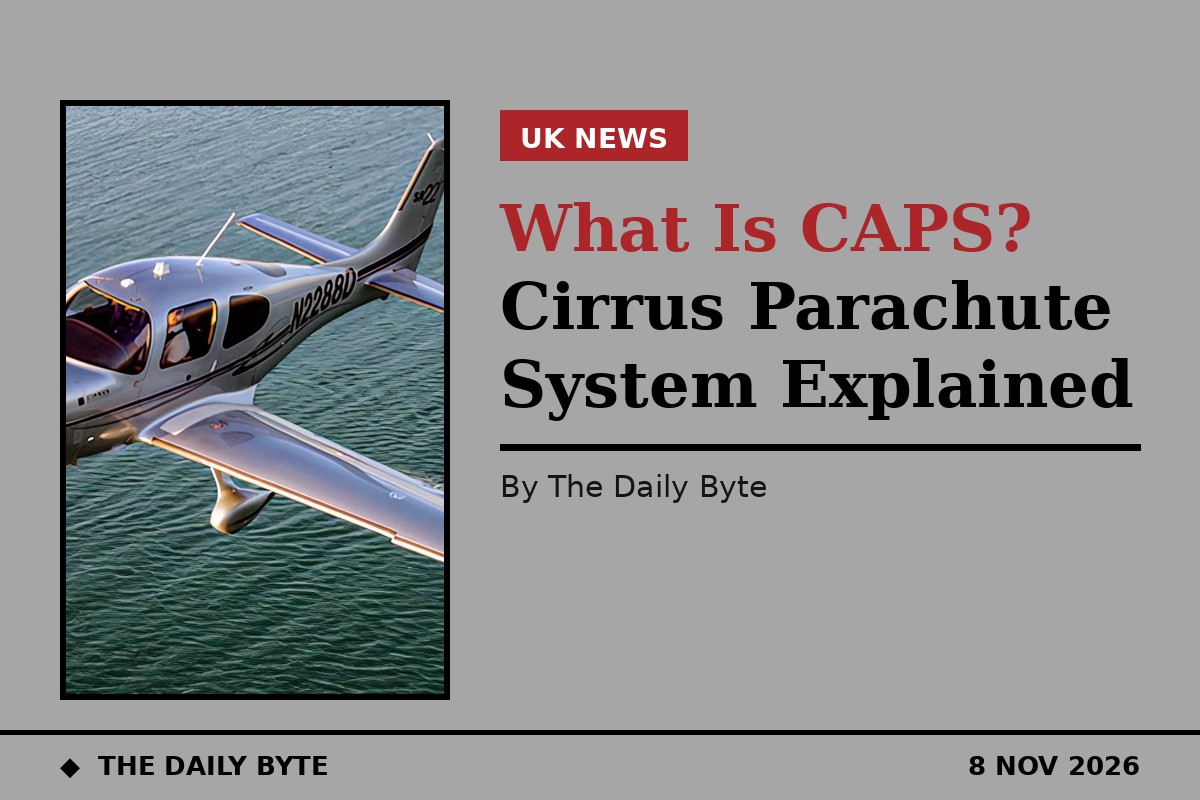
CAPS is a whole-aircraft parachute. Fitted as standard equipment to Cirrus light aircraft such as the SR20, the SR22 and the Vision SF50 jet, the Cirrus Airframe Parachute System can lower the entire aeroplane, and everyone inside it, to the ground under a giant canopy when a pilot faces a life-threatening emergency. It is not a parachute for one person. It is a parachute for the whole plane.
The question is being asked again after a Cirrus SR22T came down while landing at Beccles Aerodrome in Suffolk on Wednesday 28 October 2026. Three people were taken to James Paget Hospital in Great Yarmouth with minor injuries, and a fourth person was treated at the scene. The Air Accidents Investigation Branch has been notified and the cause remains under investigation. Reports of the crash do not say whether the parachute was used, so nothing in this explainer should be read as a claim about what happened at Beccles. It explains the system itself: what it is, how it works, when pilots use it, and what its limits are.
What is CAPS?
CAPS stands for Cirrus Airframe Parachute System. It is a ballistic parachute recovery system, which means a small solid-propellant rocket fires the parachute out of the aeroplane instead of relying on airflow or gravity to pull it clear. Cirrus developed the system with BRS in the 1990s, and the Federal Aviation Administration certified it in October 1998. According to Simple Flying, it remains the first and only aircraft ballistic parachute fitted as standard equipment. Other light aircraft can carry similar systems, but on a Cirrus it comes with the aeroplane rather than as an optional extra.
The hardware lives in a composite box mounted in the rear fuselage, just behind the baggage compartment. Inside are the parachute itself, the rocket that deploys it, and a harness built into the fuselage structure. In the cabin, the pilot pulls a T-shaped activation handle set into the ceiling, just above the pilot's right shoulder. A cover has to be removed first, and the handle must be pulled straight down with both hands in a strong, steady and continuous motion. No electrical power is needed to fire it, so the system can be activated even if the aircraft has lost power.
How does CAPS work?
Pulling the handle fires the rocket, which drags the parachute assembly out of the rear of the aeroplane. The parachute sits inside a deployment bag that stages the sequence, so the canopy only starts to inflate once the rocket has pulled the lines taut. The canopy begins to inflate in about two seconds, and the drag slows the aircraft sharply. The deceleration is kept below 3g while the aircraft is inside the parachute's operating envelope, according to the pilot's operating handbook.
At first the aircraft hangs nose-low beneath the canopy. Eight seconds after deployment, a rear riser snub line is cut automatically and the tail drops, leaving the aircraft hanging in a roughly level attitude. From there it descends at less than 1,700 feet per minute, drifting sideways at about the speed of the surface wind, and may yaw gently back and forth as it hangs from the canopy. The SR22 canopy is a round 2,400-square-foot design fitted with a slider, a fabric ring that controls how fast the canopy opens so the opening shock stays manageable.
When do pilots use it?
CAPS is designed for a life-threatening emergency, and the handbook is blunt about the trade-off: the system is intended to save the lives of the people on board, but it will most likely destroy the aeroplane, and in bad circumstances it can still cause serious injury or death. The handbook says its use should not be taken lightly, and that it is only warranted if a landing cannot be made that ensures little or no risk to the occupants.
The situations it is designed for include engine failure, fuel exhaustion, severe structural icing, a spin the pilot cannot recover from, or a mid-air collision that leaves the aircraft uncontrollable. It is also designed to work in a variety of attitudes, including spins. The pilot still has to make the decision, and the decision has to come early enough for the canopy to open. The manual lists a minimum deployment altitude of 2,000 feet, although Australian Flying has reported deployments from as low as about 400 feet, including one in which a young passenger pulled the handle after the pilot collapsed at the controls shortly after take-off. Low deployments leave very little margin, which is why training stresses deciding early rather than hoping the situation improves.
What does a CAPS landing feel like?
A descent under the canopy ends with a firm impact rather than a gentle touchdown. Australian Flying puts the impact forces at roughly the equivalent of jumping off a two-metre-high fence. To protect the occupants further, each seat sits on a crushable structure designed to crumple and absorb energy, and the cabin is built as a strong capsule designed to withstand up to 26g. That strength mattered at Beccles, where people who follow the accident online noted how well the cabin had held up, although the official investigation has not yet said what caused the crash or whether the parachute played any part.
The outcome also depends heavily on where the aircraft comes down. Rough terrain, high wind, high deployment speed and low altitude all make a worse result more likely. A descent over a flat field on a calm day is a very different prospect from a descent over trees, water or a built-up area in a strong wind. The parachute removes the pilot's ability to steer to a chosen landing spot, which is one more reason the decision to pull the handle is a last resort rather than a first response.
Has CAPS saved lives?
Yes, many times over. Simple Flying reported in March 2024 that the system had already saved 249 lives. One of the most widely reported cases came in March 2023, when a Cirrus SR22 suffered engine failure shortly after take-off from Pampulha Airport in Brazil. Six people were on board, including a three-year-old and a newborn baby, and all six survived after the aircraft came down under the parachute. It is the kind of outcome that explains why Cirrus owners talk about the red handle as the defining feature of the aeroplane, and why the system is often the first thing people ask about when a Cirrus is involved in an accident, as at Beccles.
| Fact | Detail |
|---|---|
| Full name | Cirrus Airframe Parachute System (CAPS) |
| Aircraft fitted | Cirrus SR20, SR22 and Vision SF50, as standard equipment |
| Certified | FAA, October 1998; developed with BRS in the 1990s |
| Canopy | Round canopy, 2,400 square feet, with a slider |
| Deployment | Solid-propellant rocket; canopy inflates in about 2 seconds |
| Levelling | Rear riser snub line cut automatically after 8 seconds |
| Descent rate | Less than 1,700 feet per minute |
| Lives saved | 249 reported by March 2024 |
Frequently asked questions
Does every small plane have a whole-aircraft parachute? No. Cirrus was the first manufacturer to fit one as standard equipment, and it remains the only one to do so, according to Simple Flying. Similar ballistic recovery systems exist for other light aircraft, but they are usually optional equipment rather than part of the standard build.
Can CAPS be used at low altitude? The pilot's operating handbook lists a minimum altitude of 2,000 feet, but deployments have been reported from as low as about 400 feet. The lower the aircraft, the less time the canopy has to inflate and slow the descent, so a late pull leaves very little margin.
Does using CAPS destroy the aeroplane? Almost certainly. The handbook states that the system is designed to save the occupants but will most likely destroy the aircraft. That is the deliberate trade-off: the aeroplane is sacrificed so the people inside it stand a chance of walking away.
Was CAPS used in the Beccles crash? That has not been confirmed. Reports of the 28 October 2026 crash at Beccles Aerodrome say three people were taken to hospital with minor injuries and the Air Accidents Investigation Branch has been notified. The cause remains under investigation, and no official source has said whether the parachute was deployed.
For readers following the Beccles investigation, the key point is patience. The AAIB will establish what happened, including whether the parachute system was involved, and until it reports, the crash itself proves nothing about CAPS beyond the fact that the occupants survived with minor injuries. What CAPS does prove, over more than 25 years in service, is that a light aircraft can carry its own last resort, and that last resort has brought 249 people home.