What Is Dark Matter? The Invisible Universe Explained
Dark matter is invisible stuff that has gravity but does not give off, absorb or reflect light. It makes up about 27 percent of the universe, according to NASA, while everything we can see and touch, stars, planets, gas, people and all, adds up to less than 5 percent. The rest, about 68 percent, is dark energy, a separate mystery. In other words, the overwhelming majority of the universe is made of things we cannot see directly and still do not understand. This explainer sets out what dark matter is, how astronomers know it is there, what it might be made of, and why, after almost a century of searching, nobody has yet found a single particle of it.
The idea sounds almost absurd: how can scientists be confident that most of the universe is invisible? The answer is that dark matter makes itself known through gravity. We cannot see it, but we can see what it does to the things we can see, and the evidence for it now comes from several independent directions that all point the same way.
The first clue: galaxies spin too fast
The first hint of missing mass came in 1933, when the Swiss astronomer Fritz Zwicky studied the Coma Cluster, a vast gathering of galaxies. He measured how fast the galaxies inside the cluster were moving and found they were moving so quickly that the gravity of all the visible matter should not have been able to hold the cluster together. It should have flown apart long ago. Zwicky concluded that there must be far more mass present than telescopes could see, and he called the unseen material dark matter.
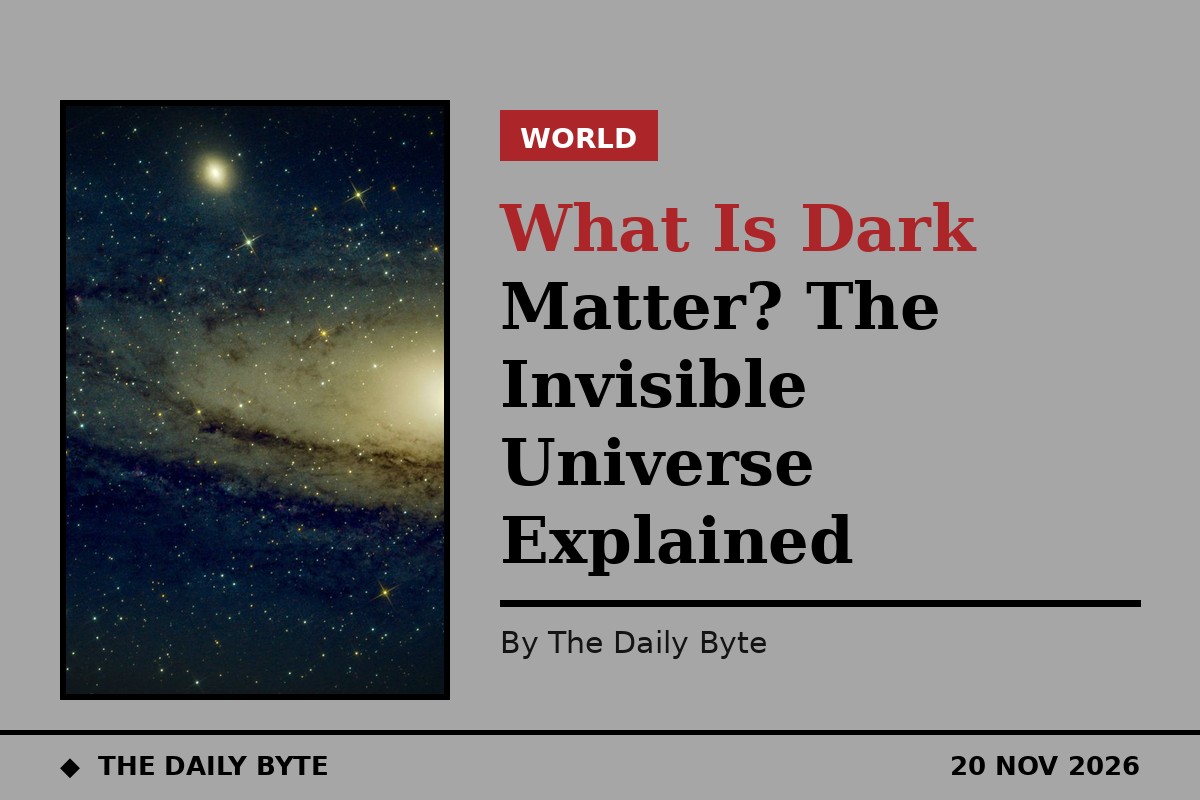
Zwicky's result was largely ignored for decades, partly because the measurements of the time were uncertain. The evidence that finally convinced most astronomers came in the 1970s from the American astronomer Vera Rubin and her colleague Kent Ford. They measured how fast gas clouds orbit within spiral galaxies, starting with our neighbour, the Andromeda galaxy, and published their results in 1970. What they found made no sense if galaxies contained only the matter we can see.
What a rotation curve is
To understand Rubin's discovery, it helps to think about our own Solar System. The Sun holds almost all of the system's mass, so planets orbit more slowly the further away they are: Mercury races around the Sun, while Neptune, far out in the cold, takes much longer to complete a single orbit. Astronomers expected spiral galaxies to behave in a similar way. Most of a galaxy's visible matter sits near its centre, so stars and gas clouds far from the centre should orbit more slowly than those near it.
Astronomers plot orbital speed against distance from the centre in a graph called a rotation curve. Rubin and Ford measured the speeds of glowing clouds of hydrogen gas across the Andromeda galaxy by looking at how their light was shifted towards the red or the blue end of the spectrum, a Doppler shift that reveals whether the gas is moving towards us or away from us. Correcting for the tilt of the galaxy, they could work out the orbital speed at each distance from its centre.
The result was startling. Instead of falling away with distance, as the visible matter predicted, the rotation curve stayed roughly flat. Gas clouds in the far outer parts of Andromeda were orbiting just as fast as those much closer in. That can only happen if there is far more mass in the galaxy than the stars and gas we can see, spread out in a vast halo reaching well beyond the visible disc. Rubin and her colleagues went on to measure many more galaxies, and by 1980 they had shown the same flat rotation curves in 21 spiral galaxies of different sizes. The pattern was the rule, not the exception.
More evidence: bent light and the early universe
Galaxy rotation is only one line of evidence. Another comes from gravitational lensing, the bending of light by gravity. When light from a distant galaxy passes a massive cluster of galaxies on its way to Earth, the cluster's gravity bends the light, distorting and magnifying the image. By measuring how much the light is bent, astronomers can weigh the cluster. Again and again, the mass they measure is far greater than the mass of everything visible in the cluster. The extra mass behaves exactly like dark matter: it exerts gravity but emits no light.
A third line of evidence comes from the early universe. The faint afterglow of the Big Bang, the cosmic microwave background, carries a pattern of tiny temperature variations that record how matter was distributed when the universe was only a few hundred thousand years old. The pattern only makes sense if the universe contained a large amount of slow-moving, invisible matter that helped ordinary matter clump together into the galaxies we see today. Without dark matter's gravity, galaxies would not have had time to form at all.
These three strands, rotation curves, lensing and the early universe, are independent of each other, yet they all require roughly the same amount of dark matter. That agreement is why astronomers are confident dark matter is real, even though no one has ever seen it directly.
What dark matter is not
Dark matter is not dark in the sense of being dim or black. It is dark because it does not appear to interact with light in any way: it does not emit it, absorb it or reflect it. That rules out many ordinary explanations. It cannot be made of dim stars, cold gas or dust, because telescopes would detect those, and careful counts show there is not nearly enough ordinary matter to account for the missing mass. NASA notes that scientists have determined dark matter is not composed of any known particle of matter, because the universe would look very different if it were.
It is also not made of black holes, at least not in any large number. Astronomers have searched for the tell-tale brightening that would occur when a black hole passes in front of a distant star, and they have not found nearly enough of them to explain the missing mass. Whatever dark matter is, it appears to be something entirely new.
What could it be?
The leading idea is that dark matter is made of a new kind of particle, one that has mass and feels gravity but barely interacts with ordinary matter or light. The best-known candidate is called a weakly interacting massive particle, or WIMP. WIMPs would be heavy, slow-moving particles left over from the early universe, drifting through space and through us, almost never colliding with anything. Other candidates include axions, extremely light particles proposed for unrelated reasons in particle physics, and sterile neutrinos, heavier cousins of the ghostly neutrinos that stream from the Sun.
None of these particles has been found. Deep underground detectors, shielded from cosmic rays by kilometres of rock, wait for the rare flash of light that would betray a dark matter particle bumping into an atom. Particle accelerators such as the Large Hadron Collider at CERN try to create dark matter particles in collisions and spot them by the energy that goes missing. So far, every search has come up empty. That does not mean dark matter does not exist; it means the particle, if it is a particle, interacts even more weakly than expected, or is something theorists have not yet imagined.
A minority of physicists argue for a different answer: that there is no dark matter at all, and that gravity itself behaves differently on galactic scales than our current theories predict. These modified-gravity theories can explain some rotation curves, but they have struggled to explain all the evidence at once, particularly the lensing measurements and the cosmic microwave background. Most astronomers therefore continue to favour dark matter, while keeping the alternatives in mind.
Dark matter is not dark energy
The two names sound alike, and both are invisible, but dark matter and dark energy are different things doing opposite jobs. Dark matter pulls things together: its gravity holds galaxies and clusters together and helped build the cosmic web of galaxies. Dark energy pushes things apart: it is driving the accelerating expansion of the universe itself. Confusing the two is easy, but they are separate mysteries, and solving one would not solve the other.
How scientists are hunting for it
The search for dark matter is now one of the biggest efforts in science. Underground laboratories in several countries run ever more sensitive detectors. Telescopes map the distribution of dark matter across the sky by measuring how it bends the light of distant galaxies. And a new generation of sky surveys is charting billions of galaxies to trace the cosmic web in unprecedented detail.
One of those surveys carries the name of the astronomer who did so much to establish the evidence. The Vera C. Rubin Observatory in Chile, named after Vera Rubin, began its ten-year survey of the sky in 2026, mapping dark matter and dark energy across the heavens. Rubin herself never received a Nobel Prize for her work, a fact that remains one of astronomy's most discussed oversights, but her legacy is now written across the sky in the observatory that bears her name.
For now, dark matter remains a mystery with a solid foundation: we know how much of it there is, we know where it is, and we know what it does, but we do not know what it is. That combination, precise knowledge of its effects and total ignorance of its nature, is what makes it one of the most compelling questions in modern science. When the answer finally comes, whether it is a new particle or a new understanding of gravity, it is likely to reshape our picture of the universe as profoundly as Rubin's flat rotation curves did more than fifty years ago.