What Is E20 Petrol? Meaning, Mileage and Car Safety
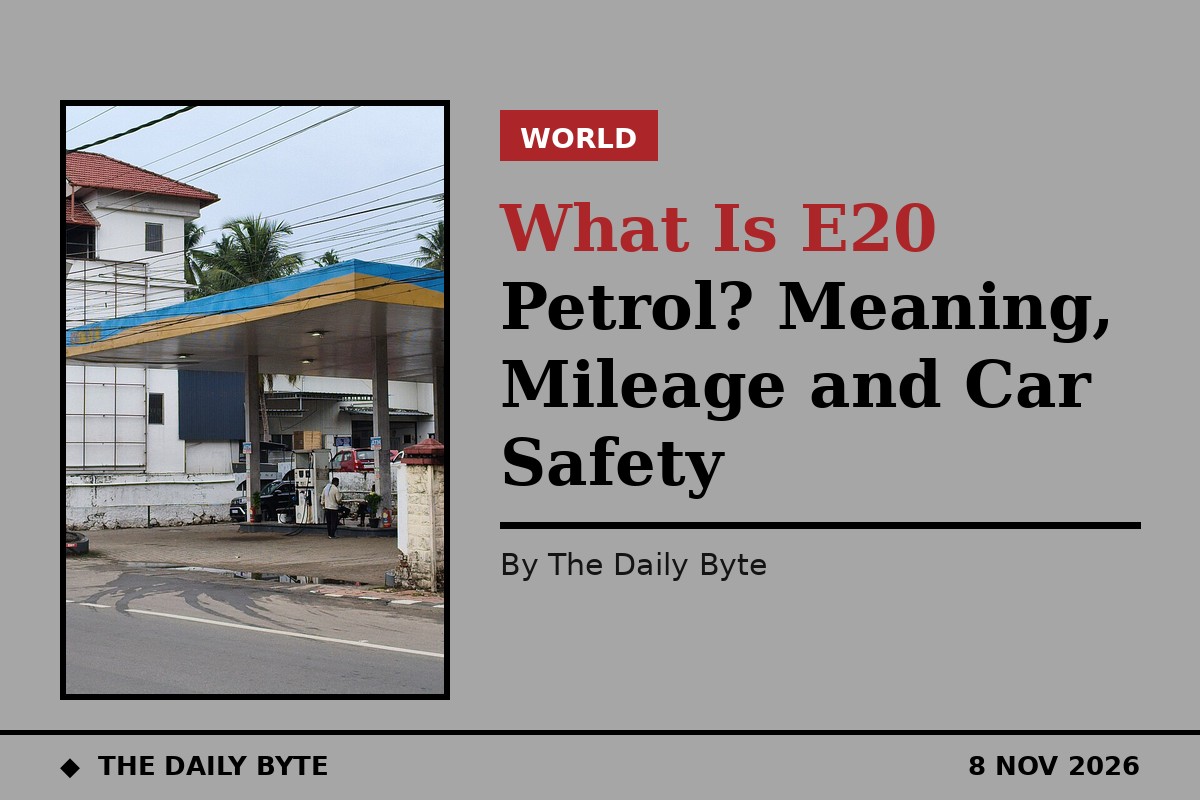
E20 petrol is motor fuel made of 20 per cent ethanol and 80 per cent ordinary petrol. It is now the standard petrol blend supplied across India, under the government's Ethanol Blended Petrol programme. The name is simple — the "E" stands for ethanol and the number is the percentage — but the fuel has become one of India's most argued-over consumer issues, over mileage, older cars, and, on 7 November 2026, a public row about how much ethanol is actually in the petrol at the pump.
This explainer sets out what E20 is, which vehicles can use it, what it does to mileage, and what the two sides in the testing dispute are actually saying.
What is E20 petrol?
E20 is a blend of 20 per cent bio-ethanol and 80 per cent petrol by volume. The ethanol is made from renewable plant material — in India mainly sugarcane, maize and food grains. It is part of a programme launched in 2003 to cut dependence on imported crude oil, support farmers, and reduce exhaust emissions.
The original National Policy on Biofuels of 2018 envisaged reaching 20 per cent blending by 2030. India brought the target forward and achieved E20 in 2025, five years early. The blend is now the default petrol sold at pumps across the country. Union Petroleum Minister Hardeep Singh Puri said on 27 October 2026 that the government has no immediate intention of raising the ethanol share beyond 20 per cent, and there is no announced move to E25 or E30 for ordinary petrol.
Which cars and bikes can use E20?
Compatibility depends on when the vehicle was made and what its fuel system was built for. All petrol cars sold in India from April 2023 onwards, built to Bharat Stage 6 Phase 2 standards, are factory-built to run on E20: their rubber parts, gaskets and fuel lines are designed to handle the blend.
Older vehicles are the grey area. Cars and two-wheelers built for E10, or for pure petrol, can generally run on E20 without immediate engine failure, but their fuel-system parts may wear faster over time, and their manuals may only mention E10. In a reply to Parliament in July 2026, the government acknowledged it had not formally assessed what proportion of the existing petrol fleet was fully E20-compatible. Owners should check the fuel-compatibility marking on their vehicle and follow the manufacturer's manual rather than assuming.
Flex-fuel vehicles are a separate category. The government has notified rules permitting specially designed vehicles capable of using blends as high as E85 or even E100, and the road transport ministry has amended the Central Motor Vehicles Rules to include E100. But those high blends are only for flex-fuel vehicles designed by manufacturers for them. Compatibility with E10 or E20 does not make an ordinary car E85- or E100-compatible.
Does E20 reduce mileage?
Yes, in some vehicles, by a small amount. Ethanol contains less energy per litre than petrol, so a litre of E20 carries slightly less energy than a litre of pure petrol. In its published clarification on E20, the government acknowledges that some vehicles may see a 3 to 5 per cent reduction in mileage.
Against that, ethanol raises the fuel's octane level, which can give smoother combustion and lower some exhaust emissions. The size of the mileage effect varies by vehicle, driving conditions and engine design, so there is no single figure that applies to every car or bike.
E20 petrol: key facts
| Fact | Detail | Source |
|---|---|---|
| What E20 is | 20% ethanol, 80% petrol by volume | Government of India E20 clarification |
| Programme | Ethanol Blended Petrol programme, launched 2003 | Government of India |
| E20 target achieved | 2025, five years ahead of the 2030 plan | National Policy on Biofuels, 2018 |
| Vehicles factory-built for E20 | Petrol vehicles sold from April 2023 (BS6 Phase 2) | Government / industry guidance |
| Mileage effect | 3–5% reduction in some vehicles | Government E20 clarification |
| Prescribed ethanol range | 19–21% under BIS standard IS 17021 | Ministry of Petroleum and Natural Gas, 7 Nov 2026 |
| Samples tested, Nov 2026 | 893 across 27 states and union territories | Ministry of Petroleum and Natural Gas, 7 Nov 2026 |
What happened on 7 November 2026?
The testing dispute flared up when the Karnataka government said its October 2026 exercise had found petrol at some outlets containing 26 to 31 per cent ethanol, with the highest sample at 31.2 per cent. On 7 November, the Ministry of Petroleum and Natural Gas replied with the results of a separate nationwide exercise run by the oil marketing companies and the Centre for High Technology Quality Coordination Cell.
According to the ministry, 893 E20 samples drawn from depots and retail outlets of Indian Oil, Bharat Petroleum and Hindustan Petroleum across 27 states and union territories were all within the prescribed 19 to 21 per cent range under Bureau of Indian Standards specification IS 17021, tested under Annex C at refinery and company quality-control laboratories. The samples comprised 330 from Indian Oil, 280 from Bharat Petroleum and 283 from Hindustan Petroleum. In Karnataka, all 56 samples in that exercise were reported between 19 and 20 per cent, averaging 19.30 per cent.
The ministry said the Karnataka exercise had bypassed the statutory sampling procedure set out in the Motor Spirit and High Speed Diesel Control Order, 2005, and the Marketing Discipline Guidelines 2024, and that the certificates produced did not contain the technical details needed to validate the ethanol figures. It has sought joint sampling and independent testing. Until both sides test the same fuel by the same method, the two sets of figures — up to 31.2 per cent on one side, 19.30 per cent on average in Karnataka on the other — stand as competing claims, not a settled finding.
Is E20 safe for your car?
For vehicles built for E20 — broadly, petrol cars and bikes sold from April 2023 onwards — yes: they were designed for it. For older vehicles, the honest answer is that it depends on the model. They can generally run on E20, but owners of older cars may see slightly lower mileage and, over the long term, faster wear on fuel-system rubber parts not designed for higher ethanol content.
Three practical steps follow from the official guidance. First, check the owner's manual and the fuel-compatibility marking on the vehicle. Second, do not use E85 or E100 in an ordinary car: those blends are only for specially designed flex-fuel vehicles. Third, if mileage drops sharply or the engine runs roughly after a fill, have the fuel system checked rather than assuming the blend is at fault — a single bad tank and a systemic blending problem look the same from the driver's seat.
Frequently asked questions
What does E20 mean? E20 is petrol blended with 20 per cent ethanol and 80 per cent petrol by volume. It is the standard petrol sold across India.
Will E20 damage an old car? Cars built for E20, sold from April 2023, are designed for it. Older cars can generally run on it, but may see 3–5 per cent lower mileage and faster wear on some fuel-system parts. Check the manual.
How much ethanol is allowed in E20? The prescribed range is 19 to 21 per cent under Bureau of Indian Standards specification IS 17021.
What did the 7 November 2026 tests find? The petroleum ministry said all 893 samples tested nationwide were within 19–21 per cent. Karnataka's own exercise had reported up to 31.2 per cent at some outlets. The two sides disagree on sampling method, and joint verification has been sought.
Will petrol go to E25 or E30? The petroleum minister said on 27 October 2026 there is no immediate intention of raising blending beyond 20 per cent.
Sources: IANS, Karnataka E20 row, 7 November 2026; Indian Economic Observer, E20 petrol meets prescribed quality norms, 7 November 2026. The testing figures are attributed to the ministry and to the Karnataka government respectively; the dispute is unresolved at the time of writing.