What Is Erasmus+? How the EU Exchange Works
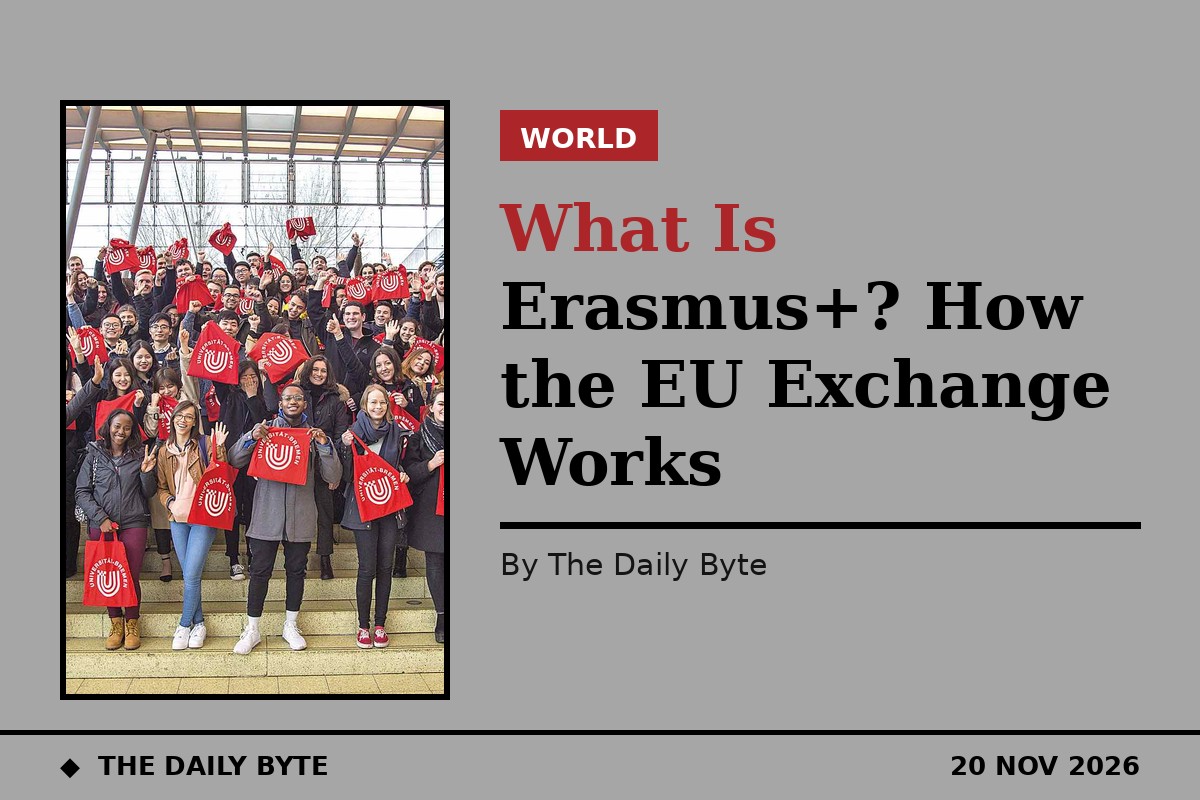
Erasmus+ is the European Union's programme for education, training, youth and sport, funding people to study, train, volunteer and work abroad. It pays grants for learning mobility and cross-border cooperation projects, so that students, apprentices, teachers, youth workers and sports staff can spend time in another country without bearing the full cost themselves. On 18 November 2026 the European Commission opened the Erasmus+ call for proposals for 2027, with a budget of more than €5.3 billion — the largest single funding round of the current programme.
The programme is one of the EU's best-known creations. It began in 1987 as a university exchange scheme and has grown into a programme covering every stage of education, plus youth work and grassroots sport. More than 16 million people have taken part since it began, and the 2027 call is the last under the current 2021–2027 programme period, before the next EU funding cycle begins.
What Does Erasmus+ Actually Fund?
Erasmus+ is organised around three Key Actions, plus the Jean Monnet actions and a sport strand. Key Action 1 funds learning mobility for individuals: students spending a semester at a university abroad, vocational learners and apprentices on work placements, school pupils on exchanges, and staff on teaching or training visits. Key Action 2 funds cooperation between organisations, including partnerships and large-scale alliances that develop new courses, tools and teaching methods. Key Action 3 supports policy development and cooperation with the EU, and the Jean Monnet actions support teaching and research on European integration.
The youth strand funds youth exchanges, youth worker mobility and youth participation projects, while the sport strand supports grassroots sport partnerships, events and cooperation. What the programme does not do is hand money directly to individuals in most cases: grants go to organisations, which then select participants and pass on funding for travel, living costs and other expenses.
A Short History of Erasmus
The programme is named after Erasmus of Rotterdam, the Renaissance scholar who travelled across Europe to teach and study — and ERASMUS is also a backronym for European Community Action Scheme for the Mobility of University Students. It began in 1987 as a stand-alone scheme for university cooperation and mobility, running through two phases until 1994. It then became the higher-education strand of the broader Socrates programme from 1995 to 2006, and of the Lifelong Learning Programme from 2007 to 2013.
In 2014 the EU merged its separate education, training, youth and sport schemes into a single programme, and extended the widely recognised Erasmus name to the whole of it. The "+" signals that it covers far more than higher education, its original focus. The current cycle, running from 2021 to 2027, has an overall budget of €26.2 billion — almost double the €14.7 billion of the 2014–2020 cycle — and focuses on inclusion, the green transition, digital transformation and democratic participation.
Who Can Take Part in Erasmus+?
Erasmus+ is not only for university students, although they are its most famous participants. School pupils, vocational learners, apprentices, adult learners and young people can all take part, as can teachers, trainers, professors, youth workers and sports coaches and staff. Organisations that can apply include schools, universities, colleges, training providers, youth organisations, sports clubs and public bodies.
Individuals generally take part through an organisation rather than applying on their own. A student applies through their university, a pupil through their school, an apprentice through their training provider, and a young person through a youth organisation. The organisation holds the grant, selects participants, arranges the placement and manages the funding, which typically covers travel and a contribution to living costs abroad.
The Erasmus+ 2027 Call in Numbers
| Item | Figure |
|---|---|
| Total budget, 2027 call | €5.36 billion |
| Education and training (including Jean Monnet) | €4.71 billion |
| Youth | €530.95 million |
| Sport | €111.86 million |
| Expected participants | Approximately 1.6 million people |
| Organisations expected to be supported | More than 120,000 |
| Programme Guide 2027, version 1 | Published 18 November 2026 |
| Main application deadlines | February–March 2027 |
Sources: European Education and Culture Executive Agency; EUR-Lex, Call for Proposals 2027 (EAC/A11/2026).
The headline deadlines fall in February and March 2027: youth and sports staff mobility applications are due first, on 11 February, school, higher education, vocational and adult education mobility on 18 February, and most cooperation partnerships on 9 March. The 2027 call is the final one of the 2021–2027 programme, and its new priorities include basic skills, teacher training, digital technologies and artificial intelligence.
The UK and Switzerland Are Back In
The 2027 call also marks the return of the United Kingdom and Switzerland to the programme, subject to their association agreements. The UK left Erasmus+ after Brexit and was replaced domestically by the Turing Scheme; it is listed in the Erasmus+ Programme Guide 2027, and UK organisations can receive funding on the terms available to associated countries provided the relevant association agreement applies when the grant agreement is signed. The same condition applies to Switzerland.
For UK students and institutions, the practical effect is that exchanges with European partners can again be funded through Erasmus+ rather than through a separate national scheme, with the same rules on mobility, grants and recognition as other associated countries. The UK government and the Commission agreed the association in 2025, with participation from January 2027.
How Do You Apply for Erasmus+?
For most people, the route in is through an institution that already holds Erasmus+ funding. Students should ask their university's international office, pupils their school, apprentices their training provider, and young people their local youth organisation. Organisations apply for funding themselves, either through their National Agency — which manages most mobility and cooperation actions — or centrally through the European Education and Culture Executive Agency for actions such as larger partnerships and centralised projects.
Applications are made through the EU Funding & Tenders Portal, and the full rules for each action are set out in the Erasmus+ Programme Guide 2027, published on 18 November 2026. Grants are competitive and awarded against published criteria, and the amount an individual receives depends on the destination country, the length of the stay and the type of activity. Anyone considering applying should check the guide and their National Agency's deadlines, because the main 2027 deadlines fall early in the year.
Frequently Asked Questions
Is Erasmus+ only for university students?
No. University students are the best-known participants, but Erasmus+ also funds school pupils, vocational learners and apprentices, adult learners, young people, teachers, trainers, youth workers and sports staff, through their schools, colleges, employers or organisations.
Do you have to pay to take part in Erasmus+?
Participants do not pay a fee to the programme. Grants administered by the participating organisation cover travel and contribute to living costs abroad, although the grant may not cover every expense, and participants should check what their institution provides.
Can UK students apply for Erasmus+ in 2027?
Yes. The UK is included in the Erasmus+ Programme Guide 2027, and UK participation is funded on associated-country terms provided the association agreement applies when the grant agreement is signed. Students should apply through their university or college.
What is the difference between Erasmus and Erasmus+?
Erasmus was the original 1987 university exchange scheme. Erasmus+, created in 2014, merged that scheme with the EU's other education, training, youth and sport programmes into a single programme — the "+" marks the wider scope beyond higher education.