What is GCAP? UK, Italy and Japan fighter jet explained
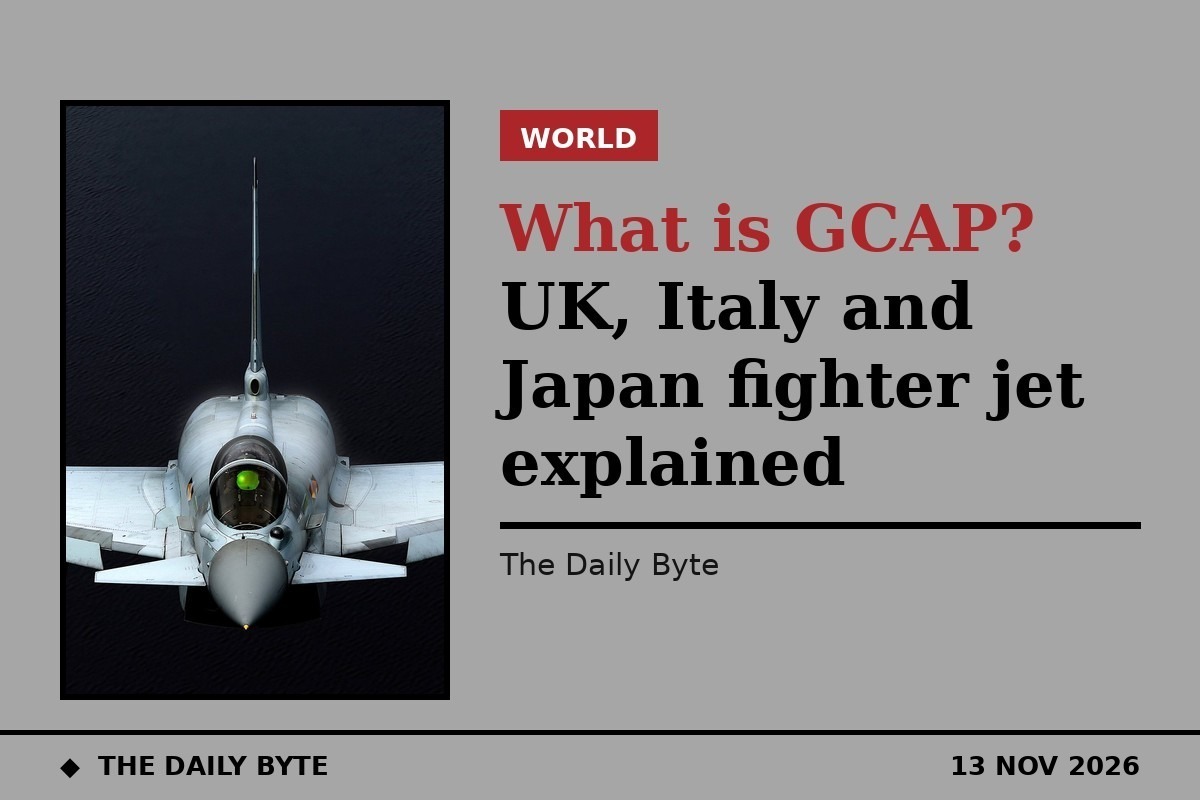
GCAP is the Global Combat Air Programme, a joint project by the United Kingdom, Italy and Japan to develop a sixth-generation fighter jet and the combat air system around it, with the aircraft targeted to enter service by 2035. It will replace the Eurofighter Typhoon in British and Italian service and the Mitsubishi F-2 in Japanese service, and it is one of the biggest defence-industrial projects any of the three countries has ever undertaken. The programme was announced on 9 December 2022, sealed by an international treaty in December 2023, and is now moving from design work into detailed development after two major contracts in 2026.
GCAP is in the news again on 13 November 2026 because the programme is on the agenda as Britain's Prime Minister Burnham meets Italy's Prime Minister Giorgia Meloni in Dublin, at a moment when the project is gathering pace and other countries are asking to join. This explainer sets out what GCAP is, who is building it, what has happened so far and what comes next.
What does GCAP stand for?
GCAP stands for Global Combat Air Programme. The name was chosen deliberately: the three partner governments say the programme is designed with allies and partners at its heart, and that the aircraft it produces must be interoperable with the United States, with NATO and with partners across Europe and the Indo-Pacific. That is the point of the word “Global” — this is not a purely national fighter project, but a shared one.
The programme is often described simply as a plan to build a new fighter jet, but that description is incomplete. The three governments and the companies involved describe GCAP as a “system of systems” that will operate across five domains — air, land, sea, space and cyber — with the crewed fighter as the core platform, connected to uncrewed aircraft and other systems. In practice that means the work covers the aircraft itself, its engines, sensors, communications, electronic warfare, weapons integration, software and the digital engineering and industrial infrastructure needed to build and support it for decades.
Which countries are in GCAP?
Three countries are full partners in GCAP: the United Kingdom, Italy and Japan. The programme was formed by merging two existing next-generation combat aircraft projects — the British-Italian Tempest programme and Japan's F-X programme — under a single trilateral framework. Each of the three brings something different: Britain and Italy bring their experience with the Eurofighter Typhoon, and Japan brings its work on the F-X and its industrial base.
Canada became the first country outside the core partnership to join GCAP in July 2026, as an observer rather than a full member. Observer status gives Ottawa access to selected programme information while it weighs up deeper participation. Germany has also shown interest: during a visit to Japan on 28 October 2026, German Chancellor Friedrich Merz said Berlin was exploring a potential role. Singapore and Saudi Arabia have also been reported as interested in joining or buying into the programme, although neither has joined. The three founding nations have said any new members must contribute to the programme without delaying the target of fielding the aircraft by 2035 — a deadline Japan in particular regards as non-negotiable.
What aircraft will GCAP build?
GCAP will build a sixth-generation fighter aircraft, intended to be the most advanced combat aircraft the three countries have ever operated. It is planned as a large, twin-engine stealth fighter with long range and a high internal payload, designed to operate alongside the F-35 and other current platforms rather than immediately replacing every existing fighter. All three partner nations already operate or are buying the F-35, and GCAP is meant to complement it, not to duplicate it.
In the United Kingdom the aircraft is known as Tempest, the name of the earlier British-Italian programme that GCAP absorbed. GCAP is the official name of the international programme, and Italy and Japan may eventually adopt their own national service names for the aircraft. The distinction matters: Tempest is a national name, GCAP is the international programme.
The aircraft is intended to replace the Eurofighter Typhoon in British and Italian service and the Mitsubishi F-2 in Japanese service. The Typhoon has been the backbone of British and Italian air defence for two decades, and the F-2 is Japan's mainstay fighter. Replacing them is a generational change, which is why the programme is planned to run for decades: the industrial joint venture behind it says its responsibility for the product lifecycle will extend beyond 2070.
Who builds GCAP: Edgewing and GIGO
GCAP has two sides, one governmental and one industrial. On the government side, the GCAP International Government Organisation, known as GIGO, manages and coordinates the programme for the three governments through the GCAP Agency. GIGO was established by the international treaty the three countries signed in Tokyo on 14 December 2023, and it is headquartered in the United Kingdom.
On the industrial side, the joint venture Edgewing is the tri-national prime contractor, responsible for system design and development and for design authority across the whole product lifecycle. Edgewing was launched in 2025 and is based in Reading, in the United Kingdom. Its three shareholders are BAE Systems of Britain, Leonardo of Italy and Japan Aircraft Industrial Enhancement Co. Ltd, each holding an equal 33.3 per cent stake. Other major suppliers are involved in the national supply chains, including Rolls-Royce, MBDA and Mitsubishi Heavy Industries, among others.
The structure is unusual: three governments, one government organisation, and one industrial company owned in equal thirds. The partners say that structure is what lets them share costs, technology and work fairly, but it also means every big decision needs agreement across three capitals — one reason the programme's political backing matters so much.
GCAP timeline: what has happened so far
| Date | Milestone |
|---|---|
| 9 December 2022 | GCAP announced by the leaders of Japan, Italy and the United Kingdom, merging Tempest and F-X |
| 14 December 2023 | International treaty signed in Tokyo, establishing GIGO |
| 2025 | Edgewing joint venture launched, with BAE Systems, Leonardo and Japan Aircraft Industrial Enhancement Co. Ltd as equal partners |
| April 2026 | First joint contract, worth £686 million, awarded for design and engineering work |
| 3 July 2026 | Second contract worth £4.6 billion awarded by the GCAP Agency to Edgewing, lasting 18 months, to complete the advanced analysis and conceptualisation phase and move into detailed design and development |
| July 2026 | Canada joins as the programme's first external partner, as an observer |
| October 2026 | First national Edgewing site inaugurated in Turin, Italy |
| 2027 (planned) | First flight of the fighter demonstrator, to test key technologies before full development |
| 2035 (target) | Aircraft targeted to enter operational service |
The immediate milestone is the demonstrator's first flight, planned for 2027. Its purpose is to de-risk key technologies — adaptive engines, advanced sensors and stealth shaping — before the programme commits to full development. Prototype testing is expected to follow from 2030 to 2032, with the first production aircraft targeted for 2035. That schedule is highly ambitious, and the programme's own backers acknowledge that delays in design, engines, software, weapons or testing could affect the 2035 objective.
Why is GCAP in the news now?
GCAP is in the news on 13 November 2026 because Britain's prime minister is meeting Italy's Giorgia Meloni in Dublin, with the fighter jet programme among the subjects for discussion. The meeting comes as the programme is visibly accelerating: the £686 million contract in April 2026 and the £4.6 billion contract in July 2026 mean serious money is now flowing, the Edgewing joint venture is established and staffed, and a first national Edgewing site has opened in Turin.
The Dublin talks also come at a moment when the question of who else joins GCAP is live. Canada's observer status, Germany's expressed interest and reported interest from Singapore and Saudi Arabia all point the same way: GCAP has emerged as the only sixth-generation fighter project open to third-party participation. Its European rival, the Future Combat Air System involving France, Germany and Spain, has run into difficulty — France and Germany reportedly ended cooperation on the manned fighter element in June 2026 — which makes GCAP's open door more attractive to countries shopping for a next-generation programme.
None of that makes the 2035 target easy. The three governments have to keep funding aligned, keep the workshare fair and keep the technology on schedule, all while the aircraft's most advanced capabilities — including artificial intelligence, collaborative autonomous systems and next-generation sensors — are still under development and will require extensive testing before they can be proven. The Dublin meeting is part of keeping the political leadership behind the project aligned as it moves from paper into metal.
How is GCAP different from FCAS?
Europe has two sixth-generation fighter programmes, and they are easy to confuse. GCAP involves the United Kingdom, Italy and Japan, targets service entry around 2035, and is built around a single common aircraft, often called Tempest in the UK. The Future Combat Air System, or FCAS, involves France, Germany and Spain, with Belgium as an observer, and its planned service entry is around 2040 or later. GCAP is the programme that has welcomed an outside observer in Canada; FCAS has struggled to hold its core partners together on the fighter itself. The two programmes are rivals for export customers and for partner nations, but they are not the same project, and GCAP is distinct from FCAS despite the similar aim.
Frequently asked questions about GCAP
What is GCAP? The Global Combat Air Programme, a joint project by the UK, Italy and Japan to develop a sixth-generation fighter jet and combat air system, targeted to enter service by 2035.
When will the GCAP fighter fly? A crewed demonstrator is planned to fly in 2027, with prototype testing expected from 2030 to 2032 and the first production aircraft targeted for 2035.
What will GCAP replace? The Eurofighter Typhoon in British and Italian service and the Mitsubishi F-2 in Japanese service. It will operate alongside the F-35, not replace it immediately.
Who builds GCAP? The industrial joint venture Edgewing — BAE Systems, Leonardo and Japan Aircraft Industrial Enhancement Co. Ltd, each with a third — under the government-side GCAP International Government Organisation (GIGO).
Can other countries join GCAP? Canada joined as an observer in July 2026, the first external partner. Germany has said it is exploring a role, and other countries have been reported as interested, but full membership would have to be agreed by the three founding nations without delaying the 2035 target.
Sources: Leonardo, “Global Combat Air Programme (GCAP)”; Joint Leader's Statement by Japan, Italy and the United Kingdom, Prime Minister's Office of Japan; House of Commons Library, “What is the Global Combat Air Programme (GCAP)?”