What Is Gravity? How It Works Explained
Gravity is the attraction between any two masses. It is the force that keeps your feet on the ground, holds the Moon in orbit around Earth, and keeps Earth circling the Sun. It is also the weakest of the four fundamental forces in nature, and in some ways the least understood. Yet it governs the largest structures in the universe, from planets and stars to galaxies and clusters of galaxies. The short answer to what gravity is depends on who you ask: Isaac Newton described it as a universal force, while Albert Einstein showed that it is really the shape of spacetime itself.
Both descriptions are useful, and both are still used today. Engineers sending spacecraft to Mars use Newton's laws because they are simple and accurate enough for the job. Astronomers studying black holes and the expanding universe use Einstein's general relativity because Newton's picture breaks down where gravity is extreme. Understanding gravity means understanding both answers, and how the second grew out of the first.
Newton's answer: a universal attraction
Before Newton, people thought the heavens and the Earth obeyed different rules. The Moon circled the Earth, the planets circled the Sun, and apples fell to the ground, and nobody had shown that one explanation covered them all. Sir Isaac Newton published the first quantitative theory of gravitation in 1687, and it did exactly that. His insight was that the force pulling an apple to the ground is the same force that holds the Moon in its orbit. Gravity is universal: every object in the universe attracts every other object.
Newton's universal law of gravitation states the rule precisely. Every particle attracts every other particle with a force along the line joining them. The force is directly proportional to the product of their masses and inversely proportional to the square of the distance between them. Double one mass and the pull doubles. Move twice as far away and the pull drops to a quarter. Move ten times as far away and it drops to a hundredth. Physicists call this an inverse-square law, and it explains why gravity feels strong on Earth's surface but fades quickly with distance, even though it never quite reaches zero.
The law is also beautifully simple in another way: the force on each object is the same. Earth pulls on an apple exactly as hard as the apple pulls on Earth. The apple moves because it is light; Earth barely moves because it is enormously heavy. The same rule explains the orbits of planets, the motions of double stars, and the clustering of galaxies. Observations of orbital motions throughout the visible universe confirm that Newton's law holds to a high degree of accuracy wherever gravity is not too strong and speeds are not too close to that of light.
Why things fall at 9.8 metres per second squared
On Earth, a dropped object speeds up by about 9.8 metres per second every second, a figure known as g. That number comes straight from Newton's law: it is the pull of Earth's mass acting at Earth's radius. A heavier object feels a bigger pull, but it is also harder to get moving, by exactly the same amount. The two effects cancel, so a hammer and a feather fall at the same rate when there is no air to get in the way. Astronauts on the Moon demonstrated this in 1971 by dropping a hammer and a feather together: both hit the ground at the same time.
Modern experiments have tested this equality, called the equivalence principle, to extraordinary precision. A satellite called MICROSCOPE compared how blocks of titanium and platinum fall, and found that they fall alike to within about one part in a thousand trillion. That is one of the most precise null results in all of physics, and it is a strong hint that gravity treats all matter the same way, regardless of what it is made of.
Mass is not weight
People often confuse mass and weight, but they are different things. Mass is the amount of matter in an object, and it does not depend on gravity. Your mass is the same on Earth, on the Moon and in deep space. Weight is the pull of gravity on that object. On the Moon, where surface gravity is about one-sixth of Earth's, you would weigh one-sixth as much, but your mass would be unchanged. That is why astronauts on the Moon could hop around in bulky suits: they were lighter, not less massive, and stopping and starting still took the same effort.
Surface gravity varies across the Solar System because it depends on a world's mass and size. Mercury's surface gravity is about 3.7 metres per second squared, Venus is about 8.9, Earth is 9.8, and the Moon is only 1.6. Jupiter, the giant of the Solar System, has surface gravity about two and a half times Earth's, which is one reason no human could stand comfortably there. The Moon's mass is only about one eighty-first of Earth's, which is why its gravity is so much weaker.
Orbits: falling and missing the ground
An orbit looks like effortless gliding, but it is really a continuous fall. The Moon is always falling towards Earth. So is the International Space Station, and so is every satellite. What keeps them from hitting the ground is that they are also moving sideways very fast. As gravity bends their path downwards, the ground curves away beneath them at the same rate. They keep falling, and they keep missing. That is the whole secret of orbit.
Newton explained this with a thought experiment about a cannon on a mountaintop. Fire a cannonball slowly and it lands nearby. Fire it faster and it lands further away. Fire it fast enough, about 8 kilometres per second near Earth's surface, and the ground curves away exactly as fast as the ball falls. The ball never lands. It has become a satellite. The Moon does the same thing on a grand scale, circling Earth once every 27 days or so, and Earth does the same around the Sun.
The same reasoning explains why the Moon does not crash into us and why Earth does not fall into the Sun. Each body is falling, but each has enough sideways motion to keep missing. Change the speed and the orbit changes: slow down and the orbit shrinks, speed up and it grows. Spacecraft use exactly this logic, firing rockets to speed up or slow down and move between orbits.
Why astronauts float when gravity is still there
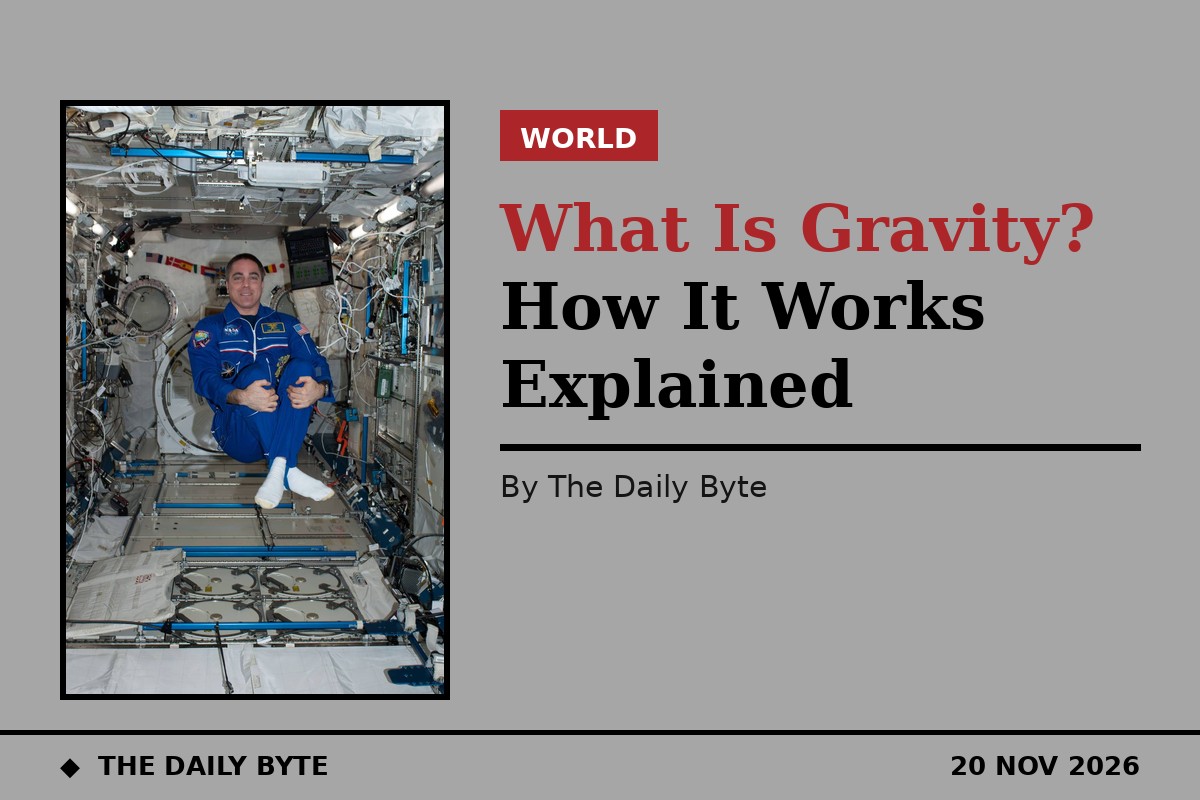
Astronauts floating inside the International Space Station are one of the most misunderstood sights in science. It looks as if there is no gravity in space, but that is not true. The station orbits only about 400 kilometres above Earth, and at that height Earth's pull is still about 90 per cent as strong as it is on the ground. The astronauts float because the station, its crew and everything inside it are all falling together around the planet.
Weight is not gravity itself. Weight is what you feel when something pushes back against gravity, like the floor pushing up on your feet. In free fall there is no floor pushing back, so the sensation of weight disappears. Everything inside the station falls at the same rate, so nothing presses on anything else. That is also why a falling lift, a diving aircraft or a drop tower can create brief periods of weightlessness on Earth. The space station's advantage is duration: it has been falling around Earth continuously for more than two decades, so its crews can live and work in weightlessness for months at a time.
The tides: the Moon pulling the oceans
The tides are one of the most familiar effects of gravity, and they puzzled thinkers for centuries before Newton explained them. They are caused by the gravitational pull of the Moon and, to a lesser extent, of the Sun. The Moon pulls hardest on the ocean directly beneath it, drawing the water up into a bulge. A second bulge forms on the opposite side of Earth, because the Moon pulls Earth itself slightly more strongly than it pulls the water on the far side. As Earth rotates beneath these bulges, coastal places experience two high tides and two low tides each day.
The Sun also raises tides, though its effect is smaller because it is so much further away. When the Sun, Moon and Earth line up, at new Moon and full Moon, their pulls combine and the tides are at their highest, called spring tides. When they are at right angles, the tides are at their lowest, called neap tides. The same gravitational squeezing also explains why the Moon is slowly drifting away from Earth, by a few centimetres a year, and why Earth's rotation is gradually slowing down.
Einstein's answer: curved spacetime
Newton's theory was a triumph, but it had a puzzle at its heart. How could the Sun pull on Earth across 150 million kilometres of empty space, instantly, with nothing in between? Einstein's answer, published as the general theory of relativity in 1915, was that there is no pulling at all. Instead, mass and energy curve the fabric of the universe, which physicists call spacetime, and objects simply follow the curves.
The usual analogy is a rubber sheet with a bowling ball in the middle. The ball makes a dip, and a marble rolled nearby curves around it as if it were being pulled. A planet orbiting a star is doing the same thing in four dimensions: it is following the straightest possible path, called a geodesic, through spacetime that has been curved by the star. As the physicist John Wheeler put it, matter tells spacetime how to curve, and spacetime tells matter how to move.
The equivalence principle is the idea at the heart of this picture. Einstein realised that the effects of acceleration and the effects of gravity are indistinguishable. If you were sealed inside a lift with no windows, you could not tell whether you were standing on Earth or accelerating through deep space. From this simple observation he built a theory in which gravity is not a force at all, but geometry. Where there is no mass, spacetime is flat and objects travel in straight lines. Near a massive object, spacetime is strongly warped, and the curvature grows greater the closer you get.
How Einstein's theory was tested
General relativity made predictions that Newton's theory could not. One was that the orbit of Mercury should slowly rotate in a way that astronomers had observed but could not explain. Einstein's theory predicted that behaviour precisely. Another was that light itself should bend as it passes a massive object. That was confirmed during a solar eclipse in 1919, when starlight was seen to bend around the Sun by the amount Einstein had predicted, and it made him world famous overnight.
Other tests followed. Clocks run slightly slower in stronger gravity, a prediction confirmed by precise clocks flown on aircraft and carried by satellites. Gravitational lensing, where a massive galaxy bends the light of objects behind it, is now a routine tool for mapping dark matter and studying the distant universe. In 2016 scientists announced the first direct detection of gravitational waves, ripples in spacetime itself, produced by two merging black holes more than a billion light-years away. Einstein had predicted those waves a century earlier.
Even everyday technology depends on relativity. The satellites of the Global Positioning System carry atomic clocks, and their timekeeping has to be corrected for both the speed of the satellites and the weaker gravity at their altitude. Without those corrections, which follow directly from Einstein's theories, satellite navigation would drift out of accuracy by kilometres within a single day. Gravity is not just an idea for astronomers: it is built into the phone in your pocket.
What we still do not know
For all its success, our understanding of gravity is unfinished. General relativity describes gravity beautifully on the scale of planets, stars and galaxies, but it does not fit with quantum mechanics, the theory that describes the world of atoms and particles. Somewhere, at the centre of a black hole or in the first instants of the universe, the two theories collide, and neither gives a complete answer. Physicists are still searching for a theory of quantum gravity that would reconcile them.
Gravity is also the key to two of the biggest mysteries in modern cosmology. Galaxies spin too fast for the gravity of their visible matter to hold them together, which is evidence for dark matter, a substance that seems to pull gravitationally but does not emit light. And the expansion of the universe is speeding up, driven by something called dark energy. Gravity, the oldest force known to science, is still the one that raises the deepest questions. It keeps our feet on the ground, it holds the Moon in the sky, and after more than three centuries of study, it still has secrets left.