What Is HIMARS? Rocket System Explained
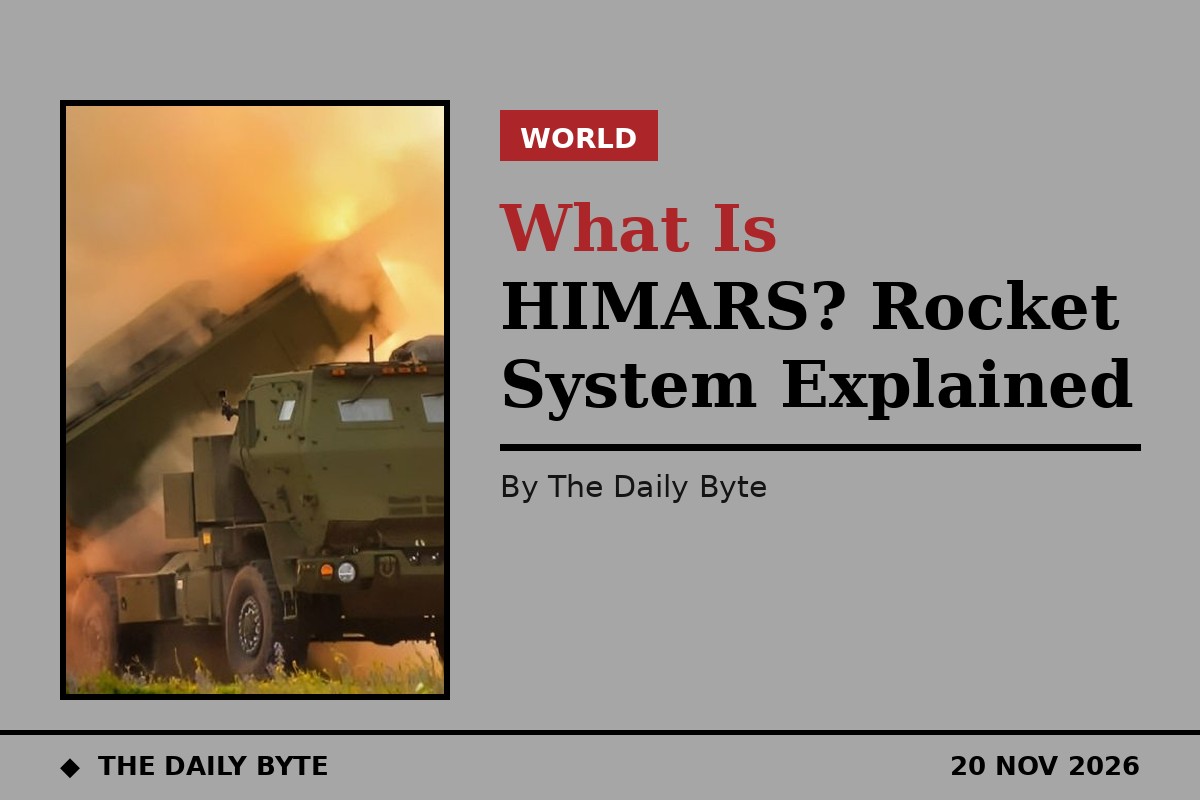
HIMARS is a truck-mounted rocket launcher built by the American defence company Lockheed Martin, and it has become one of the most talked-about weapons of the decade. Its full name is the M142 High Mobility Artillery Rocket System, and the short version, HIMARS, is pronounced "high-mars". It is in the news after the United States approved a possible 210 million dollar sale of two HIMARS launchers to Albania on 17 November 2026, giving the NATO ally its first modern long-range precision rocket artillery. This guide explains what HIMARS is, what it can fire, how far it can reach, and why armies around the world want it.
The simple answer is that HIMARS is a lighter, faster version of the rocket artillery the US Army has used since the 1980s. It is mounted on a standard five-ton army truck, which means it can drive on ordinary roads at highway speeds, be loaded onto a C-130 transport aircraft, fire its rockets, and move away before enemy artillery can reply. That combination of precision, mobility and range is what made it famous in Ukraine, and it is what Albania is now buying into.
What does HIMARS stand for?
HIMARS stands for High Mobility Artillery Rocket System. The "M142" is its US military designation, and the "High Mobility" part is the key to the whole design. Earlier rocket artillery, like the tracked M270 Multiple Launch Rocket System, was heavy and slow to move. HIMARS was developed in the late 1990s to give the US Army a version that could be flown into a conflict zone quickly and driven fast on roads once it arrived.
Development began as a private venture by Loral Vought Systems, which later became part of Lockheed Martin. The US Army awarded a contract to build four prototypes in 1996, low-rate production began in 2003, and the system entered service in 2005. Production of the launcher is now centred at Lockheed Martin's Missiles and Fire Control facility in Camden, Arkansas. Around 750 launchers had been built by late 2025.
What is HIMARS and how does it work?
A HIMARS launcher is a six-wheeled truck with a single launch pod mounted on the back. The truck is based on the US Army's Family of Medium Tactical Vehicles, a standard five-ton chassis, and it is powered by a 330-horsepower Caterpillar diesel engine. The vehicle weighs about 16.25 tonnes in combat configuration, has a top road speed of around 85 to 94 kilometres per hour, and can travel about 480 kilometres on a tank of fuel. It is operated by a crew of three: a commander, a gunner and a driver.
The launch pod can rotate through 360 degrees, and the whole system is designed around a tactic known as "shoot and scoot". The crew drives to a firing position, raises the pod, launches its rockets, lowers the pod and drives away within minutes. Because modern artillery can be located by radar as soon as it fires, speed matters as much as firepower: a launcher that stays in one place is a target. HIMARS is built to fire and disappear.
What can HIMARS fire?
Each HIMARS pod holds either six Guided Multiple Launch Rocket System rockets, known as GMLRS, or a single larger missile. The standard GMLRS rocket is 227 millimetres in diameter and GPS-guided, which means it can hit a target the size of a small building from dozens of kilometres away. The M30 and M31 versions of the rocket have a range of up to 92 kilometres, and the extended-range version, ER GMLRS, reaches about 150 kilometres.
For longer-range targets, the same launcher can fire a single Army Tactical Missile System missile, or ATACMS, which has a range of up to 300 kilometres. The newest missile for the system is the Precision Strike Missile, known as PrSM, which is designed to reach beyond 500 kilometres. Two PrSM missiles fit in a single pod. The launcher can also fire the Ground Launched Small Diameter Bomb, a converted aircraft bomb with a range of about 150 kilometres. One vehicle, in other words, can do the work of several different artillery systems depending on what is loaded into it.
How is HIMARS different from the M270?
HIMARS is often compared with the M270, the tracked launcher it was derived from. The M270 carries two pods, giving it twelve GMLRS rockets to HIMARS' six, and it is armoured and built to keep up with tanks cross-country. But it is far heavier, harder to transport by air, and slower on roads. HIMARS trades half the firepower for a much lighter vehicle that a C-130 Hercules transport aircraft can carry, and that can move quickly on ordinary roads.
That trade-off suits many armies. A country that needs to defend a long coastline or a large territory often prefers several mobile HIMARS launchers that can be moved quickly to wherever they are needed, rather than a smaller number of heavy tracked vehicles. The US Army and Marine Corps use both systems side by side, with the M270 providing heavier firepower and HIMARS providing speed and reach.
Why did HIMARS become famous in Ukraine?
Before 2022, HIMARS was known mainly to military specialists. That changed when the United States began supplying the system to Ukraine after Russia's full-scale invasion. Ukrainian crews used HIMARS to strike ammunition depots, command posts and bridges far behind the front line, targets that older Soviet-designed artillery could not reach with the same accuracy. The strikes disrupted Russian logistics and became a regular feature of news coverage of the war.
The system earned a reputation for precision. Because GMLRS rockets are GPS-guided, they can hit a specific building or bridge span rather than an area, which reduces the number of rockets needed for each target. That accuracy, combined with the shoot-and-scoot tactic, also made HIMARS hard for Russian forces to destroy, even though Russia made it a priority target. The war turned HIMARS from a specialist weapon into a household name, and orders from other countries followed.
Who operates HIMARS?
More than a dozen countries operate or have ordered HIMARS, including the United States, Ukraine, Poland, Romania, Taiwan, Singapore, Jordan, the United Arab Emirates, Bahrain, Estonia, Latvia, Lithuania, Australia, Italy, Canada and Morocco. Poland has become one of the largest operators in Europe, and several NATO allies on the alliance's eastern flank have bought the system as a deterrent. The list keeps growing: every major sale is announced by the US State Department, which must approve exports of American-made weapons.
Albania is the latest country to join that list. The US State Department announced on 17 November 2026 that it had approved a possible 210 million dollar sale of two M142 HIMARS launchers to Albania, and notified Congress the same day. The approval is a determination that the sale may go ahead, not a completed purchase, and no delivery date has been set.
What is Albania buying?
The Albanian package covers two launchers and twelve GMLRS pods carrying 72 guided 227-millimetre rockets, split evenly between M31A2 unitary-warhead pods and M30A2 alternative-warhead pods. It also includes eight International Field Artillery Tactical Data Systems, two Humvees, radios, a resupply truck, a wrecker, spare parts and training. Albania will pay for the purchase with US Foreign Military Financing loan funds, and Lockheed Martin of Grand Prairie, Texas, is the principal contractor. Up to 15 US government and 15 contractor representatives would travel to Albania to support the programme.
Two details of the package are worth noting. First, the conventional GMLRS round can engage targets beyond 70 kilometres, with demonstrated firing ranges reaching 92 kilometres. Second, the package does not include extended-range GMLRS rockets or ATACMS tactical ballistic missiles, so Albania's HIMARS will be limited to the standard GMLRS range unless further missiles are approved later. The State Department said the sale would improve Albania's ability to deter, neutralise and destroy threats and strengthen its contribution to NATO defence plans, while not altering the basic military balance in the region.
What are HIMARS' limits?
HIMARS is a powerful system, but it is not a wonder weapon, and its limits are well understood. The most obvious is capacity: one pod holds only six rockets, so a single launcher cannot sustain a long bombardment the way a battery of conventional guns can. Reloading takes about five minutes with a trained crew, but the launcher must be resupplied with fresh pods, which means a logistics chain of trucks carrying heavy ammunition.
The second limit is that HIMARS depends on accurate targeting information. GPS-guided rockets are only as good as the coordinates they are given, so the system works best when it is linked to drones, satellites and reconnaissance that can find targets. The third limit is cost and availability: demand has surged since 2022, production is booked out, and countries joining the queue now face long waits. Albania's approval is only the first step; delivery, training and integration into NATO systems will take years, not months.
Even so, the logic of the purchase is clear. For a small NATO ally, two launchers with precision-guided rockets provide a long-range strike capability that Albania has never had before, and they plug directly into the alliance's artillery networks. That is why HIMARS, a system designed in the 1990s for rapid deployment, is still the rocket launcher that governments ask for first.