What Is NATO Article 5? Collective Defence Explained
Article 5 of the North Atlantic Treaty is NATO's collective defence clause. In plain terms, it means that an armed attack against one NATO member is treated as an attack against them all, and every ally is expected to help the member under attack. It does not, however, mean automatic war: each ally decides for itself what action it deems necessary, and the clause has been invoked only once in more than 75 years.
That single invocation followed the terrorist attacks of 11 September 2001 on the United States. Since then, Article 5 has been discussed almost every time tensions rise in Europe — most recently after drone alerts in the Baltic states — so it is worth understanding what the clause actually says, what it does not say, and how it would work in practice.
What does Article 5 actually say?
Article 5 is part of the North Atlantic Treaty, also known as the Washington Treaty, which was signed in Washington on 4 April 1949 and came into force on 24 August 1949. The United Kingdom was one of the 12 founding signatories, alongside the United States, Canada, France, Italy, Portugal, the Netherlands, Belgium, Luxembourg, Denmark, Norway and Iceland. NATO today has 32 members, after Finland joined on 4 April 2023 and Sweden joined on 7 March 2024.
The text of Article 5 states: "The Parties agree that an armed attack against one or more of them in Europe or North America shall be considered an attack against them all and consequently they agree that, if such an armed attack occurs, each of them, in exercise of the right of individual or collective self-defence recognized by Article 51 of the Charter of the United Nations, will assist the Party or Parties so attacked by taking forthwith, individually and in concert with the other Parties, such action as it deems necessary, including the use of armed force, to restore and maintain the security of the North Atlantic area."
Three phrases in that sentence do most of the work. First, "shall be considered an attack against them all" is the promise of solidarity at the heart of the alliance. Second, "such action as it deems necessary" means each government chooses its own response. Third, "including the use of armed force" makes clear that military force is permitted, but it is not the only possible response — and it is not mandatory.
Article 5 also requires any armed attack, and any measures taken in response, to be reported immediately to the United Nations Security Council, and says those measures should end once the Security Council has taken the steps needed to restore international peace and security. The clause draws its legal authority from Article 51 of the UN Charter, which recognises the inherent right of individual and collective self-defence.
What Article 5 does not mean
The most common misunderstanding about Article 5 is that it is an automatic tripwire for war. It is not. Nothing in the treaty obliges every ally to declare war or to send troops the moment one member is attacked. Each member decides what help to give, and that help could take the form of troops, equipment, intelligence, sanctions, logistics, medical support or access to bases and airspace. The treaty also says in Article 11 that its provisions are to be carried out in accordance with each member's own constitutional processes — so, for example, decisions about the use of force in the United States remain subject to Congress, and in the United Kingdom they remain a matter for the government and Parliament under their usual arrangements.
Nor does Article 5 give NATO itself the power to order a member state into war. Decisions in the alliance are taken by consensus in the North Atlantic Council, the body where all 32 allies sit. Invoking Article 5 requires the agreement of every member, so any single ally can block it. That is a high bar, and it is one reason the clause has been used only once.
How is Article 5 invoked?
There is no automatic trigger. The process begins with the North Atlantic Council meeting to consider whether an armed attack has taken place and whether it falls within the scope of the treaty. The attacked ally would normally be at the centre of that discussion, and the Council would need to agree unanimously that Article 5 applies before collective measures are authorised. The decision is political as well as legal: allies must agree on the facts, on who is responsible, and on what response is proportionate.
Before that point, allies often use Article 4, the treaty's consultation clause, which allows any member to call formal talks whenever, in its opinion, its territorial integrity, political independence or security is threatened. Article 4 consultations have been used several times — including by Turkey, Poland and the Baltic states — as a way of signalling concern and coordinating a response without taking the formal step of invoking Article 5.
The only time Article 5 has been used: 11 September 2001
On 11 September 2001, the United States was struck by terrorist attacks that killed thousands of people. The North Atlantic Council issued a statement of solidarity the same day, and on the evening of 12 September 2001 — less than 24 hours after the attacks — it agreed that if the attack was determined to have been directed from abroad against the United States, it would be regarded as an action covered by Article 5. That was the first time in the alliance's history that the clause had been invoked.
On 2 October 2001, once the Council had been briefed on the results of investigations into the attacks, it formally determined that they were effectively covered by Article 5. Two days later, on 4 October 2001, NATO agreed a package of eight measures to support the United States, including enhanced intelligence sharing, blanket overflight clearances for US and allied aircraft, access to ports and airfields, and the deployment of NATO naval forces to the Eastern Mediterranean.
Two operations followed. Operation Eagle Assist, which ran from 9 October 2001 to mid-May 2002, deployed seven NATO AWACS radar aircraft to help patrol the skies over the United States; 830 crew members from 13 NATO countries flew more than 360 sorties. It was the first time NATO military assets had been deployed in support of an Article 5 operation. Operation Active Endeavour, launched on 26 October 2001, used elements of NATO's Standing Naval Forces to patrol the Mediterranean to detect and deter terrorist activity. It began as an Article 5 operation and continued, with support from non-NATO countries from 2004 onwards, until it ended in 2016.
Notably, the United States did not ask NATO to take a leading role in the military campaign in Afghanistan that followed. The alliance's Article 5 response was real but limited, and it illustrates the point that invocation does not hand control of a war to NATO: the attacked state keeps the right to act independently, and each ally contributes what it judges appropriate.
Where in the world does Article 5 apply?
Article 5 does not cover the whole world. Article 6 of the treaty defines the area in which it applies: attacks on the territory of any ally in Europe or North America, and attacks on allied forces, vessels or aircraft in or over those territories, the Mediterranean Sea, or the North Atlantic area north of the Tropic of Cancer. That geography matters. An attack on allied forces outside that area — for example, in the Pacific or the South Atlantic — would not, on the face of the treaty, be covered by Article 5, although allies could still choose to help through other means.
This is one reason that debates about Article 5 often turn on maps as much as on politics. The Baltic states, Poland and Romania are squarely inside the covered area, which is why drone sightings and airspace incursions in eastern Europe prompt such close attention. By contrast, Ukraine is not a member of NATO, so the Article 5 guarantee does not apply to it — a point NATO leaders have repeated since Russia's full-scale invasion in February 2022, even while allies have supplied Ukraine with weapons, training and financial support.
Could a cyberattack trigger Article 5?
At the Wales Summit in 2014, NATO allies formally recognised cyber defence as part of the alliance's core collective defence task, and agreed that a cyberattack could be grounds to invoke Article 5. No threshold has ever been set in public for what kind of cyberattack would qualify, and no cyberattack has yet led to an invocation. The question is deliberately left to the North Atlantic Council to judge case by case, weighing the scale, effects and attribution of an attack.
The question has become more live as Russia has been accused of sabotage, arson and cyber operations against European states. Lord Robertson of Port Ellen, who was NATO Secretary-General when Article 5 was invoked after 9/11, warned in September 2026 that Russian sabotage or cyberattacks could in principle trigger the clause, while saying the threshold for retaliation had not been crossed. His warning underlines that Article 5 is a decision for governments, not an automatic mechanism: allies would have to agree that an incident amounted to an armed attack, and agree on what to do about it.
Why is Article 5 in the news now?
Drone alerts in Latvia, Lithuania and Estonia in November 2026, following a series of drone incidents and airspace violations in eastern Europe, have put the question back in the headlines. Each incident prompts the same public debate: does this count as an armed attack, and would NATO respond collectively? So far, allies have answered those incidents with consultations under Article 4, air policing, and public warnings — not with an Article 5 invocation. That pattern is consistent with the clause's history: it is a last resort, not a first response.
The debate is also shaped by the fact that the alliance has grown. When the treaty was signed in 1949 it had 12 members; today it has 32, and its border with Russia is far longer than it was before Finland joined in 2023. More members, and more shared border, mean more situations in which the question of collective defence can arise — and more governments whose agreement is needed before Article 5 is invoked.
Article 5 at a glance
The table below brings together the key facts. The North Atlantic Treaty was signed in Washington on 4 April 1949 and came into force on 24 August 1949. It began with 12 founding members and now has 32, the most recent being Finland, which joined on 4 April 2023, and Sweden, which joined on 7 March 2024. NATO's headquarters is in Brussels, and its Secretary-General is Mark Rutte. Article 5 has been invoked once, after the attacks of 11 September 2001; the formal determination came on 2 October 2001. Decisions are taken by consensus in the North Atlantic Council, where every ally has an equal voice.
Frequently asked questions
Does Article 5 mean NATO automatically goes to war? No. It means an attack on one ally is treated as an attack on all, but each ally decides what action it deems necessary. Military force is permitted, not required.
How many times has Article 5 been invoked? Once — after the terrorist attacks of 11 September 2001 on the United States.
Does Article 5 protect Ukraine? No. Ukraine is not a member of NATO, so the Article 5 guarantee does not apply to it, although allies have supported Ukraine in other ways.
What is the difference between Article 4 and Article 5? Article 4 allows any ally to call consultations when it feels threatened. Article 5 is the collective defence clause, invoked only when an armed attack has taken place.
Could a cyberattack trigger Article 5? In principle, yes. Allies agreed in 2014 that a cyberattack could be grounds for invocation, but no threshold has been set publicly and no cyberattack has yet led to one.
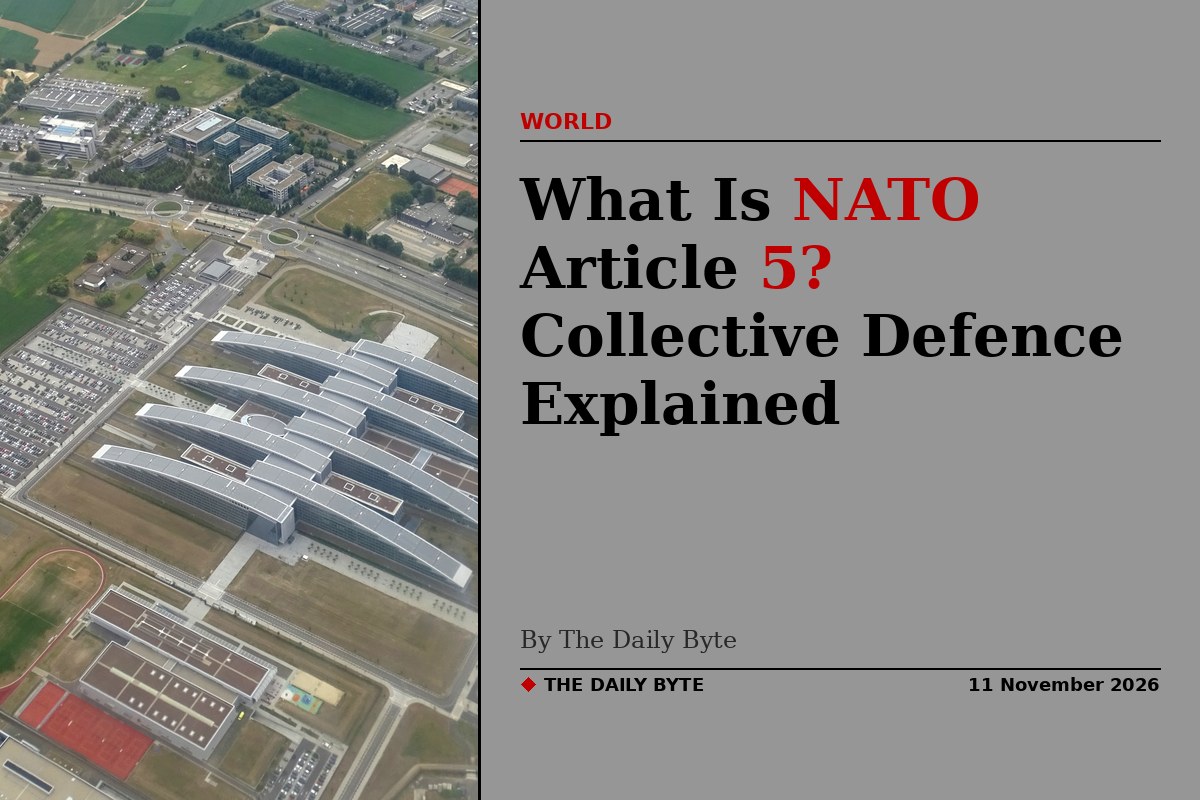
Photograph: the NATO headquarters in Brussels (Ad Meskens / Wikimedia Commons). Sources: NATO, "Collective defence and Article 5"; House of Commons Library, "NATO enlargement: Finland and Sweden".