What Is NHS Continuing Healthcare?
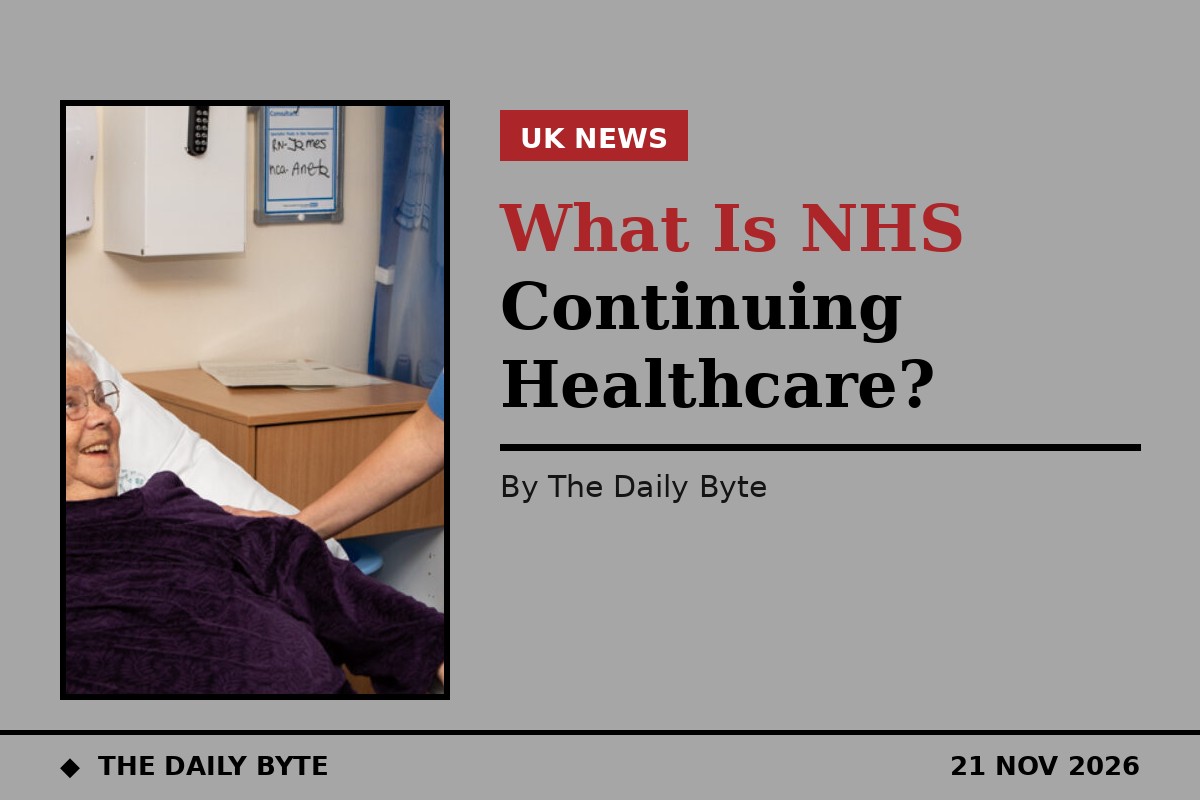
NHS Continuing Healthcare, often shortened to NHS CHC, is a package of ongoing care that is arranged and paid for entirely by the NHS. It is for a relatively small number of adults whose needs are mainly health needs rather than social care needs, and it is free. Unlike most adult social care arranged by a local council, it is not means-tested: how much money or savings a person has does not affect whether they qualify. For families facing large care costs, it can be the difference between the NHS paying for everything and paying for care themselves, which is why the question of who qualifies is asked so often.
The key idea is the primary health need. A person has a primary health need when most of the care they need is focused on addressing or preventing health needs that arise from a disability, an accident or an illness. Eligibility does not depend on a particular disease or diagnosis. A person with dementia, a person recovering from a stroke, a person with a severe neurological condition and a person with complex physical needs could all qualify, or none of them could, depending on the nature of their needs rather than the name of their condition. It also does not depend on who provides the care or where it is provided. NHS Continuing Healthcare can be provided in a person's own home, in a care home, in a hospice, or in another setting that can meet their assessed needs. If care in a care home is part of the package, the NHS pays for it, including accommodation where that is part of the person's overall needs.
Who can be considered
NHS Continuing Healthcare is for adults, meaning people aged 18 or over. Children and young people are covered by a separate continuing care process. Health and social care professionals should consider whether a person may be eligible whenever their physical or mental health deteriorates significantly, when their current care package no longer meets their needs, when they have new needs after a hospital stay, when they need a nursing home to meet their needs, or when their condition is rapidly deteriorating and may be entering a terminal phase. A person who is in hospital and has a primary health need should speak to a health professional before discharge, so that the assessment can be started.
Anyone can ask for an assessment to be considered. In practice, the request usually comes from a GP, a social worker, a district nurse, a care home nurse or another health professional, or the person can ask their local integrated care board directly. Integrated care boards, known as ICBs, are the NHS organisations that commission local health services, and it is the ICB that must assess a person for NHS Continuing Healthcare if it seems they may need it, and that decides the package of support for someone who is eligible.
What eligibility depends on
Eligibility is decided by looking at the person's assessed needs, not at their diagnosis and not at their finances. The team carrying out the assessment looks at what help the person needs, how complex those needs are, how intense they can be, and how unpredictable they are, including any risks to their health if the right care is not provided at the right time. A person is more likely to qualify if their needs are complex or severe, involve a range of medical professionals, are unpredictable and associated with a high risk of serious consequences, are not under control with their current management, or are likely to get worse without professional support.
The assessment considers needs across a set of care areas, or domains. The full assessment, using the decision support tool described below, looks at twelve domains: breathing, nutrition, continence, skin and tissue viability, mobility, communication, psychological and emotional needs, cognition, behaviour, drug therapies and medication, altered states of consciousness, and other significant care needs. No single domain decides the outcome. The team looks at the whole picture, including how the needs interact with each other. A person whose needs are severe in one area and significant in several others may qualify, while a person with a single stable need that is well managed may not, even if that need is serious.
The two-stage assessment
For most people, the assessment has two stages. The first is a screening step using a checklist. The checklist can be completed by a nurse, a doctor, another healthcare professional or a social worker. The person being assessed should be told that the assessment is happening and what it involves. The professional completing the checklist should record the reasons for the decision in writing, sign and date it, and the person should be given a copy of the completed checklist. The purpose of the checklist is to make sure that anyone who might be eligible has the opportunity for a full assessment. If the checklist indicates that a full assessment is needed, the person is referred for one. If it does not, they are told they do not meet the criteria for a full assessment and are therefore not eligible at that stage, and they can be referred to their local council to discuss whether they may be eligible for support from the council instead.
The second stage is a full assessment by a multidisciplinary team, meaning a team of at least two professionals, ideally one from health services and one from social care. The team carries out a comprehensive assessment of the person's health and social care needs, reviewing evidence such as medical records, examinations and previous assessments. It uses a standardised tool called the decision support tool to help inform the decision. The decision support tool brings together the evidence across the twelve care domains and records the team's judgement about the level of need in each one. The team then makes a recommendation about eligibility to the integrated care board, which makes the decision.
The person being assessed should be fully involved in the process and kept informed, and their views about their needs and support should be taken into account. A family member or representative can also be involved, with the person's agreement. A decision about eligibility for a full assessment should usually be made within 28 days of an initial assessment or request for a full assessment, and the guidance says an eligibility decision should be made within 28 days of the integrated care board receiving a positive checklist. In practice, families often find the process takes time, and the complexity of gathering evidence from several professionals is one reason for that.
The fast-track route
There is a faster route for people who need care urgently. If a person is terminally ill, or their condition is deteriorating rapidly, their assessment may be fast-tracked. The fast-track assessment is for people with a rapidly deteriorating condition that may be entering a terminal phase. A clinician who knows the person, such as a GP, a consultant or a senior nurse, can complete a fast-track tool, and the integrated care board should then arrange the package of care quickly, without waiting for the full checklist and decision support tool process. This is the route used for many people who are being discharged from hospital for end-of-life care at home or in a hospice, and it is designed to avoid delays at a time when delays matter most.
What the package covers and how it is reviewed
When a person is eligible, the integrated care board is responsible for deciding the appropriate package of support. The package is designed around the person's assessed needs, and it can include nursing care, personal care, therapy, equipment, and the cost of a care home placement where that is needed. Because the care is arranged and funded solely by the NHS, the person does not pay for it, and there is no financial assessment. That is the sharpest difference from local authority social care, where the person may have to contribute depending on their income and savings, and where the council carries out a means test.
There is a related but different form of NHS funding called NHS-funded nursing care. That is a contribution towards the cost of nursing care for people in a care home who need nursing care but are not eligible for full continuing healthcare. It is paid at a set weekly rate to the care home, and it is not the same as having the whole package funded. People who receive NHS-funded nursing care should still be considered for continuing healthcare if their needs change, and the guidance says eligibility should be considered again if a person who receives the nursing care payment reaches an annual review.
A care package should normally be reviewed after three months, and then every twelve months. Eligibility can change if needs change, in either direction. A person whose condition improves may no longer have a primary health need, and a person whose condition worsens may become eligible even if they were not before. The review looks at whether the current package still meets the person's needs, and whether eligibility should be reconsidered. Families should keep records of changes in needs, hospital admissions and new symptoms, because that evidence is what a review will rely on.
What to do if the answer is no
Many applications are refused, and a refusal is not necessarily the end of the matter. The first step is to ask the integrated care board to explain the decision and to look at the evidence again, through the local resolution process. The person or their representative can ask for the decision to be reviewed, can point to evidence that was not considered, and can ask for a fresh assessment if needs have changed. If local resolution does not resolve the disagreement, the person can ask NHS England for an independent review. An independent review panel looks at whether the national framework was followed and whether the decision was reasonable on the evidence. It can recommend that the integrated care board reconsider its decision.
There are also practical steps that help. Ask for a copy of the completed checklist and the decision support tool, so that the reasoning can be checked against the evidence. Ask which domains were scored at which level, and whether evidence from everyone involved in the person's care was included. Ask a GP, district nurse or social worker to support the request for an assessment, because applications are stronger when a professional who knows the person agrees that their needs are primarily health needs. The charity Beacon gives free independent advice on NHS Continuing Healthcare, and its helpline can talk families through the process.
It is also worth knowing what continuing healthcare is not. It is not a benefit that is claimed like a pension, and it is not available simply because a person is old, frail or has a particular diagnosis. It is not a way of avoiding care home fees for someone whose needs are mainly social, such as help with washing, dressing and meals, even though those needs are real and important. For those needs, the local council is the route, and the council will carry out a care needs assessment and a financial assessment. The distinction between a health need and a social care need is the heart of the system, and it is also the part that families find hardest, because in real life the two are often tangled together.
How to start
The practical starting point is a conversation. If the person is in hospital, ask a nurse or doctor on the ward whether continuing healthcare has been considered before discharge. If they are at home or in a care home, ask their GP, social worker or district nurse, or contact the local integrated care board's continuing healthcare team directly. Say that you believe the person may have a primary health need and ask for a checklist assessment. Put the request in writing, keep a copy, and note the date, because the 28-day timescale runs from the request. If the person's condition is deteriorating quickly or they are terminally ill, ask specifically about the fast-track route.
NHS Continuing Healthcare matters because it is the one route through which the NHS pays for all of a person's ongoing care, including care home fees, without a means test. That makes the assessment one of the most consequential decisions in the care system, and it is why the process is detailed, evidence-based and sometimes slow. Understanding the primary health need test, the two-stage assessment, the fast-track route and the right to challenge a refusal does not guarantee a particular outcome, but it does mean families can ask the right questions, gather the right evidence, and make sure the decision is made on the full picture of the person's needs. This article is general information, not personal advice, and anyone dealing with a specific case should speak to the professionals involved in that person's care or to an independent advice service.