What Is Ofgem's Energy Debt Relief Scheme?
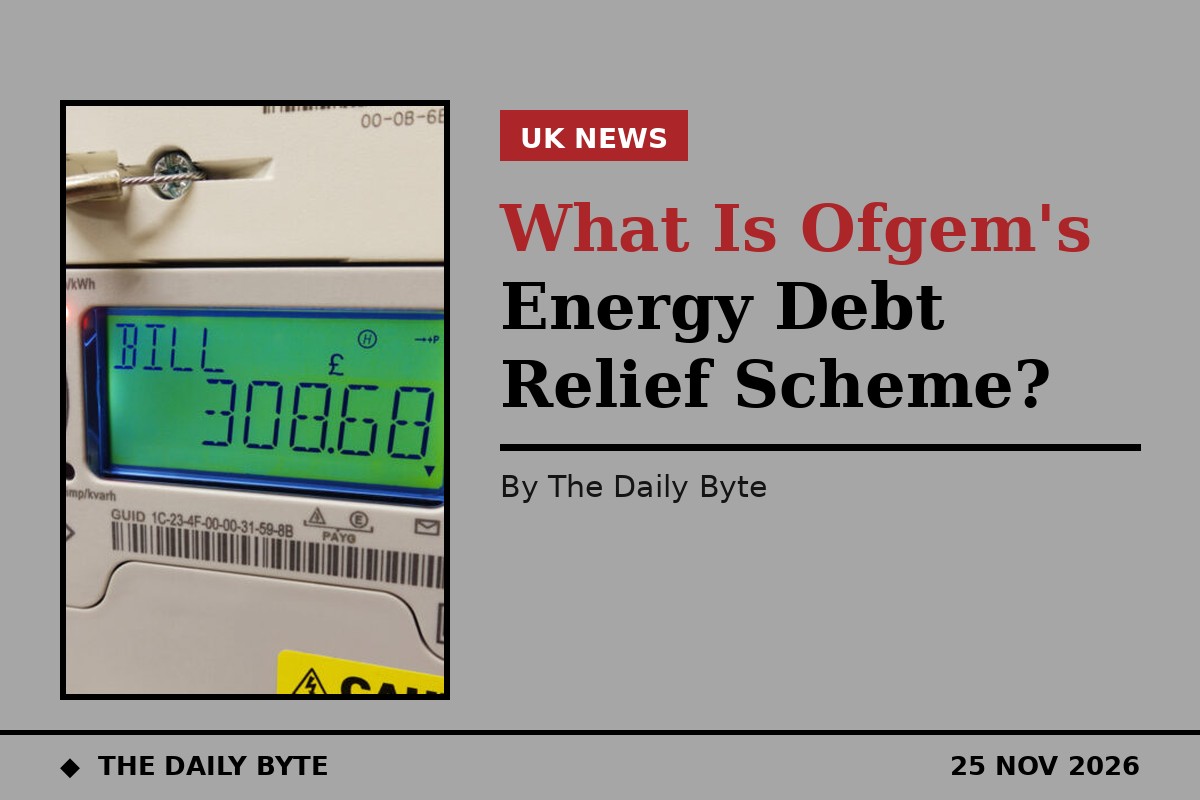
Ofgem's Energy Debt Relief Scheme is a one-off plan to write off some of the energy debt that households built up during the 2022 to 2024 energy crisis. It is part of a joint “circuit breaker” strategy from Ofgem and the government, announced alongside the Budget on 28 October 2026, and it is scheduled to launch in spring 2027. Customers will not need to apply: suppliers are expected to identify who qualifies and make contact directly.
The scheme matters because energy debt in Britain has reached a scale that the existing system cannot clear. Total electricity and gas debt and arrears in Great Britain reached £5 billion in the second quarter of 2026, according to Ofgem, roughly triple the level before the Russian invasion of Ukraine in 2021. A large part of that debt dates from the energy crisis, when prices soared and households fell behind faster than repayment plans could catch up. The Debt Relief Scheme is the write-off arm of the response; it is not a cut to bills, and it does not cover debt built up outside the crisis years.
How big is the problem?
Ofgem's figures put the scale in plain terms. Consumer energy debt in Great Britain stands at £5 billion as of the second quarter of 2026. The debt and arrears accumulated between 2022 and 2024, the period the scheme targets, total £2.47 billion. Ofgem's impact assessment identified around 2.4 million customers with historical debt that may be considered for support under the scheme — but not all of them will be eligible, and not all of those who are eligible will receive support. The final amount written off will depend on how many customers engage with the scheme, including working with suppliers and debt advisers on repayment plans they can realistically afford and stick to.
That gap between 2.4 million people with eligible debt and the number who will actually get help is the central fact about the scheme. It is a targeted, one-off relief, not a general amnesty. Suppliers have also estimated that, in a worst-case scenario, between £1.1 billion and £1.7 billion of historic debt is never paid and will be written off as commercially unrecoverable. The scheme is designed to bring order to that process rather than to clear every pound.
Who qualifies for the Debt Relief Scheme?
The design has changed since the scheme was first proposed, so the answer depends on which version is being described. Under the earlier design consulted on in November 2025, the first phase was aimed at around 195,000 households on means-tested benefits with more than £100 of debt built up between April 2022 and March 2024, measured as at 6 November 2025. The government described the scheme as clearing between £500 million and £1 billion of energy debt across its phases, with the first phase at the lower end, around £500 million.
The revised scheme announced with the Budget is broader and simpler. It will now be delivered in a single phase rather than two, and support will extend to pensioners and people on disability benefits as well as those on means-tested benefits. The debt window remains the crisis period, 2022 to 2024. Ofgem says it will consult shortly on the revised proposals, with the scheme expected to launch in the spring, and the final eligibility rules will be settled through that consultation in late 2026. Until that consultation concludes, the precise qualifying conditions should be treated as provisional.
| Feature | Earlier design (consulted Nov 2025) | Revised scheme (announced Oct 2026) |
|---|---|---|
| Phases | Two phases planned | Single phase |
| Who is covered | Means-tested benefits | Means-tested benefits, pensioners and people on disability benefits |
| Debt window | April 2022 to March 2024 | 2022 to 2024 |
| Minimum debt | More than £100 | To be confirmed in consultation |
| Scale | Around 195,000 households; up to £500 million | Up to 2.4 million customers have debt that could be considered; final numbers depend on engagement |
| Launch | Early 2026 (as then planned) | Spring 2027 |
Do you need to apply?
No, under the published design customers do not apply. Suppliers are expected to identify eligible households, make contact, apply the rules and keep the evidence for every pound written off. That is deliberate: the households most in need of relief are often the least likely to navigate an application process, and the scheme is built around suppliers finding them instead.
But the write-off is not automatic for every eligible customer. Under the delivery guidance published for the earlier design, a customer who had made a payment in the billing period immediately before enrolment was treated as already engaged, and prepayment customers were treated as meeting the condition. Everyone else had to take one of three routes: agree a repayment plan that is fair and reasonable and meets the ability-to-pay rules in the supply licence; enrol in Fuel Direct, so payments come straight from benefits; or accept a warm referral to an FCA-authorised debt advice service. The revised scheme's engagement conditions will be set in the late-2026 consultation, but the principle — relief in exchange for engagement — is part of the design.
Who pays for the write-off?
The cost is recovered through the bills system rather than from general taxation. Under the earlier design, Ofgem confirmed that a £5 annual charge would be added to everyone's energy bills to help fund the write-off, with the increase taking place in the 2027/28 year. The regulator has also said the rise could be lower depending on how the scheme is taken up, and that it expects the cost to be somewhat offset by measures reducing what customers pay towards debt-related costs such as debt collection. The funding mechanism for the revised single-phase scheme will be part of the consultation, so the £5 figure should be read as the position under the earlier design rather than a confirmed charge for the new scheme.
This is the part of the scheme that draws the most argument. Spreading the cost across all bill-payers means households who kept up with their bills contribute towards clearing the arrears of those who did not. Ofgem's answer is that unrecoverable debt already lands on everyone's bills through the price cap's debt allowance, which has risen materially since 2022, and that a managed write-off with engagement conditions is cheaper and fairer than letting the debt sit and grow. Others, including some campaigners, have argued the cost should fall on energy company profits instead. That debate is about who funds relief, not about whether the debt exists.
Why has it taken so long?
Ofgem first set out the case for a debt relief scheme in December 2024, consulted on it, and announced the first phase in October 2025 with a launch planned for early 2026. It then stalled. The scheme depended on a change in the law to let the Department for Work and Pensions share benefit data with suppliers, so that suppliers could identify who receives means-tested benefits. That legislation, the Digital Government (Disclosure of Information) Regulations 2026, which amend section 36 of the Digital Economy Act 2017, came into force on 18 September 2026. By May 2026, reporting noted the scheme had yet to launch while industry warned total arrears could reach £7 billion by year-end. The Budget announcement in October 2026 relaunched it as a revised single-phase scheme for spring 2027, with the data-sharing law now in place.
What else is in the circuit breaker strategy?
The Debt Relief Scheme is one of three parts of the joint strategy, built on the principles of relief, repayment and reform. Relief is the write-off itself. Repayment covers support for sustainable repayment plans for customers who can pay over time. Reform tackles the root causes, including whether standard credit — the most expensive way of paying for energy — should remain the default payment method, and an expansion of smart pay-as-you-go options to give households more control over usage and costs. The strategy also includes a review of the Priority Services Register, which identifies customers in vulnerable situations, and a response to the energy consumer outcomes consultation in early 2027.
Is this the same as a Debt Relief Order?
No, and the similar names cause real confusion. A Debt Relief Order is a personal insolvency procedure for people in England and Wales with low debts, low income and few assets. It is a legal process run through the Insolvency Service that freezes debts for a year and then writes them off. Ofgem's Debt Relief Scheme is entirely different: it is an energy-industry scheme that writes off a defined slice of energy arrears for households in genuine financial difficulty, with no court or insolvency process involved and no application from the customer. If you are considering a Debt Relief Order, that is a question for a debt adviser, not for your energy supplier.
What should you do if you are in energy debt now?
Do not wait for the scheme. It does not launch until spring 2027, its final rules are not yet settled, and there is no guarantee any particular household will qualify. The practical steps are the same ones debt advisers have always recommended: contact your supplier and ask for an affordable repayment plan based on what you can actually pay; ask about the Priority Services Register if you are in a vulnerable situation; and speak to a free debt advice service such as Citizens Advice, National Debtline or StepChange. Suppliers have obligations under their licence to offer repayment plans that are fair and reasonable and to take ability to pay into account. If you are on means-tested benefits, keep paying what you can, because engagement with your supplier is likely to matter when the scheme's conditions are finalised.
Frequently asked questions
Will the scheme clear all my energy debt?
Almost certainly not. It targets debt built up in 2022 to 2024, and Ofgem says around 2.4 million customers have debt that could be considered, but not all will be eligible or receive support. The amount written off will depend on engagement with the scheme and the final rules set in the late-2026 consultation.
Do I need to apply?
No. Under the published design, suppliers identify eligible customers and contact them directly. You will need to engage — for example by agreeing a repayment plan, enrolling in Fuel Direct or speaking to a debt advice service — but there is no application form to fill in.
When does it start?
Spring 2027, under the revised timetable announced with the Budget on 28 October 2026. Ofgem will consult on the revised proposals in late 2026 first. The earlier plan for an early-2026 launch did not happen, largely because the data-sharing law needed to identify eligible households only came into force in September 2026.
Will my bills go up to pay for it?
Under the earlier design, Ofgem confirmed a £5 annual charge on everyone's bills in 2027/28 to help fund the write-off. The funding of the revised scheme will be set in the consultation. Some of that cost is expected to be offset by lower spending on debt collection.
What if my debt is from before 2022 or after 2024?
It falls outside the scheme's window, which covers debt accumulated during the energy crisis years of 2022 to 2024. Speak to your supplier about a repayment plan and to a debt advice service about your options; the scheme is not the only route to dealing with arrears.
Sources: Ofgem – New ‘circuit breaker’ strategy launched to help households get out of energy debt; GOV.UK – Energy debt circuit breaker: our joint strategy for domestic energy debt. Figures are as published by Ofgem; the revised scheme's final rules are subject to consultation in late 2026.