What Is the Your First Home Scheme?
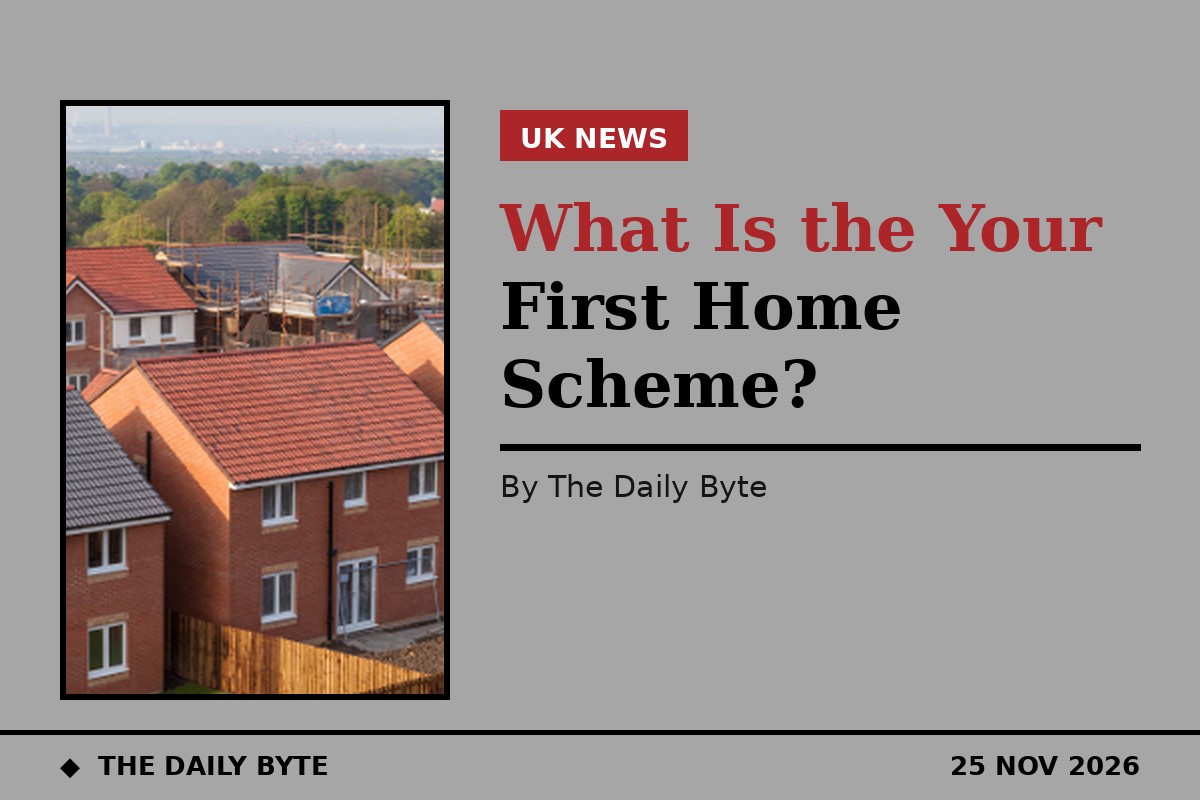
Your First Home is the government's new scheme for first-time buyers in England. It lets an eligible buyer purchase a new-build home with a deposit of at least 2.5% of the price, a government equity loan worth 20% of the price, and a repayment mortgage for the rest. The scheme was confirmed in the Budget on 28 October 2026 by Chancellor John Healey, and the first sales are expected from April 2027.
The deposit is the obstacle that stops most first-time buyers. Saving 10% of a typical house price can take years, and even a 5% deposit is out of reach for many renters. Your First Home cuts that barrier in half compared with the old Help to Buy scheme, which asked for a 5% deposit. But the help comes with conditions: household income caps, local price caps, and a loan that has to be repaid. This guide sets out how the scheme works, who qualifies, what it costs over time, and what is still unknown.
How does Your First Home work?
Every purchase under the scheme is built from three parts. The buyer puts down a deposit of at least 2.5% of the purchase price, and no more than 15%. The government lends 20% of the price as an equity loan. A repayment mortgage from a participating lender covers the remaining balance. The home must be a new-build bought from a developer that has chosen to take part in the scheme, and the buyer must intend to live in it.
A worked example makes the shape of the deal clear. On a home priced at £300,000, the buyer would pay a deposit of £7,500 (2.5%), receive a government equity loan of £60,000 (20%), and take a repayment mortgage of £232,500 (77.5%). The buyer still needs a mortgage lender willing to lend that amount on their income, and the mortgage must be a repayment mortgage from a lender participating in the scheme. The scheme does not remove the affordability test; it shrinks the deposit and the size of the mortgage.
The equity loan is interest-free for the first five years. Interest is then charged at 1.5% in year six and 3% from year seven onwards. Because it is an equity loan rather than a fixed cash loan, the amount owed is a share of the property's value, so what has to be repaid moves with the home's value in the same way as under Help to Buy. The full loan documents and repayment terms have not yet been published; the government says the full eligibility rules will be published before applications open.
Who can use the scheme?
| Condition | What is known so far |
|---|---|
| Buyer status | First-time buyer |
| Location | England only |
| Property | New-build home from a participating developer |
| Occupancy | Buyer must intend to live in the property |
| Deposit | At least 2.5% and no more than 15% of the price |
| Equity loan | 20% of the purchase price from the government |
| Mortgage | Repayment mortgage from a participating lender |
| Household income | £110,000 or less outside London; £140,000 or less in London |
| Price | Within the local price cap for the area |
The word “normally” matters in the official guidance. The conditions above are the published frame, not necessarily the final test, and the government has said the full eligibility rules will be published before applications open. Anyone planning around the scheme should treat the income and price caps as the shape of the rules, and check the final guidance when it appears.
What are the income and price caps?
The household income cap is £110,000 a year outside London and £140,000 a year inside London. That is total household income, not a single salary, and it is one of the clearest differences from Help to Buy, which had no general household income cap. The cap is aimed at buyers who could not otherwise afford to buy, rather than at higher earners who could buy without help.
Price caps are set locally rather than as a single national figure. Reporting on the Budget put the caps at £650,000 for inner London and £500,000 outside London, with further regional caps based on median prices. The Ministry of Housing, Communities and Local Government published guidance on the scheme on Budget day, 28 October 2026, and added a full table of local price caps on 3 November 2026. A buyer will need to check the cap for their own area, because a home above the local cap cannot be bought through the scheme however far below the income cap the buyer sits.
When does the scheme open?
| Date | Milestone |
|---|---|
| September 2026 | Scheme first announced |
| 28 October 2026 | Confirmed in the Budget by Chancellor John Healey; government guidance published the same day |
| 3 November 2026 | Full table of local price caps added to the guidance |
| By end of December 2026 | Customer pre-registration opens; first developer registrations |
| February 2027 | First customer applications open |
| April 2027 | First property sales and first equity loans expected |
The government has committed £4.7 billion to the scheme over five years, with £700 million allocated in 2027/28 and £1 billion in each of the subsequent years. Reporting on the Budget put the expected reach at around 70,000 households in England. Pre-registration does not commit a buyer to purchasing through the scheme, but it is the way to find out whether they are likely to be eligible and to confirm the price cap for their area.
What does the equity loan cost over time?
For the first five years the equity loan costs nothing in interest. From year six, interest is charged at 1.5%, and from year seven it rises to 3%. That schedule is the same shape as Help to Buy, and it means the cheapest years of the loan are the first five. A buyer who can repay the loan, in full or in part, inside that window avoids the interest altogether, but the repayment terms, including whether part-repayment is allowed and in what slices, are part of the loan documents that have not yet been published.
The other cost to weigh is that the loan is a share of the home's value. If the home rises in value, the amount repayable rises with it; if it falls, the amount repayable falls. That is the nature of an equity loan, and it is why the scheme is cheaper than borrowing the same sum as an ordinary loan at the start but can cost more than £60,000 on a £300,000 home if prices rise. Buyers should also remember that the mortgage itself still has to be repaid with interest, and that the equity loan sits alongside it as a second charge on the property.
How is it different from Help to Buy?
Your First Home is deliberately similar to Help to Buy, the equity loan scheme that ran between 2013 and 2022, and the comparison is the fastest way to understand it. Both offer a 20% government equity loan, interest-free for five years, on a new-build home. The differences are in who can use it and how much deposit is needed.
| Feature | Help to Buy (2013–2022) | Your First Home (from 2027) |
|---|---|---|
| Deposit | 5% | 2.5% (maximum 15%) |
| Equity loan | 20% of the price | 20% of the price |
| Interest-free period | Five years | Five years |
| Household income cap | No general cap | £110,000 outside London; £140,000 in London |
| Who qualifies | First-time buyers in its later stages | First-time buyers only |
| Price cap | £600,000 nationally, then regional caps | Local caps; £650,000 inner London, £500,000 outside London |
The lower deposit is the headline change, and it is aimed squarely at renters whose incomes can support a mortgage but whose savings cannot stretch to a 5% deposit. The income cap is the other side of the same choice: the scheme is targeted at buyers who need help, not at anyone buying a new-build.
How is it different from shared ownership?
Shared ownership and Your First Home are often confused because both help people buy with less than the full price. They work differently. Under shared ownership, the buyer purchases a share of the home and pays rent on the rest, with the housing association as landlord. Under Your First Home, the buyer owns the whole home from the start. The official guidance is explicit that the government will not be a joint owner or the buyer's landlord. The 20% is a loan secured on the property, not a retained share of it, and the buyer takes a normal repayment mortgage for the balance.
Is it the same as the 1% deposit mortgage?
No. The 1% deposit mortgage is a separate product from a lender, not a government scheme. Nationwide launched its Helping Hand 1% Deposit Mortgage on 25 November 2026, a five-year fixed-rate mortgage for first-time buyers buying an existing home with a 1% deposit. Your First Home is a government equity loan for new-build homes, opening to applications in February 2027. The two could both help the same buyer in theory, but they are different products from different providers, and the 1% mortgage is only for existing houses while Your First Home is only for new-builds.
What is still unknown?
Several important details are still to come. The full eligibility rules and the loan documents have not been published, and the list of participating developers and lenders is not yet public. The Budget said the Ministry of Housing, Communities and Local Government will legislate for the scheme “as soon as Parliamentary time allows”, with Homes England delivering it first and the National Housing Bank taking it over later. The government has also announced a new First Time Buyer ISA from April 2029, to be offered in place of the Lifetime ISA, and from 29 October 2026 the charge for using a Lifetime ISA on a home above £450,000 fell from 25% to 20%. Anyone weighing Your First Home against saving for longer should watch both the final scheme rules and the ISA changes before deciding.
Frequently asked questions
Can I use Your First Home to buy an existing home?
No. The scheme is only for new-build homes bought from a developer participating in the scheme. Buyers looking at existing homes need a different route, such as a low-deposit mortgage from a lender.
How much deposit do I need?
At least 2.5% of the purchase price, and no more than 15%. On a £300,000 home that is at least £7,500. The government equity loan covers 20% and a repayment mortgage covers the rest.
What is the income limit?
Total household income of £110,000 or less outside London, or £140,000 or less inside London. The full eligibility rules, which may add further conditions, will be published before applications open in February 2027.
When can I apply?
Pre-registration opens by the end of December 2026, full applications open in February 2027, and the first sales and equity loans are expected from April 2027.
Does the government own part of my home?
No. The government lends 20% of the price as an equity loan. It is not a joint owner and not your landlord, which is the key difference from shared ownership. The loan is interest-free for five years, then charged at 1.5% in year six and 3% from year seven.
Sources: GOV.UK – New first-time buyer scheme to be confirmed at Budget; MoneySavingExpert – Budget 2026: New ‘Your First Home’ homebuying scheme to launch in England. Figures are as published in the Budget and the official guidance; full eligibility rules are still to be published.