What Is Quantum Computing? Qubits Explained Simply
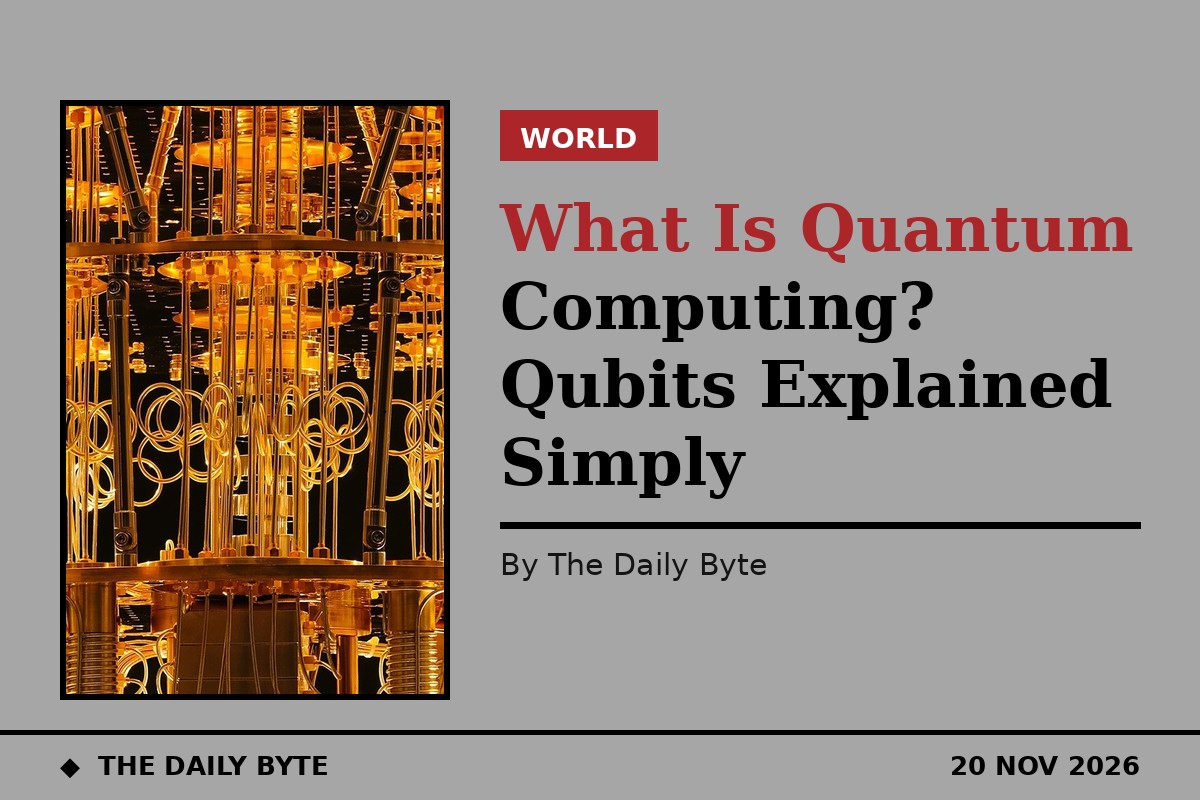
Quantum computing is a new kind of computing that stores and processes information using the strange rules of quantum mechanics, the physics of atoms and subatomic particles. Where an ordinary computer works with bits that are either 0 or 1, a quantum computer works with quantum bits, or qubits, which can hold a combination of 0 and 1 at the same time. That difference, together with two other quantum effects called entanglement and interference, lets quantum computers tackle certain problems in a fundamentally different way from any machine built before them.
That short answer raises an obvious question: if the idea is so powerful, why is it not in every home and office already? The honest answer is that quantum computers are still young, fragile machines. They exist today in research laboratories and in a small number of commercial systems, but they are difficult to build, need extreme cold to work, and are easily disturbed by the slightest interference from their surroundings. This explainer sets out what a quantum computer is, how a qubit works, what the machines might one day be good for, and what they will never do.
How an ordinary computer works
Every digital device you have ever used, from a pocket calculator to a supercomputer, works in the same basic way. It stores information as bits. A bit is the smallest unit of information, and it can take exactly one of two values: 0 or 1. Everything a computer does, whether it is playing a video, sending a message or forecasting the weather, comes down to flipping vast numbers of bits between those two states using simple operations called logic gates, such as AND, OR and NOT.
Modern computers are astonishingly good at this. A laptop contains billions of transistors, each acting as a tiny switch, and it can perform billions of operations per second. For most everyday jobs that is more than enough. But some problems resist this approach. Simulating the behaviour of a single molecule, for example, can require tracking so many interacting quantum states that even the fastest supercomputer would take an impractical amount of time. It was this difficulty that first made physicists wonder whether a computer built from quantum parts might do better.
What is a qubit?
A qubit, pronounced cue-bit, is the quantum version of a bit. Like a bit, it can be read out as 0 or 1. Unlike a bit, before it is measured it can exist in a state called superposition, a combination of 0 and 1 at the same time. IBM, which builds quantum computers, describes this as the core idea behind the technology: quantum computers take advantage of the laws of quantum mechanics found in nature, using qubits rather than bits to represent information.
A popular way to picture superposition is a spinning coin. While a coin lies flat on a table it is definitely heads or tails, but while it spins it is neither one nor the other in any settled sense. A qubit is something like that, except that the comparison only goes so far. A spinning coin is still an ordinary object whose state is simply unknown to us; a qubit in superposition is in a definite quantum state of its own, described by probabilities that determine how likely it is to read out as 0 or 1 when measured. The moment you measure a qubit, the superposition ends and you get a single definite answer, 0 or 1.
One qubit on its own is not especially powerful. The real strength appears when many qubits work together. A system of n qubits can represent 2 to the power of n states at once, so the number of states grows extremely fast as qubits are added: two qubits can represent four states, ten qubits can represent 1,024, and three hundred qubits could in principle represent more states than there are atoms in the observable universe. That enormous space of possibilities is what quantum algorithms explore.
Entanglement: qubits that act together
The second key idea is entanglement. When two qubits become entangled, their states are linked in a way that has no everyday equivalent. Measure one of them, and you instantly learn something definite about the other, however far apart they are. IBM explains that the most useful quantum superpositions are entangled states of the whole computer, states that do not correspond to any assignment of separate states to the individual qubits.
Entanglement is what makes a group of qubits more than the sum of its parts. A classical computer with many bits can only ever be in one configuration at a time, while an entangled set of qubits holds a single shared state that ties all of them together. Quantum algorithms are designed to exploit that shared state, arranging the computation so that the many possibilities interfere with each other in a useful way.
It is worth clearing up a common misunderstanding here. Entanglement does not let information travel faster than light, and it cannot be used to send messages instantly across the world. What it does is create correlations between measurements that no classical system can reproduce. That correlation is a resource for computation, not a signalling device.
Interference: how the answer emerges
The third idea is interference, and it is the one that turns quantum possibilities into answers. Quantum states behave in some ways like waves, and like waves they can add together or cancel each other out. A quantum algorithm is arranged so that the paths leading to wrong answers interfere destructively and cancel, while the paths leading to the right answer interfere constructively and grow stronger. When the qubits are finally measured, the correct answer is the one most likely to appear.
This is why a quantum computer is not simply a machine that tries every answer at once and picks the best one, as it is sometimes described in popular accounts. It explores many possibilities in superposition, but it can only ever read out one result. The skill of quantum algorithm design lies in shaping the interference so that the single result it returns is the one you want.
Why quantum computers are so cold
Photographs of quantum computers show a striking golden structure that looks like a chandelier. That structure is the heart of the machine, and it hangs inside a large unit called a dilution refrigerator. The reason for all that equipment is isolation. Qubits are extraordinarily sensitive, and the slightest heat, vibration or stray electromagnetic signal can disturb them and destroy the fragile quantum state before the calculation finishes.
To protect them, the quantum processor is cooled to temperatures close to absolute zero, the lowest temperature physically possible. IBM has described how its systems step down through stages of cooling, from about 40 degrees above absolute zero at the top to around 15 thousandths of a degree above absolute zero at the bottom, where the processor itself sits. That is colder than outer space. The golden colour comes from the copper and gold plating used in the refrigerator, chosen because those metals conduct heat well at such extreme temperatures.
Not every quantum computer uses this design. Some use trapped ions held in place by electric fields, others use photons, the particles of light. But every approach faces the same challenge: keeping quantum states intact long enough to finish a useful calculation. That challenge, known as error correction, is the main reason building a large, reliable quantum computer is so hard.
What could quantum computers be good for?
Quantum computers are not expected to replace ordinary computers. They are specialist machines, likely to be useful for particular kinds of problem where the quantum approach offers a genuine advantage. The most commonly discussed uses fall into three broad areas.
The first is simulating nature. Because molecules and materials are themselves quantum systems, a quantum computer should in principle be able to model them far more accurately than a classical machine. That could help researchers design new medicines, better batteries or more efficient fertilisers by testing candidate molecules in simulation before ever making them in a laboratory. This is the use that first motivated the idea: in 1981, the physicist Richard Feynman argued that simulating quantum systems on classical computers is so hard that we should build computers out of quantum systems themselves.
The second is optimisation, finding the best answer among a huge number of possibilities. Logistics, finance and engineering are full of such problems, from routing deliveries to managing investment portfolios. Quantum algorithms may one day find better solutions faster, although for many optimisation problems classical methods remain extremely strong, and the quantum advantage is still unproven.
The third is cryptography. In 1994, the mathematician Peter Shor showed that a sufficiently powerful quantum computer could factor large numbers far faster than any classical machine. That matters because much of the encryption protecting online banking and communications relies on factoring being hard. A large fault-tolerant quantum computer could in theory break those codes, which is why governments and companies are already working on new forms of encryption designed to resist quantum attack. It is important to stress that no existing quantum computer is anywhere near powerful enough to do this today.
What quantum computers will not do
For all the excitement, there are clear limits. A quantum computer will not make your web browser faster, improve your video streaming or run a spreadsheet better than a laptop. For ordinary tasks, a classical computer is faster, cheaper, smaller and far more reliable, and that will remain true. Quantum computers are not simply faster versions of ordinary computers; they are different machines that are better at some things and worse, or useless, at others.
There is also a limit that comes from the physics itself. Reading out a result destroys the superposition, so a quantum computer can only return a limited amount of information from each run. Problems that require reading huge amounts of data in and out are therefore poor candidates for quantum speed-up, whatever the headlines suggest.
A short history
The idea of quantum computing took shape in the early 1980s, when Feynman made his case for building computers from quantum parts. In 1985, the physicist David Deutsch described a universal quantum computer, a machine that could in principle run any quantum algorithm. For years the field was mostly theory, because nobody knew how to build and control qubits reliably.
Shor's 1994 algorithm changed that, turning quantum computing from a curiosity into a subject of serious investment. Since then, companies including IBM and Google, along with universities and start-ups around the world, have built machines with ever more qubits and steadily better control. IBM has made small quantum processors available over the internet, so that students and researchers can run real experiments on real hardware from an ordinary laptop.
Where the technology stands today
Quantum computing in 2026 is best described as promising but unfinished. Machines exist and can run real calculations, but they are noisy and error-prone, and the number of reliable qubits is still small. The field's central challenge is error correction: combining many physical qubits into a single reliable logical qubit that can survive a long calculation. Until that problem is solved at scale, quantum computers will remain research tools rather than everyday machines.
Even so, the direction of travel is clear. Governments and companies are investing heavily, standards bodies are preparing for a world in which quantum-safe encryption is needed, and a generation of students is learning to program machines that did not exist a decade ago. Quantum computing may not change your daily life tomorrow, but it is one of the few technologies where the basic science is settled, the engineering is visibly advancing, and the eventual impact could be large. The question is not whether quantum computers work in principle, but when they will work well enough, and at what scale.