Remembrance Sunday 2026: What It Is and Why We Mark It
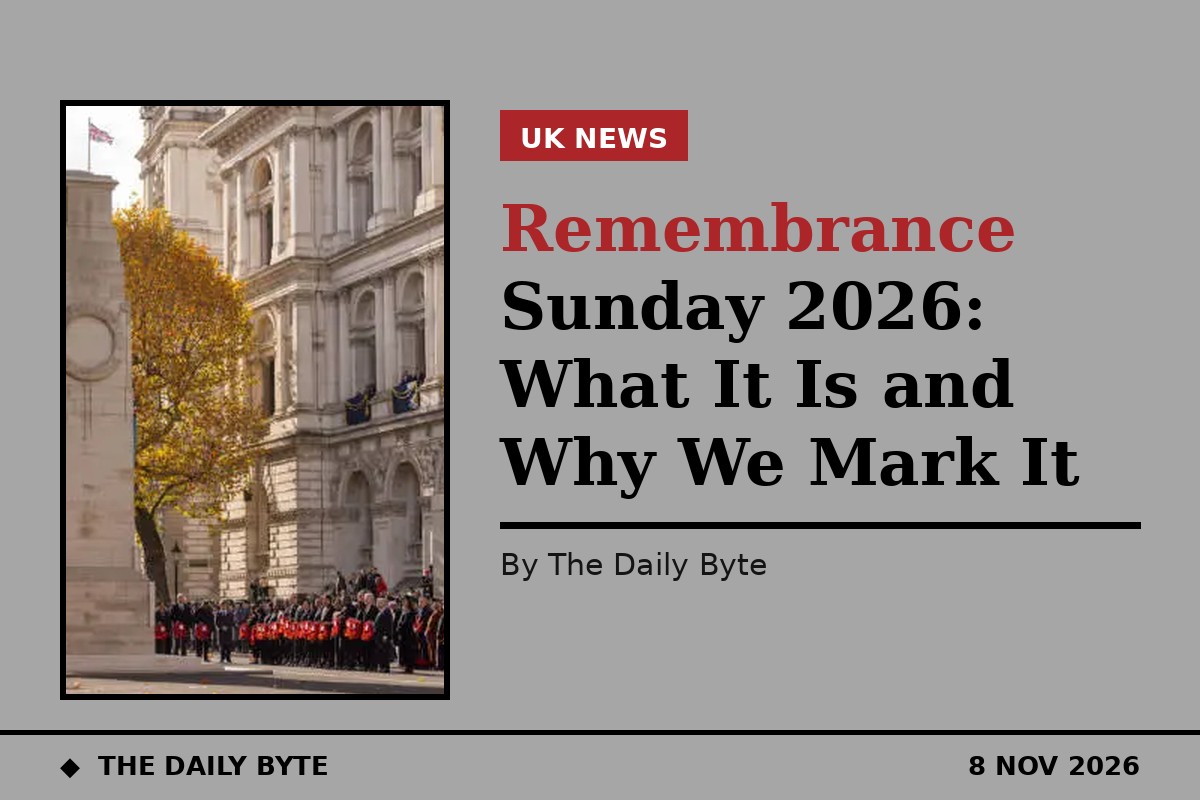
Remembrance Sunday is the day the United Kingdom honours the service and sacrifice of British and Commonwealth armed forces and civilians in the two world wars and every conflict since. In 2026 it falls on Sunday 8 November, the second Sunday of the month, when the country falls silent for two minutes at 11am and wreaths are laid at war memorials in almost every town and village. It is not the same as Armistice Day, which always falls on 11 November.
The national ceremony takes place at the Cenotaph in Whitehall, London. In 2026, King Charles III led the commemorations, observing the two-minute silence and laying the first wreath of red poppies, followed by other members of the Royal Family, senior political figures and Commonwealth representatives. Around 10,000 veterans took part in the march past the Cenotaph, organised by the Royal British Legion.
What is Remembrance Sunday?
Remembrance Sunday is the UK's main day of ceremony for remembering those who died in military conflicts. Services and parades are held at war memorials across the country, and the national service at the Cenotaph is the centrepiece. The Royal British Legion is the national custodian of Remembrance: it runs the Poppy Appeal in the weeks beforehand, organises the Cenotaph march past, and supports services held by its branches across the country.
The day honours British and Commonwealth servicemen and women and civilians who served in the two world wars and later conflicts. In 2026, the Royal British Legion marked the 35th anniversary of the end of the 1990-91 Gulf War, which followed Iraq's invasion of Kuwait, as part of the commemorations.
Remembrance Sunday vs Armistice Day: what is the difference?
The two dates are often confused, but they mark different things. Armistice Day is always 11 November, the anniversary of the armistice that took effect at 11am on 11 November 1918 and ended the fighting on the Western Front in the First World War. A two-minute silence is held at 11am on that date whatever day of the week it falls on; in 2026 it is Wednesday 11 November.
Remembrance Sunday is always the second Sunday in November, the Sunday nearest to Armistice Day. It is the main national day of commemoration, when the Cenotaph service, the veterans' march past and most local parades and church services take place. The distinction exists for a practical reason: after the Second World War, holding the main commemorations on a weekday disrupted the working week, so the principal national occasion moved to the nearest Sunday.
Where did the two-minute silence come from?
The silence dates to 1919, the year after the First World War ended. The idea was suggested by Edward George Honey, an Australian journalist who had served in the British Army during the war and was living in London. In 1919 he wrote to the London Evening News proposing a period of silence to honour those who had died. A similar proposal reached King George V through the South African politician Sir Percy Fitzpatrick, who had lost his eldest son on the Western Front in 1917.
A trial was held in the garden of Buckingham Palace, with Honey present, and five minutes proved too long. Two minutes was the compromise: one minute for the dead, and one for the survivors who had to go on living. On 7 November 1919, King George V issued a proclamation asking that at the eleventh hour of the eleventh day of the eleventh month, there should be two minutes of complete suspension of normal activities. The first national two-minute silence was observed on 11 November 1919.
At the Cenotaph today, the silence begins at 11am and is opened and closed by a gun fired by the King's Troop Royal Horse Artillery on Horse Guards Parade, followed by buglers sounding the Last Post. The timing recalls the eleventh hour of the eleventh day of the eleventh month, when the Armistice came into force in 1918.
What is the Cenotaph?
The Cenotaph stands in Whitehall, London, and has been the focus of the national ceremony for more than a century. The word comes from the Greek for empty tomb: no one is buried beneath the monument, and it symbolises those who lost their lives abroad without a known grave.
Sir Edwin Lutyens designed a temporary wood and plaster monument for the Peace Day parade in July 1919. Public feeling for it was so strong that a permanent version in Portland stone was unveiled in 1920, the same year as the burial of the Unknown Warrior in Westminster Abbey.
Why do we wear poppies?
Red poppies became the symbol of remembrance through In Flanders Fields, a poem written in May 1915 by Canadian army doctor John McCrae. Serving at a dressing station on the Ypres Salient in Belgium after the Second Battle of Ypres, McCrae wrote about the wild poppies already flowering between the graves on the churned-up battlefields of Flanders. The poem was published in Punch magazine in December 1915 and became the war's most widely read poem.
An American academic, Moina Michael, read the poem in 1918 and vowed to wear a red poppy as a sign of remembrance. A French woman, Anna Guerin, took the idea further and began selling artificial poppies to raise money for war orphans. The Royal British Legion adopted the poppy as its remembrance symbol in 1921, and Britain's first Poppy Day was held on 11 November 1921, with the money going to the Earl Haig Fund to support ex-servicemen and the families of those who had died.
The annual Poppy Appeal is the Royal British Legion's main fundraiser, raising money for serving personnel, veterans and their families. Poppies are available from late October, and most people wear one from the launch of the appeal until Armistice Day or Remembrance Sunday, whichever comes later. The poppy has been made entirely from paper since 2023, so it can go in household recycling afterwards. The Poppy Factory in Richmond, founded in 1922 to employ wounded veterans, still makes the Cenotaph wreaths and tens of thousands more each year.
White poppies are worn by some people as a symbol of pacifism and a commitment to peace. The Legion says wearing a poppy is a personal choice, and that the symbol represents remembrance and support for the Armed Forces community rather than endorsement of any particular war or political position.
How did Remembrance Sunday itself begin?
After the First World War, Armistice Day on 11 November was the main commemoration. During the Second World War, the main national commemorations on 11 November were suspended to avoid disrupting war production. In 1946, King George VI formally established Remembrance Sunday, observed on the Sunday closest to Armistice Day, as the primary national occasion of commemoration, allowing the whole nation to gather without affecting the working week.
The scope of remembrance has widened since then. Originally Armistice Day commemorated those killed in the First World War; after 1945 it widened to include the dead of the Second World War and later conflicts involving British and Commonwealth forces. Remembrance Sunday now covers all of them, from the world wars to the most recent operations, and the civilians affected by war as well.
How is Remembrance Sunday marked in 2026?
The National Service of Remembrance took place at the Cenotaph on Sunday 8 November 2026, beginning at 11am. Guns fired by the King's Troop Royal Horse Artillery marked the start and the end of the silence after the first stroke of Big Ben. The King laid the first wreath, followed by the Prince of Wales and other senior royals, political leaders and Commonwealth representatives. About 20 of the veterans taking part had served during the Second World War.
Local services were held across the country, and the national event was broadcast live on BBC television and Sky News for those unable to travel. A further two-minute silence will be held at 11am on Wednesday 11 November, Armistice Day itself.
Frequently asked questions
When is Remembrance Sunday 2026? Sunday 8 November 2026, the second Sunday of November.
When is Armistice Day 2026? Wednesday 11 November 2026. It always falls on 11 November, the anniversary of the 1918 Armistice.
Why is the silence at 11am? It recalls the eleventh hour of the eleventh day of the eleventh month, when the Armistice took effect in 1918.
Why do we wear red poppies? Red poppies grew on the battlefields of Flanders in the First World War, and John McCrae's 1915 poem In Flanders Fields made them the symbol of the war dead. The Royal British Legion adopted the poppy in 1921.
What does Cenotaph mean? It comes from the Greek for empty tomb. No one is buried beneath it; it stands for those who died abroad without a known grave.