What Is Singles' Day? 11.11 Explained
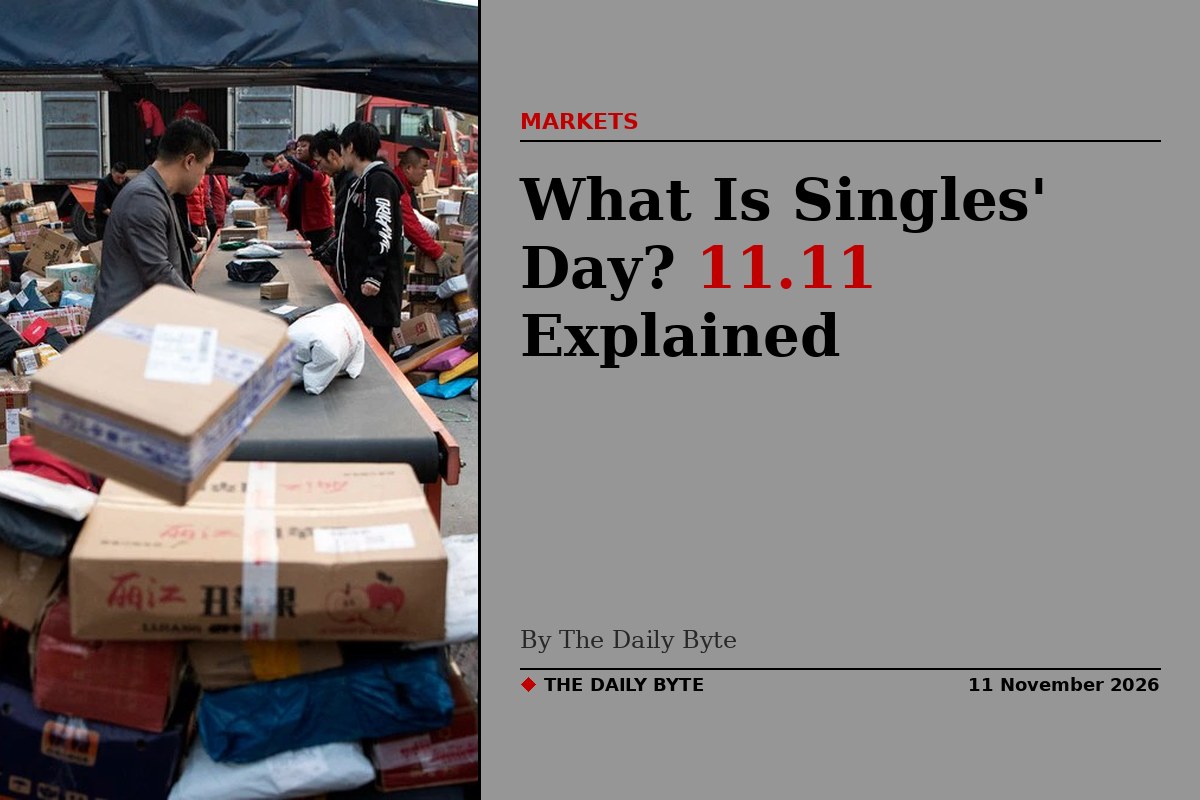
Singles' Day, also called Double 11, is an unofficial Chinese holiday on 11 November that celebrates being single, and it is also the world's biggest online shopping festival. It began as a joke among students at Nanjing University in 1993, and in 2009 the e-commerce company Alibaba turned it into a one-day online sale. That sale has since grown into a shopping season lasting weeks, with sales counted in the hundreds of billions of yuan. This explainer answers the questions people search for every 11 November: why the date was chosen, how Alibaba built it into a festival, how big it has become, and what it looks like in 2026.
The short answer is that Singles' Day is two things at once. It is still, in its original sense, a light-hearted celebration of single life, an anti-Valentine's Day for people without a partner. And it is, in its modern sense, a retail event on a scale no other shopping day matches, when China's biggest e-commerce platforms compete with discounts, livestreams and games, and couriers handle a flood of parcels. Both halves of that story matter, because the shopping festival only works as well as it does because the date already meant something to young people.
Why is Singles' Day on 11 November?
Singles' Day falls on 11 November because of how the date looks when it is written down: 11/11, four number ones standing side by side. In Chinese slang, a single person was traditionally described as a bare stick, guanggun, and the four ones came to stand for four single people. The date was chosen, in the widely told origin story, precisely because its four ones look like four people standing alone.
That visual joke is the reason the day has its Chinese name, Guanggun Jie, which translates as Bare Sticks Day or Bachelors' Day, and its other name, Double 11, or Shuang Shiyi, after the doubled eleven of the date. The year 2011 was even nicknamed the Singles' Day of the Century, because 11/11/11 contains six ones. The date is also popular for weddings in China, as some couples choose it precisely because it is memorable.
How did Singles' Day begin?
The most widely accepted account traces Singles' Day to Nanjing University in 1993. According to the story, four single male students in one dormitory, the Mingcaowuzhu dorm, decided to turn their singleness into an occasion rather than a complaint, and agreed that 11 November would be a day of events and celebrations in honour of being single. The idea spread to other universities in Nanjing through the 1990s, and then, as graduates carried it into offices and cities, it caught on more widely among young adults.
Writers who have traced the story treat parts of it as legend rather than documented fact, and there are competing versions of exactly which students started it. What is not in doubt is the shape of the tradition that emerged: a self-mocking campus celebration, a kind of anti-Valentine's Day, in which single people treated themselves instead of buying a gift for a partner. That idea, buying something for yourself because you deserve it, is the thread that runs directly from the dorm rooms of Nanjing to the shopping festival that followed.
How did Alibaba turn Singles' Day into a shopping festival?
The commercial transformation came in 2009, when Daniel Zhang, then in charge of Taobao Mall, Alibaba's platform for brands, which was renamed Tmall in 2012, saw the opportunity in the date. Alibaba was looking for a way to lift sales in the quiet commercial stretch between the October national holiday and Chinese New Year, and 11 November was easy to remember and already meant something to young shoppers. Zhang turned it into a 24-hour sale on Tmall, offering discounts of around 50 percent and free delivery, and just 27 merchants took part.
That first event, on 11 November 2009, grossed around 7 million US dollars, a modest sum by the standards of what followed, but enough to prove the idea. Alibaba repeated it every year, renamed it the 11.11 Global Shopping Festival in 2015 to reflect its ambitions beyond China, and built it into an entertainment spectacle with celebrity performances, livestreams and games. Rival platforms followed: JD.com and others launched their own 11.11 events, so the festival stopped belonging to one company and became a season for the whole Chinese e-commerce industry.
How big is Singles' Day now?
Singles' Day is, by sales, the largest shopping event in the world, larger than Black Friday and Cyber Monday combined. In 2019, Alibaba reported a record 38 billion US dollars in sales on the day. Alibaba reported a single headline figure, gross merchandise volume, or GMV, for every edition from 2009 to 2021, and its last disclosed figure was 540.3 billion yuan, about 84.54 billion US dollars, across its platforms for the 2021 event. Alibaba has not disclosed a headline GMV figure since then.
The event has also stretched far beyond a single day. From 2020, Alibaba counted an 11-day event rather than one day, and the 2024 campaign lasted 28 days. Independent tracker Syntun estimated that orders across Chinese platforms during the 2025 Double 11 period, counted from 7 October to 11 November, reached 1.695 trillion yuan, about 238 billion US dollars. For 2026, Alibaba said its Taobao and Tmall campaign opened for presales on 15 October, with the main sale beginning at 8pm on 20 October, China time. The precise totals for 2026 will only be known once the event closes, and Alibaba no longer publishes a single headline number.
Is Singles' Day only celebrated in China?
Singles' Day began in China and remains a Chinese event at heart, but its shopping version has spread. Alibaba's platforms, Taobao and Tmall, sell to shoppers in China, and the company's Lazada platform carries 11.11 sales across Southeast Asia, including Singapore, Malaysia, Thailand, Indonesia, Vietnam and the Philippines. JD.com and other Chinese platforms run their own rival events, and retailers in other countries have adopted 11.11 as a sale date, including shops in Britain and the United States that use it as a pre-Black Friday promotion.
The original social celebration has travelled too, in a smaller way. Students and young single people in other countries mark 11 November as Singles' Day, and the date is used for singles' parties and events. But outside China, the day is mostly known, where it is known at all, as a shopping event, and its cultural meaning as a celebration of single life remains strongest in China itself.
Is Singles' Day still about being single?
Not really, or at least not mainly. The shopping festival has largely shed its romantic meaning, and for most shoppers 11.11 is now simply the date of the year's biggest sale. The name Double 11 is used just as often as Singles' Day, and the marketing is aimed at everyone, not only single people. The original idea survives in the event's founding logic, though: the pitch was always that you should buy yourself something, and that still describes how millions of shoppers treat the day.
There is also a counter-current. Some people use the day to celebrate single life deliberately, and 11 November remains a popular date for weddings, as couples pick it because it is easy to remember. The day's double identity, a joke about being alone that became the world's biggest excuse to shop, is what makes it distinctive. No other shopping festival started in a university dormitory.
Frequently asked questions about Singles' Day
When is Singles' Day? Singles' Day is every year on 11 November, written 11/11. In 2026 it falls on Wednesday 11 November, but the shopping festival around it runs for weeks beforehand: Alibaba's Taobao and Tmall presales opened on 15 October 2026, with the main sale from 8pm on 20 October, China time.
Why is 11 November called Singles' Day? Because the date, written as 11/11, consists of four number ones, and in Chinese slang a single person was called a bare stick. The four ones were taken to represent four single people standing alone, and the day became known in Chinese as Guanggun Jie, Bare Sticks Day.
Who started the Singles' Day shopping festival? Alibaba started it. In 2009, Daniel Zhang, then running Taobao Mall, turned 11 November into a 24-hour sale on the platform, with 27 merchants taking part and around 7 million US dollars in sales. Alibaba later renamed it the 11.11 Global Shopping Festival.
How big is Singles' Day compared with Black Friday? It is far bigger. Alibaba alone reported 38 billion US dollars in sales on Singles' Day in 2019, and 540.3 billion yuan, about 84.54 billion US dollars, in gross merchandise volume for the 2021 event. Independent tracker Syntun estimated 1.695 trillion yuan, about 238 billion US dollars, in orders across Chinese platforms during the 2025 Double 11 period.
Is Singles' Day the same as Double 11? Yes. Double 11, or Shuang Shiyi, is the other name for Singles' Day, taken from the doubled eleven of the date, 11/11. Alibaba uses the name 11.11 Global Shopping Festival for its own event, while Double 11 is the general name for the shopping season across all platforms.
Sources: the origins, the 1993 Nanjing University story and the meaning of the date are set out in the Singles' Day overview, and the 2009 launch, the 27 merchants and the first year's sales are covered by TechCrunch's explainer of the festival. Sales figures are from Alibaba's reported GMV history, and the 2026 presale and sale dates are from a 2026 guide to Singles' Day.