What Is the Strait of Hormuz and Why It Matters
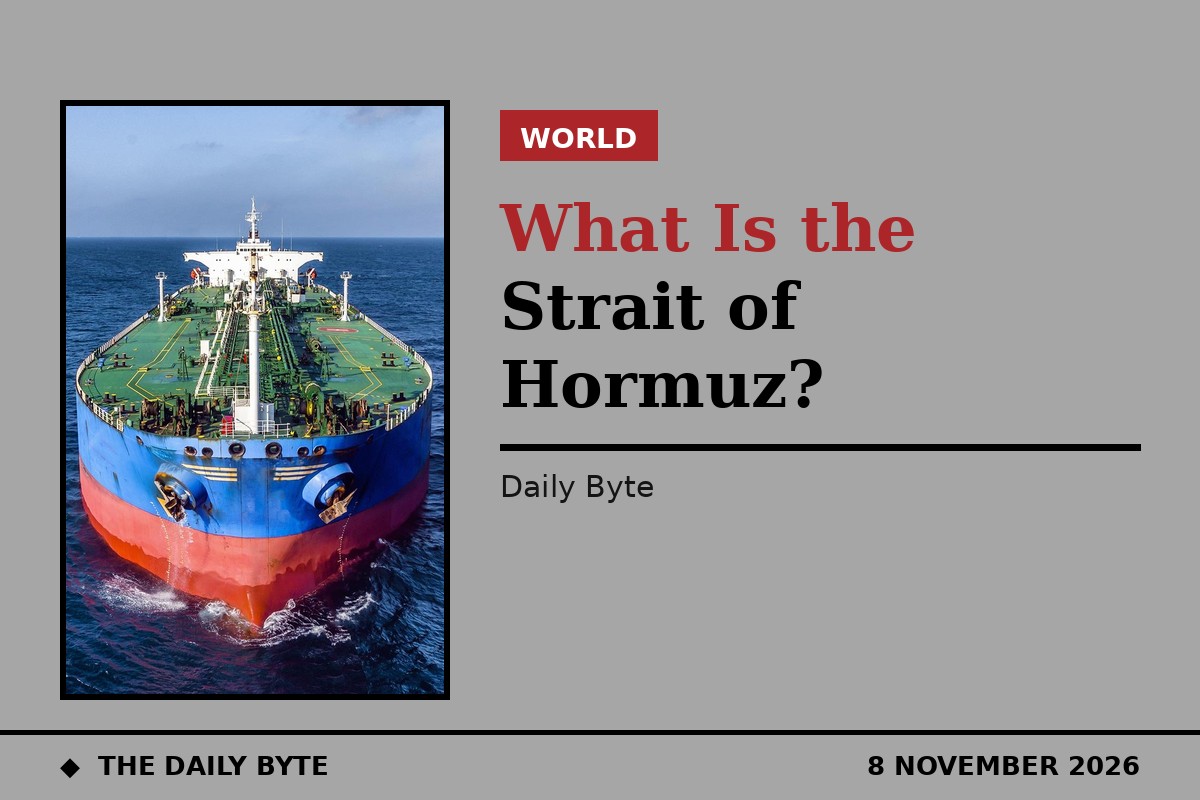
The Strait of Hormuz is the narrow sea passage between Iran and Oman that links the Persian Gulf to the Gulf of Oman and the open ocean. It is the only sea exit from the Gulf, which is why it has become the most closely watched waterway in the world during the 2026 Iran crisis. About 20 million barrels of oil a day passed through it in 2025, according to the International Energy Agency (IEA), along with close to a fifth of global trade in liquefied natural gas (LNG).
That single fact explains almost everything else about the strait: a mine, a missile, or even a credible warning in these waters can push up the price of petrol and diesel thousands of miles away, because so much of the world's energy has no other way out.
Where is the Strait of Hormuz?
The strait separates Iran on its northern shore from Oman, including Oman's Musandam Peninsula, on the southern shore. Ships leaving the Gulf's great oil ports — in Saudi Arabia, Iraq, Kuwait, Qatar, Bahrain and the United Arab Emirates, as well as Iran itself — must pass through it to reach the Arabian Sea and world markets.
It is narrow. The IEA's February 2026 factsheet puts its narrowest point at 29 nautical miles, while the agency's own website gives 21 nautical miles; the difference comes from where and how the width is measured. Either way, the shipping lanes themselves are only about two miles wide in each direction, separated by a two-mile buffer zone. That is why a small naval force, a minefield, or a handful of missiles can threaten a very large flow of trade without sinking a single ship: insurers and shipowners hold vessels back at the first sign of danger.
How much oil and gas passes through Hormuz?
The numbers, from the IEA's factsheet based on 2025 tanker-tracking data, are stark. Nearly 20 million barrels a day of crude oil and oil products were shipped through the strait in 2025 — around 25 per cent of all oil traded by sea, and roughly a fifth of the oil the world consumes. Of that, nearly 15 million barrels a day was crude oil, about 34 per cent of global crude oil trade. The US Energy Information Administration (EIA) reaches a similar figure, estimating 20.9 million barrels a day in the first half of 2025.
Natural gas is even more exposed. About 93 per cent of Qatar's LNG exports and 96 per cent of the United Arab Emirates' LNG exports pass through the strait, together representing about 19 per cent of global LNG trade. Qatar is the world's second-largest LNG exporter, shipping more than 112 billion cubic metres in 2025. The IEA notes there is no alternative route for those cargoes.
Asia is the biggest customer. About 80 per cent of the oil passing through the strait is destined for Asia, and almost 90 per cent of the LNG. China and India are the largest single buyers. Saudi Arabia is the largest single user of the route: its crude and condensate made up 38 per cent of Hormuz crude flows in 2024, according to EIA data.
Strait of Hormuz: key facts
| Fact | Figure | Source and period |
|---|---|---|
| Oil shipped through the strait | About 20 million barrels a day | IEA, 2025 |
| Share of world seaborne oil trade | About 25 per cent | IEA, 2025 |
| Crude oil through the strait | Nearly 15 million barrels a day | IEA, 2025 |
| Share of global LNG trade | About 19 per cent | IEA, 2025 |
| Qatar LNG via the strait | About 93 per cent of exports | IEA, 2025 |
| UAE LNG via the strait | About 96 per cent of exports | IEA, 2025 |
| Spare pipeline bypass capacity | 3.5 to 5.5 million barrels a day | IEA, February 2026 |
Why does the strait matter for fuel prices?
When flows through the strait are threatened, oil prices react within hours, because the market prices in the risk of a much bigger loss. After US and Israeli strikes on Iran began on 28 February 2026, daily ship transits fell sharply, and Brent crude rose from about 71 dollars a barrel on 27 February to a 2026 high of 138.21 dollars on 7 April, according to EIA data cited by SourceFirst News. Flows have partly recovered since: the IEA said 10.9 million barrels a day crossed the strait in September 2026, against about 20 million in 2025.
The effect reaches beyond petrol stations. Gulf producers supply a large share of the world's urea fertiliser exports, and disruption to shipping has fed through to fertiliser prices too. And because more than three-quarters of the world's spare oil production capacity sits in Gulf countries that ship through Hormuz, a closure would leave little slack anywhere else.
What happens if the strait is blocked?
There are limited workarounds. Pipelines can redirect some crude: Saudi Arabia's East-West pipeline carries oil to the Red Sea port of Yanbu, and the UAE has a pipeline to Fujairah on the Gulf of Oman. But the IEA counts only 3.5 to 5.5 million barrels a day of spare pipeline capacity — a fraction of the roughly 20 million barrels a day that normally moves by sea. For LNG there is no bypass at all.
That is why tanker incidents in and around the strait are treated as global news rather than a regional shipping story. Iran has imposed restrictions on vessels it says use unauthorised routes, and incidents involving tankers — including explosions the Iranian navy has attributed to mines — have continued through October and into November 2026, alongside a reported three-tanker incident on 8 November. Each one tightens insurance, raises freight rates, and adds a risk premium to the oil price.
Who controls the Strait of Hormuz?
No single country controls it. Iran borders the northern side and Oman the southern side, and the shipping lanes pass through the territorial waters of both. Under the United Nations Convention on the Law of the Sea, ships have a right of transit passage through straits used for international navigation, but Iran has not ratified the convention, and the legal argument has run alongside the military one throughout the 2026 crisis.
In practice, control is contested daily. Iran's Islamic Revolutionary Guard Corps navy patrols the northern side, the US-led naval presence operates in the Gulf, and Gulf Arab states have built up their own maritime defences. The strait's status has been a bargaining chip in the wider confrontation: Iran has at various points threatened closure, proposed temporary reopening plans, and set conditions for restoring normal traffic, while the US and its partners have said transit must remain open.
Frequently asked questions
How wide is the Strait of Hormuz? The IEA gives 29 nautical miles at its narrowest in its February 2026 factsheet and 21 nautical miles on its website; the shipping lanes are about two miles wide in each direction.
How much of the world's oil goes through Hormuz? About 20 million barrels a day in 2025, roughly a fifth of world oil consumption and a quarter of seaborne oil trade, according to the IEA.
Can oil bypass the Strait of Hormuz? Only partly. Pipelines can redirect 3.5 to 5.5 million barrels a day, far less than the 20 million that moves by sea, and LNG has no alternative route.
Why do Hormuz incidents raise petrol prices? Because the strait carries a fifth of the world's oil and a fifth of its LNG, any threat to it adds a risk premium to crude prices, which feeds through to fuel, freight and fertiliser costs worldwide.
Sources: International Energy Agency, Strait of Hormuz factsheet, February 2026; SourceFirst News, Why the Strait of Hormuz Matters to the Global Economy. Figures are as published by those sources for the periods stated; the 2026 crisis is still developing and flows change week to week.