What Is the Strait of Hormuz and Why Does It Matter for Oil Prices?
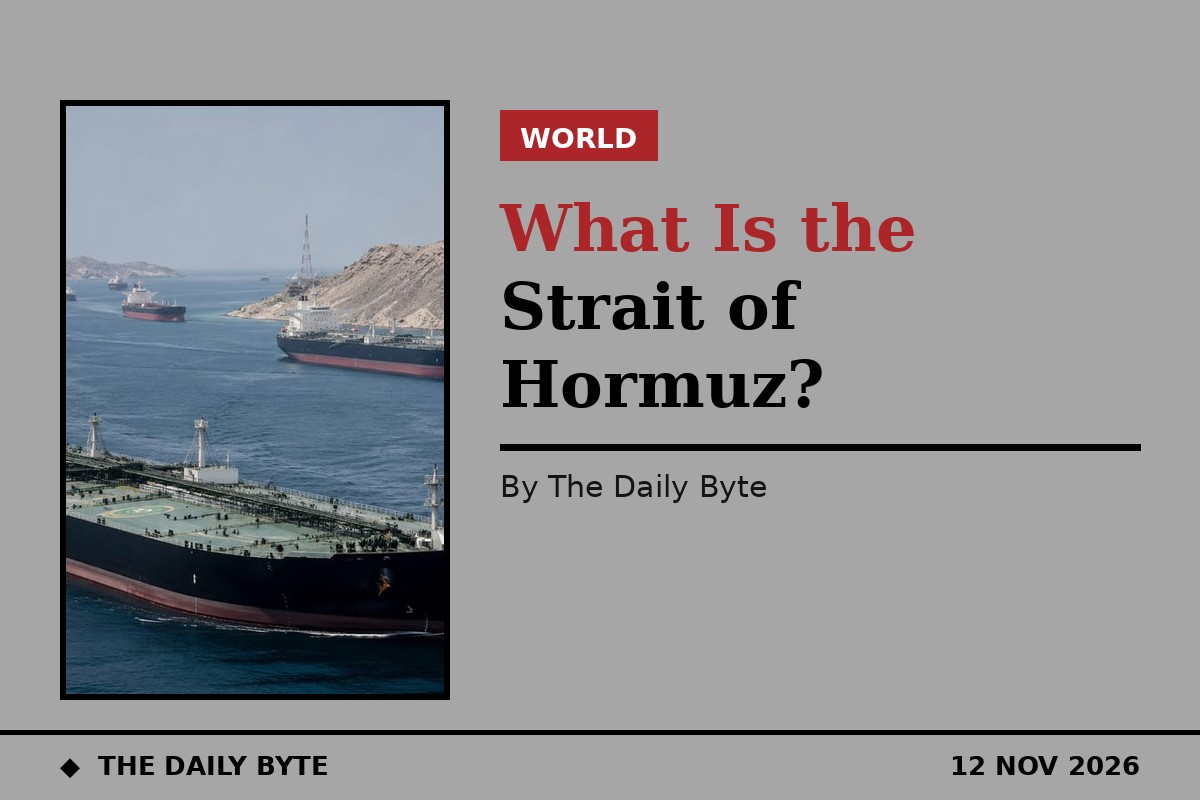
The Strait of Hormuz is the narrow stretch of water between Iran to the north and Oman and the United Arab Emirates to the south, linking the Persian Gulf with the Gulf of Oman and the open sea beyond. It is the single most important oil transit chokepoint in the world: about 20 million barrels of oil passed through it every day in 2025, roughly a fifth of all the oil the world uses. That is why any incident there moves oil prices and makes headlines around the world.
On 12 November 2026, Iran's Revolutionary Guards Navy said two supertankers carrying more than four million barrels of oil between them had been disabled by explosions in the strait after using what it called an unauthorised southern route. The claim has not been independently verified, but it is the latest in a series of tanker incidents in the waterway since the war between the United States, Israel and Iran began in February 2026. This explainer sets out what the strait is, how much energy flows through it, what happened on 12 November, and why it matters for fuel prices.
Where is the Strait of Hormuz?
The strait sits at the mouth of the Persian Gulf. To the north is Iran. To the south is Oman's Musandam Peninsula, a finger of mountainous land that juts into the sea, with the United Arab Emirates alongside it. Ships leaving the Gulf — from Saudi Arabia, Iraq, Kuwait, Qatar, Bahrain, the UAE and Iran itself — must pass through the strait to reach the Gulf of Oman, the Arabian Sea and then the Indian Ocean.
At its narrowest point the strait is about 29 nautical miles wide, or 54 kilometres, according to the International Energy Agency's factsheet published in February 2026. That sounds wide, but the deep-water shipping lanes are much narrower: about two miles wide in each direction, separated by a two-mile buffer zone. Large tankers cannot simply sail anywhere they like; they must follow these lanes, which is one reason the waterway is so vulnerable to disruption.
Under the United Nations Convention on the Law of the Sea, straits used for international navigation are subject to a transit passage regime, which means ships and aircraft may pass through. In practice, however, control of the waters around the strait has become a central part of the confrontation between Iran and the United States and its allies in 2026.
How much oil and gas passes through the Strait of Hormuz?
The US Energy Information Administration (EIA), which publishes the most widely cited figures, estimated that total oil flows through the strait averaged 20.9 million barrels a day in the first half of 2025. That is the equivalent of about 20 per cent of global petroleum liquids consumption and about a quarter of all the oil traded by sea. The International Energy Agency (IEA), using tanker-tracking data for the whole of 2025, reached a similar figure of almost 20 million barrels a day, made up of 14.95 million barrels of crude oil and condensate and 4.93 million barrels of refined oil products.
Liquefied natural gas (LNG) matters just as much. The EIA estimated that 11.4 billion cubic feet of LNG a day moved through the strait in the first half of 2025, or more than 20 per cent of global LNG trade, most of it from Qatar. The IEA puts the share slightly lower, at 19 per cent of global trade, and notes that about 93 per cent of Qatar's LNG exports and 96 per cent of the UAE's LNG exports pass through the strait.
Most of the oil is heading in one direction: east. The IEA estimates that around 80 per cent of the oil crossing the strait is destined for Asian markets, and about 83 per cent of the LNG that passes through it is also bound for Asia.
| Flow through the Strait of Hormuz | Figure | Source |
|---|---|---|
| Oil (crude and products), first half of 2025 | 20.9 million barrels a day | US Energy Information Administration |
| Oil (crude and products), full year 2025 | About 20 million barrels a day | International Energy Agency |
| Share of world oil consumption | About 20 per cent | EIA / IEA |
| Share of seaborne oil trade | About 25 per cent | EIA / IEA |
| LNG through the strait | About 20 per cent of global LNG trade | EIA / IEA |
| Share of oil flows bound for Asia | About 80 per cent | IEA |
| Width at narrowest point | 29 nautical miles (54 km) | IEA factsheet, February 2026 |
What happened in the Strait of Hormuz on 12 November 2026?
On Thursday 12 November 2026, the public relations office of the Islamic Revolutionary Guard Corps (IRGC) Navy said two supertankers had suffered massive explosions overnight and stopped sailing after ignoring repeated warnings against using an unauthorised and unsafe southern shipping route. The statement, carried by Iranian state media, said the two vessels were carrying a combined cargo of more than four million barrels of oil and were now burning. Reuters reported the same account on 12 November, noting that the statement did not provide details on the cause of the explosions and that the claims had not been independently verified.
Iran has maintained that only designated northern corridors through the strait are authorised, and that southern routes near Omani waters are unauthorised and mined. Iranian forces have said vessels that switch off their tracking systems and attempt those routes have struck mines, exploded and caught fire. Iran imposed the restrictions in response to the latest round of US-Israeli military action, which began on 28 February 2026.
The 12 November report follows a run of incidents in the same waters. The United Kingdom Maritime Trade Operations agency (UKMTO) reported a tanker incident in the strait on 11 November, and said a tanker had been struck by an unidentified projectile on 10 November, with all crew members safe. Separate reports said an ADNOC vessel was damaged in an attack in UAE territorial waters on 10 November. Shipping data reported by Reuters showed the effect on traffic: the number of commercial cargo ships passing through the strait fell from 31 at the end of the previous week to five on Saturday, with no transits recorded on Sunday, although experts cautioned that some vessels may have been travelling with their tracking systems switched off.
Why does disruption in the strait push oil prices up?
Oil prices react to the risk of lost supply, not only to actual lost supply. When tankers are attacked or stop sailing through Hormuz, traders must weigh the chance that a fifth of the world's oil — and a fifth of its LNG — could be cut off, even temporarily. That risk is priced into crude oil futures within hours, and the effect feeds through to petrol, diesel, heating oil and gas prices over the following days and weeks.
Three things drive the price reaction. First, there is the direct supply effect: every day of reduced transits removes millions of barrels from the market. Second, there are freight and insurance costs: war-risk insurance premiums for vessels in the region rise sharply, and shipowners demand higher rates to send crews into a danger zone. Third, there is the uncertainty premium: because nobody can be sure how long a disruption will last, buyers build up stocks and bid for alternative supplies, which pushes prices higher still.
The effect is not limited to countries that buy Gulf oil directly. Oil is traded on a global market, so a supply shock in the Gulf raises the benchmark price paid everywhere, including in the UK, even though Britain imports relatively little crude directly from the Gulf. The same logic applies to LNG: Qatar is one of the world's largest LNG exporters, and a closure of the strait would leave Europe and Asia competing for a smaller pool of available gas cargoes.
Can oil bypass the Strait of Hormuz?
Only a small share of it can. Saudi Arabia has a pipeline running from its Gulf coast oilfields across the country to the Red Sea port of Yanbu, and the UAE has a pipeline from its onshore fields to the port of Fujairah on the Gulf of Oman, which sits outside the strait. These pipelines allow some crude to reach the sea without passing through Hormuz.
But their capacity is limited. The IEA estimates potential bypass capacity at between 3.5 million and 5.5 million barrels a day — far short of the roughly 20 million barrels a day that normally flows through the strait. That means even if every bypass pipeline ran at full capacity, around three-quarters of the normal flow could not be replaced. There is also no pipeline alternative for LNG: Qatar's gas can only leave by ship, and every ship must pass through the strait.
Building new pipelines or expanding existing ones takes years and enormous investment, so in the short term there is no practical substitute for the strait. That is what makes it a chokepoint: a narrow passage through which a huge share of world energy must travel, with no easy alternative route.
Who depends on the Strait of Hormuz most?
The Gulf producers depend on it to sell their oil at all. Saudi Arabia, Iraq, Kuwait, the UAE, Qatar and Iran all export the bulk of their crude through the strait, and for several of them oil revenue is the main source of government income. A prolonged closure would hit their economies directly.
On the buying side, Asia is the most exposed, because about 80 per cent of the oil passing through the strait is bound for Asian markets. China, India, Japan and South Korea are among the world's largest oil importers and take large volumes of Gulf crude. Europe is less directly dependent on Gulf crude than Asia, but European buyers would still feel the effect through higher global prices, and Europe imports significant volumes of Qatari LNG through the strait.
The United States is the least directly exposed of the major economies, because it produces most of the oil it uses. But American consumers still pay world prices for petrol, so a Hormuz disruption raises fuel costs in the US too — which is one reason Washington has kept a naval presence in the region and has taken military action against vessels it says are breaching its blockade of Iran.
Frequently asked questions
Is the Strait of Hormuz closed? As of 12 November 2026, the strait is not formally closed, but commercial traffic has fallen sharply. Shipping data reported by Reuters showed only five commercial cargo transits on the Saturday before 12 November, down from 31 the previous week, and none on Sunday. Iran says only designated northern corridors are authorised, and several tankers have been attacked or reported incidents in the waterway in November 2026.
How wide is the Strait of Hormuz? About 29 nautical miles, or 54 kilometres, at its narrowest point, according to the IEA. The shipping lanes themselves are about two miles wide in each direction, with a two-mile separation zone between them.
What percentage of the world's oil goes through Hormuz? About 20 per cent of global petroleum liquids consumption, or about a quarter of all oil traded by sea, according to the EIA and the IEA. Around 20 per cent of global LNG trade also passes through the strait.
Why is it called a chokepoint? A chokepoint is a narrow channel through which a large share of world trade must pass, with no practical alternative route. The EIA describes Hormuz as the world's most important oil transit chokepoint because of the volume of oil involved and the limited capacity of bypass pipelines.
Has the strait ever been closed before? It has never been fully closed to all shipping, but it has been disrupted by conflict before, including during the Iran-Iraq war in the 1980s, when tankers were attacked in what became known as the Tanker War, and during periods of tension in 2019 and in 2026.
Sources: Reuters, 12 November 2026; US Energy Information Administration, World Oil Transit Chokepoints; International Energy Agency, Strait of Hormuz Factsheet, February 2026.