What Is the £190 Million Case? The Al-Qadir Trust Case Explained
By aminah
·18 Nov 2026
·11 min read
The £190 million case, formally known as the Al-Qadir Trust case, is the corruption case in which former prime minister Imran Khan and his wife Bushra Bibi were convicted in January 2025. At its centre is a £190 million settlement between the United Kingdom's National Crime Agency and the family of property tycoon Malik Riaz, and the question of where that money went once it reached Pakistan. On 18 November 2026 the Islamabad High Court is due to hear the couple's appeals against their convictions, which is why the case is back in the headlines.
This explainer sets out what the case is, how the money moved, what each side argues, and what happens next. The appeals have not yet been decided, so nothing in this article should be read as a verdict on the outcome.
## The short answer: what the case is about
In 2019, the UK's National Crime Agency (NCA) agreed a settlement worth £190 million with the family of Malik Riaz, the head of the property developer Bahria Town. The NCA had been investigating suspected money laundering. The settlement was a civil agreement: it involved no admission of guilt and no finding of guilt in the UK.
The money was returned to Pakistan. The prosecution's case, brought by Pakistan's National Accountability Bureau (NAB), is that instead of going into the Government of Pakistan's accounts, the funds were deposited into an account of the Supreme Court of Pakistan that was earmarked for fines owed by Bahria Town in a separate land case. NAB alleges that Imran Khan, as prime minister, helped arrange that outcome, and that in return Bahria Town gave land and funding to the Al-Qadir Trust, a trust connected to Khan and Bushra Bibi, for a university project. Imran Khan and Bushra Bibi deny the charges.
## Where the £190 million came from
The starting point is the NCA investigation into assets held in the UK by Malik Riaz's family. The NCA is the UK agency that investigates serious and organised crime, including money laundering and illicit finance. Its settlement with the Riaz family, agreed in December 2019, was reported at the time as the largest settlement of its kind in the agency's history.
The £190 million figure was made up of about £140 million in cash and a property in London, One Hyde Park, valued at about £50 million. Under the settlement, the assets were released and the money was to be returned to Pakistan, as the state affected by the suspected laundering. Because the agreement was a civil settlement, it did not establish that any crime had been committed in the UK, and the NCA made clear that it represented no finding of guilt.
That distinction matters, because the Pakistani case is not about whether the NCA settlement itself was lawful in the UK. It is about what the government of Pakistan did with the money once it was returned, and whether the decisions taken in Islamabad amounted to misuse of authority and corruption under Pakistani law.
## The cabinet meeting of 3 December 2019
On 3 December 2019, the federal cabinet chaired by then prime minister Imran Khan approved the settlement with the NCA. According to contemporary reporting, the details of the private agreement were not disclosed to the cabinet in full, and the decision was taken on the basis of a sealed document presented by the then accountability adviser, Shahzad Akbar.
Two days later, on 5 December 2019, Akbar announced at a press conference in Islamabad that £140 million had been repatriated to Pakistan. The money went into an account of the Supreme Court of Pakistan, rather than into the government's own accounts. The Supreme Court account was the one designated to receive payments under Bahria Town's settlement of a separate case, in which the company had been ordered to pay Rs 460 billion over land acquired for its Karachi housing project.
NAB's case is that this routing of the money was the core of the offence: funds that belonged to the state were, in its view, used to settle Bahria Town's own liability, at a cost of £190 million to the national exchequer. The defence has argued that the money was always destined for the Supreme Court account under the terms agreed, and that no personal benefit flowed to Imran Khan or Bushra Bibi.
## Al-Qadir Trust and the university
Weeks after the cabinet decision, on 26 December 2019, the Al-Qadir Trust was registered. Its stated purpose was to run the Al-Qadir University, an educational institution in Sohawa, in the Jhelum district of Punjab. The foundation stone for the university had been laid by Imran Khan in May 2019, before the NCA settlement was concluded.
The trust's named trustees included Bushra Bibi, the PTI leader Zulfi Bukhari, Babar Awan, and Bushra Bibi's close friend Farah Khan. Bahria Town became a donor to the project. According to reports of the prosecution case, Bahria Town transferred about 460 kanals of land for the university, and in March 2021 an agreement was signed under which the company would pay for the construction and running of the institution. Reports at the time said the trust received donations of about Rs 180 million during 2021.
NAB alleges that the land and the funding were effectively the price of the help Bahria Town received over the £190 million: a benefit given in exchange for the settlement of the company's liability through the Supreme Court account. The defence case, as reported, is that the trust is a genuine charitable and educational venture, that trust property cannot lawfully be used for personal benefit, and that the prosecution has not shown that Imran Khan or Bushra Bibi personally gained from it.
## How the case reached court
The case resurfaced publicly in June 2022, after the PTI government had been removed from office in a no-confidence vote, when an alleged audio recording said to feature Malik Riaz and his daughter discussing demands said to have been made by Farah Khan circulated online. NAB then opened a formal inquiry into alleged misuse of authority, financial gain and criminal breach of trust, and in December 2022 it summoned Malik Riaz and other beneficiaries.
On 9 May 2023, Imran Khan was arrested by Rangers officers outside the Islamabad High Court, where he had gone to seek bail in a number of cases, including the Al-Qadir Trust case. His arrest triggered violent protests across Pakistan. The Supreme Court later ruled that the arrest itself had been unlawful, but the case against him continued.
NAB filed its formal reference in the accountability court on 1 December 2023. The trial ran through 2024, with repeated adjournments and disputes over the defence's access to the record, and concluded in January 2025.
## The convictions
On 17 January 2025, an accountability court in Islamabad convicted Imran Khan and Bushra Bibi. Imran Khan was sentenced to 14 years in prison and Bushra Bibi to seven years. The court also imposed fines. The convictions were among the most politically contested in Pakistan's recent legal history, and both defendants appealed.
The couple have faced other cases as well. In December 2025, both received additional 17-year sentences in the Toshakhana-2 case, which concerns a Bulgari jewellery set said to have been gifted by the Saudi crown prince. That is a separate case from the Al-Qadir Trust matter, and it is also under appeal. The appeals in the £190 million case are the ones listed for hearing on 18 November 2026.
Imran Khan and Bushra Bibi remain in Adiala Jail. In November 2026, Khan wrote an open letter to Pakistan's three most senior judges, published by his lawyer on 16 November, appealing for medical treatment for himself and his wife. According to the letter, Bushra Bibi suffered a retinal detachment in April 2026 and underwent eye surgery, and her eyesight has since deteriorated. Imran Khan has also received eye treatment at the Pakistan Institute of Medical Sciences. Those health claims are the subject of a separate appeal to the courts and are not part of the £190 million case itself.
## What happens next: the 18 November hearing
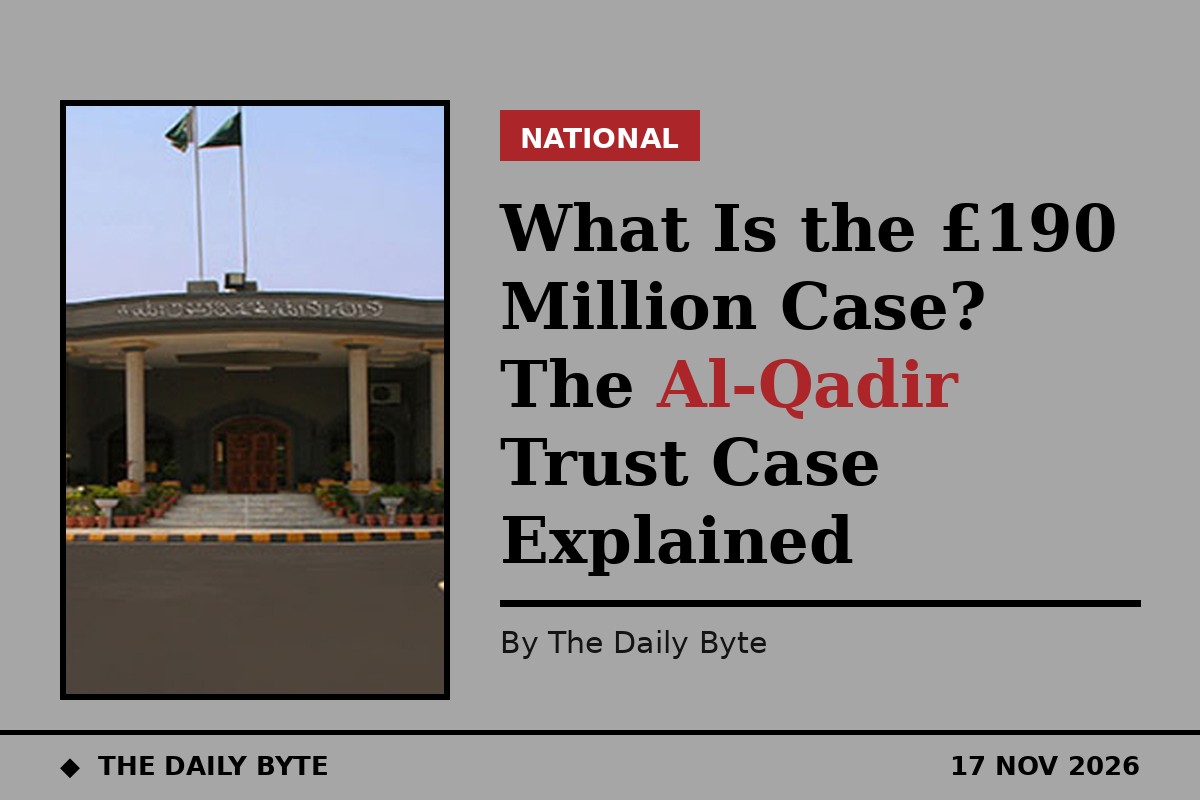
The Islamabad High Court admitted the appeals against the £190 million convictions and fixed them for hearing on 18 November 2026. A two-member bench, headed by Chief Justice Sarfraz Dogar and including Justice Muhammad Asif, is to hear the case, and the court has directed the parties to present their final arguments.
At the previous hearing, on 10 November, the court allowed the defence a week to prepare after the lawyers said they needed time to take instructions from their clients, and directed the court's office to prepare the paper books for the appeals within seven days. The defence lawyers, Barrister Salman Safdar and Sardar Latif Khosa, met Imran Khan and Bushra Bibi at Adiala Jail for about three hours on 11 November, after the court directed that the meeting be arranged and that discussion be confined to legal matters.
Admitting an appeal is a procedural step, not a view on its merits. What the bench decides on 18 November, and whether the hearing proceeds to arguments or is adjourned, will be the first real test of the convictions since they were handed down in January 2025. If the appeals succeed, the convictions would be set aside; if they fail, the sentences stand, subject to any further appeal to the Supreme Court.
## The arguments on each side
The prosecution's case, in brief, is that the state lost £190 million because money that should have gone to the Government of Pakistan was instead credited against Bahria Town's own liability, and that the benefit returned to the Al-Qadir Trust was the consideration for that decision. It points to the sealed cabinet approval, the speed of the trust's registration, and the transfer of land and funds from Bahria Town.
The defence case, in brief, is that the NCA settlement was a civil agreement whose terms directed the money to the Supreme Court account, that the cabinet acted on the advice of its accountability adviser, and that the Al-Qadir Trust is a genuine educational project from which the couple derived no personal gain. It also argues that the prosecution has not proved a direct link between the cabinet decision and the trust's funding.
Both positions will now be tested in the High Court. Until the bench rules, the convictions stand but remain under challenge, and the facts set out above are allegations and findings at trial level rather than settled law.
## What the case is not
It is worth clearing up three common misunderstandings. First, the £190 million was not money that vanished: it was returned to Pakistan and deposited in a Supreme Court account, and the dispute is about which account it should have gone into. Second, the NCA settlement in the UK did not find anyone guilty of anything; it was a civil agreement. Third, the Al-Qadir Trust case is not the same as the Toshakhana cases, which concern gifts received by Imran Khan while prime minister, although the same two defendants are involved in both.
## Frequently asked questions
**What is the £190 million case?**
It is the Al-Qadir Trust case, in which Imran Khan and Bushra Bibi were convicted in January 2025 over the handling of a £190 million NCA settlement with the family of property tycoon Malik Riaz.
**How much were Imran Khan and Bushra Bibi sentenced to?**
Imran Khan was sentenced to 14 years in prison and Bushra Bibi to seven years by an accountability court on 17 January 2025. Both have appealed.
**When is the appeal hearing?**
The Islamabad High Court is due to hear the appeals on 18 November 2026, before a two-member bench headed by Chief Justice Sarfraz Dogar.
**What is the Al-Qadir Trust?**
A trust registered in December 2019 to run Al-Qadir University in Sohawa, Jhelum. Bahria Town donated land and funding for the project, which the prosecution says was linked to the NCA settlement.
**Did the UK find anyone guilty?**
No. The NCA settlement was a civil agreement and involved no finding of guilt.
The £190 million case has been running, in one form or another, since 2019, and the hearing on 18 November is the first time an appellate court will examine the convictions in full. Whatever the bench decides, it will shape not only the fate of the two defendants but also the wider debate in Pakistan about how settlements with foreign agencies are handled, and who is accountable when public money is moved between accounts.
*Sources: Dawn's report on the 18 November hearing; Pakistan Point's report of the Islamabad High Court order; The Pakistan Daily's report on the admission of the appeals.*