What Is the 28th Amendment in Pakistan? New Provinces Explained
By aminah
·18 Nov 2026
·12 min read
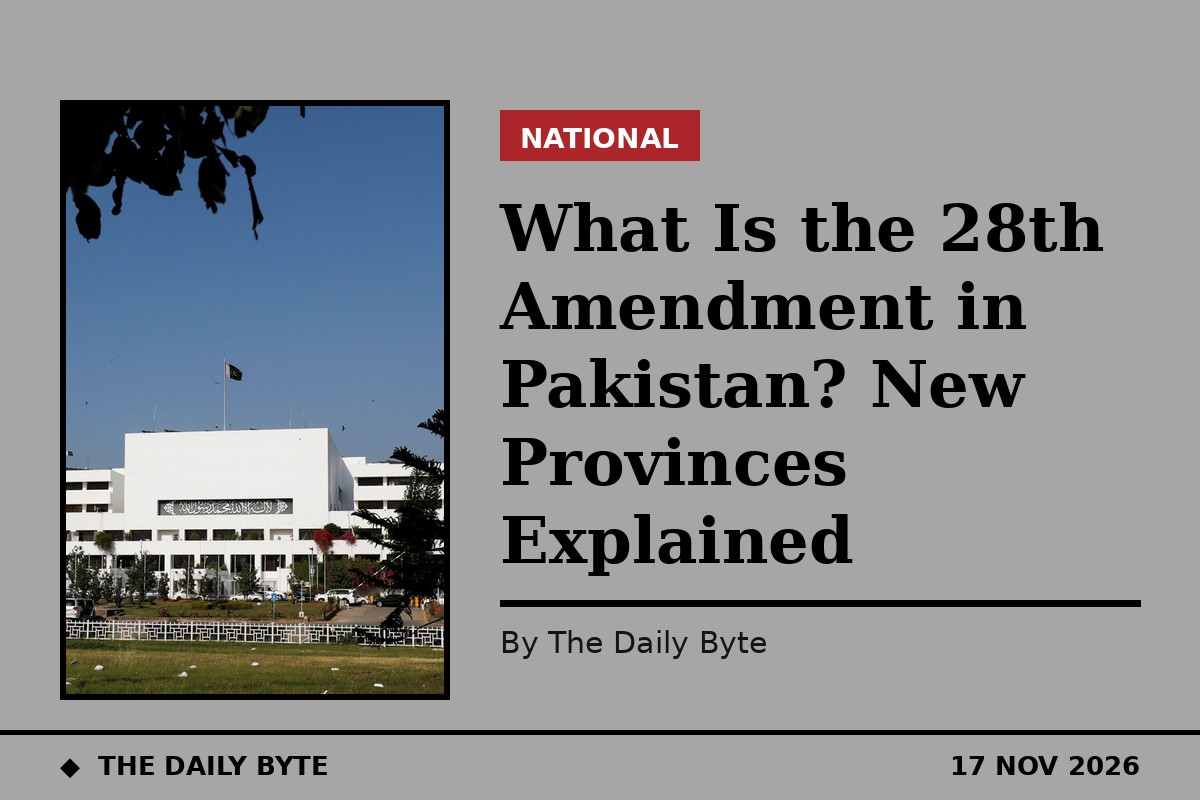
There is no 28th Amendment in Pakistan yet. No draft has been published, no bill has been tabled in Parliament, and the Speaker of the National Assembly has said no draft has been received. What does exist is a proposal, reported on 8 November 2026, to redraw Pakistan's map from four provinces into twelve, possibly after a nationwide referendum, and to give effect to that change through a 28th Constitutional Amendment. This explainer sets out what is actually proposed, what has genuinely happened so far, who is saying what, and what the Constitution would require before a single boundary could change.
The distinction between a proposal and an amendment matters. A proposal can be discussed, denied, revived or dropped. An amendment is a legal text, passed by two-thirds majorities in Parliament and, where provincial boundaries are involved, by the provincial assemblies concerned. The 28th Amendment is still at the proposal stage, and the route to it is far harder than the headlines suggest.
## What people mean by the 28th Amendment
Pakistan's Constitution has been amended 27 times since 1973. The most recent change, the 27th Amendment, was passed in November 2025 and created a new Federal Constitutional Court, taking constitutional cases away from the Supreme Court. It also changed the leadership structure of the armed forces and extended immunity to the President and senior military commanders.
The next numbered amendment would be the 28th. The label is being used for a specific idea: creating new provinces. The proposal, first reported by The News on 8 November 2026, would split Pakistan's four provinces into twelve. Punjab would be divided into four provinces, Khyber Pakhtunkhwa into three, Balochistan into three, and Sindh into two. A nationwide referendum would be held first, and the constitutional amendment would follow.
No boundaries have been settled, no names for the new provinces have been agreed, and no administrative structure has been published. The proposal remains, in the words of those reporting it, under consideration, with no final decision taken.
## The 12-province proposal in detail
Under the reported layout, Punjab, Pakistan's largest province by population, would become four provinces. Khyber Pakhtunkhwa and Balochistan, the two largest by land area, would each become three. Sindh would be divided in two. That would take the total from four provinces to twelve.
The stated aim, according to those familiar with the discussions, is to improve governance, bring administration closer to citizens, and distribute development spending more evenly. Supporters of the idea point to the size of the existing provinces: Punjab alone has a population larger than that of many countries, and Balochistan covers about 44 per cent of Pakistan's land but recorded fewer than 15 million residents in the last count, which makes it difficult to govern from a single capital.
The idea of new provinces is not new. Bills to create a South Punjab province and to restore Bahawalpur as a province have been tabled in Parliament before, including a PML-N amendment in 2019, without completing the process. The last time Pakistan's internal map actually changed by constitutional means was the 25th Amendment in 2018, which merged the former Federally Administered Tribal Areas into Khyber Pakhtunkhwa.
What is new is the scale, twelve provinces at once, and the suggestion of a referendum first. A separate draft said to be circulating on social media goes further, proposing a switch from a parliamentary system to a presidential one, but the authenticity of that draft has not been confirmed by any official source, and it should not be treated as the government's plan.
## What has actually happened so far
The timeline of confirmed events is short, and it is worth separating it from the speculation around it.
On 1 November 2026, the Special Assistant to the Prime Minister, Huzaifa Rehman, said the 28th Amendment could come before the end of the year, a faster timetable than others have suggested.
On 8 November, The News reported the twelve-province proposal, saying the amendment could be taken up in the first half of 2027, with preparatory steps possibly beginning in the first quarter of the year. The same day, Defence Minister Khawaja Asif said in Sialkot that Pakistan could have as many as twelve provinces if the exercise were based on administrative grounds rather than ethnic, linguistic or political considerations.
On 12 November, Interior Minister Mohsin Naqvi proposed a referendum, saying in Lahore that "if people say in a referendum that provinces should be formed, we should go ahead with it". He had first made the case for new provinces at the Pakistan Economic Summit in July. Later on 12 November, Imran Khan's lawyers raised the 28th Amendment during proceedings at Adiala Jail, in the context of the £190 million case appeals.
On 13 November, the Minister for Parliamentary Affairs, Tariq Fazal Chaudhry, said Parliament and the provincial assemblies could not be "bypassed", and invited the PTI to debate the issue in Parliament.
On 14 November, the Presidency said no discussion had taken place on matters related to provinces when Naqvi met President Asif Ali Zardari in Nawabshah. The same day, the National Assembly Speaker, Ayaz Sadiq, said no draft of a 28th Amendment had been received. Sindh's provincial minister Nasir Hussain Shah said a referendum alone could not create a province, and that a bill would need a two-thirds majority in the provincial assembly concerned.
That is the full public record as of 17 November 2026. No draft, no timetable agreed by the government, and no vote scheduled.
## Who is saying what
The proposal divides the governing coalition itself, which is one reason it has not advanced beyond discussion.
The PML-N, the largest party in the coalition, has yet to fully endorse or reject the measure, saying it will set out its position when the matter reaches Parliament. Within the party, Khawaja Asif has spoken in favour on administrative grounds, while others have been more cautious.
The PPP, the coalition's main partner, is opposed to dividing Sindh. Sindh Chief Minister Murad Ali Shah rejected the claim that the system had collapsed, called the proposal outdated, and warned that no bloodshed would be allowed over new provinces. The Sindh Assembly has already passed a resolution against the division of the province. The PPP's position matters because, as explained below, Sindh's own assembly would have to approve any change to its boundaries by a two-thirds majority.
The MQM-P, which has long campaigned for new provinces, backed the idea in August and called for a national dialogue. It described the Sindh Assembly's resolution against division as unconstitutional.
The PTI's chairman, Barrister Gohar Ali Khan, has said new provinces are necessary but require broad consensus and a two-thirds majority. The party's parliamentary party reportedly decided it would support a 28th Amendment only if Imran Khan is released, according to ARY News citing sources, a condition the government has not accepted.
Public opinion, if one recent survey is to be believed, leans towards more provinces. The Meridian National Barometer 2026, a survey of 5,000 people, reported that 77 per cent support more provinces, up from 54 per cent in 2022 and 66 per cent in 2024. The survey's method has not been independently reviewed, so those figures should be treated as reported rather than established fact.
## What the Constitution actually requires
This is where the proposal meets its hardest obstacle. Creating a new province is not something Parliament can do on its own, and it is not something a referendum can do at all.
Article 239(4) of the Constitution says that a bill which alters the limits of a province cannot be presented to the President for assent unless it has first been passed by the provincial assembly of that province by a vote of not less than two-thirds of its total membership. That is a separate requirement from the two-thirds majorities needed in the National Assembly and the Senate for any constitutional amendment.
The numbers involved are large. A constitutional amendment needs 224 of the 336 seats in the National Assembly and 64 of the 96 seats in the Senate. On top of that, altering a province's boundaries would need 248 of 371 votes in the Punjab Assembly, 112 of 168 in the Sindh Assembly, 97 of 145 in the Khyber Pakhtunkhwa Assembly, and 44 of 65 in the Balochistan Assembly. Each of those votes would have to be won in an assembly whose members would, in many cases, be voting to divide their own province.
Some constitutional lawyers argue the task is harder still. They say the Constitution contains no express provision for creating new provinces at all, and that an enabling provision would have to be written first. Legal experts cited in the press have estimated that as many as twelve separate articles of the Constitution would need to be amended to make the change work, covering matters from Senate representation to the distribution of seats in the National Assembly, the National Finance Commission Award, and the Council of Common Interests.
## Why a referendum alone cannot create a province
The referendum idea is the part of the proposal most often misunderstood. Under Article 48(6) of the Constitution, the Prime Minister may refer a matter of national importance to a joint sitting of Parliament, and if the joint sitting approves, the matter may be put to a referendum as a yes-or-no question to voters.
A referendum under that provision can gauge public opinion. It cannot change the Constitution, create a province, or bypass Article 239(4). The text of Article 48(6) says nothing about the result of a referendum having legal effect on the Constitution. That means a referendum could build political pressure for new provinces, and a strong result in favour might make it harder for a provincial assembly to refuse, but the legal decision would still sit with Parliament and with each affected provincial assembly.
For Sindh, that means the PPP-led assembly, which has already voted against division. For Punjab, it means an assembly in which the PML-N holds power but where many members represent districts that would be carved into new units. The referendum, in other words, changes the politics of the proposal. It does not change the vote counts.
## Why the 27th Amendment matters here
The debate over a 28th Amendment is taking place only a year after the 27th Amendment, which was passed with unusual speed and minimal public debate in November 2025. That amendment created the Federal Constitutional Court, which came into being on 13 November 2025, with Justice Aminuddin Khan as its first Chief Justice. It transferred constitutional interpretation, federal-provincial disputes and the enforcement of fundamental rights from the Supreme Court to the new court, and it changed the rules governing the appointment of judges and the leadership of the armed forces.
The 27th Amendment showed that a determined government with a two-thirds majority can change the Constitution quickly. It also showed the political cost: the amendment was boycotted by the opposition during its passage, was criticised by bar associations and by the International Commission of Jurists, and remains contested. Any 28th Amendment would face the same arithmetic, and a harder one, because it needs the provincial assemblies as well.
## What to watch next
Four things will show whether the 28th Amendment is a real plan or a trial balloon. The first is a published draft: until a text exists, there is nothing for Parliament, the provinces or the public to debate. The second is a reference to a joint sitting of Parliament under Article 48(6), which would be the first formal step towards a referendum. The third is any resolution in a provincial assembly in favour of new provinces, which would isolate Sindh's opposition or reshape the plan. The fourth is the position of the PML-N as a party, which has so far avoided committing itself either way.
None of those four things has happened yet. Until one of them does, the 28th Amendment remains what it is today: a proposal reported in the press, backed by some ministers, opposed by the PPP, and blocked, for now, by the Constitution's own requirement that the provinces themselves must agree to be divided.
## Frequently asked questions
**What is the 28th Amendment in Pakistan?**
It is a proposed constitutional amendment that would create new provinces, taking Pakistan from four provinces to twelve. No draft has been published and no bill has been tabled.
**How many new provinces are proposed?**
Twelve in total: Punjab divided into four, Khyber Pakhtunkhwa into three, Balochistan into three, and Sindh into two.
**Would a referendum create the new provinces?**
No. A referendum under Article 48(6) can only gauge public opinion. Creating a province requires a constitutional amendment passed by two-thirds majorities in Parliament and in the provincial assembly of the province concerned.
**What votes are needed?**
Two-thirds of the National Assembly (224 of 336) and the Senate (64 of 96), plus two-thirds of the total membership of each affected provincial assembly, including 112 of 168 votes in Sindh.
**When could it happen?**
Reported timelines differ: one adviser to the Prime Minister said before the end of 2026, while The News reported the first half of 2027. No date has been confirmed by the government.
**What did the 27th Amendment do?**
Passed in November 2025, it created the Federal Constitutional Court, transferred constitutional jurisdiction from the Supreme Court, and changed rules on judicial appointments, military leadership and presidential immunity.
The argument for new provinces, that smaller units govern better, is an old one in Pakistan, and the polling suggests it has public support. The argument against, that the federation cannot be redrawn without the consent of the provinces themselves, is written into the Constitution. Until a draft is published, the debate will go on in press conferences and on television. The law will not move until the votes are counted, in Islamabad and in the four provincial capitals.
*Sources: Digital Debate's analysis of the twelve-province proposal and the constitutional requirements; The News' report of 8 November 2026 via Islamabad Today; Sub News English's report of the Defence Minister's remarks.*
Source
Digital Debate — https://digdebate.com/12-provinces-referendum-what-constitution-allows/