What Is the Bank of England?
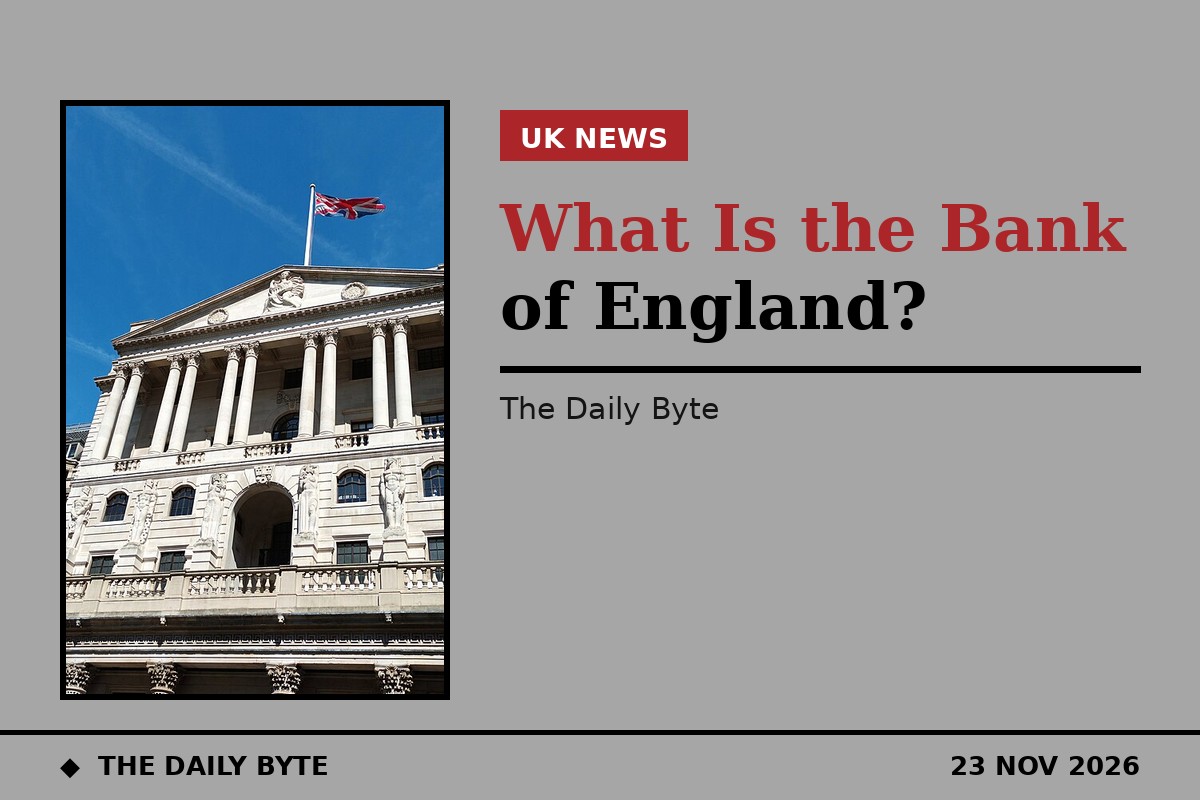
The Bank of England is the central bank of the United Kingdom. Founded in 1694, it sets the interest rate that shapes borrowing costs across the country, issues banknotes in England and Wales, and works to keep the financial system stable. Its headquarters is on Threadneedle Street in the City of London, which is why it is nicknamed the Old Lady of Threadneedle Street.
In short, the Bank has two core jobs: keeping prices stable and keeping the financial system safe. It does the first mainly by setting Bank Rate, the interest rate it charges commercial banks, and the second through regulation, supervision and its role as the lender of last resort. It describes its core purpose as promoting the good of the people of the United Kingdom by maintaining monetary and financial stability.
What does the Bank of England do?
The Bank's work falls into three broad areas. The first is monetary stability: keeping inflation low and stable. The government sets an inflation target of 2%, measured by the Consumer Prices Index, and the Bank aims to meet it by adjusting Bank Rate. When the Bank raises Bank Rate, borrowing becomes more expensive, which tends to cool spending and bring inflation down. When it cuts Bank Rate, borrowing becomes cheaper.
The second area is financial stability: protecting savers, investors and borrowers from threats to the financial system as a whole. The Bank's Financial Policy Committee watches for risks building up in the system, and the Prudential Regulation Authority, set up in 2011, regulates and supervises the UK's major banks, building societies, credit unions, insurers and investment firms. The Bank also runs stress tests on the largest banks to check they could keep lending in a severe downturn, and it is the UK's resolution authority, meaning it handles the orderly failure of a bank or building society if one gets into trouble.
The third area is banking and payments. The Bank is the government's banker, it manages the UK's foreign exchange reserves and is custodian of the country's gold reserves, and it operates the payment systems that settle transactions between banks. In 2024 it was settling around £500 billion worth of payments between banks each day. It also has a monopoly on issuing banknotes in England and Wales, and it regulates the banks in Scotland and Northern Ireland that issue their own notes.
Who runs the Bank of England?
The Governor is Andrew Bailey, who has led the Bank since 2020. Interest rate decisions are made by the Monetary Policy Committee, or MPC, a nine-member committee chaired by the Governor. It meets eight times a year to decide the level of Bank Rate needed to bring inflation back to, or keep it at, the 2% target. If inflation misses the target, the Governor must write an open letter to the Chancellor of the Exchequer explaining why and what will be done about it.
The Bank is an independent public organisation, wholly owned by the Treasury Solicitor on behalf of the government. Its operational independence over monetary policy was announced in May 1997 by the then Chancellor, Gordon Brown, and formalised by the Bank of England Act 1998, which put the MPC on a statutory footing. Parliament holds the Bank to account, including through Treasury Select Committee hearings, and the government sets the inflation target the Bank must aim for. As the House of Lords Economic Affairs Committee put it in its review of the Bank's independence, the Bank was founded in 1694 to promote the public good, was nationalised in 1946, and has set interest rates independently since 1997.
What is Bank Rate, and what is it now?
Bank Rate is the Bank of England's main interest rate. It is the rate the Bank charges commercial banks to borrow from it, and it ripples through the economy: it influences the interest banks charge on mortgages and loans, and the interest they pay on savings. It is the single most watched number the Bank produces.
As of 23 November 2026, Bank Rate is 4%. The MPC raised it by 0.25 percentage points on 5 November 2026, voting 8–1 in favour. The one dissenting member, Catherine L. Mann, wanted a larger rise, to 4.25%. The Bank said it had raised Bank Rate to reduce how much rising energy costs feed through into other prices. UK inflation stood at 3.6%, above the 2% target. The MPC's next decision is due on 17 December 2026.
A short history of the Bank
The Bank was established by royal charter on 27 July 1694 to act as the English Government's banker and to lend it money for its war with France. The £1.2 million it raised was subscribed in 12 days. It is the world's second-oldest central bank, after Sweden's, founded in 1668. It has been based in the City of London since 1694 and on Threadneedle Street since 1734.
The building itself is part of the story. The Bank moved to its present Threadneedle Street site in 1734, and the great curtain wall and courtyards were designed by Sir John Soane between 1788 and 1808. The grand portico that faces Threadneedle Street today dates from a major remodelling by Sir Herbert Baker in the 1920s and 1930s, when the Bank was largely rebuilt behind Soane's historic outer walls.
For most of its history the Bank was privately owned by stockholders. It was nationalised in 1946, and for the next five decades interest rates were effectively set by the Chancellor of the Exchequer. That changed in 1997, when the Bank was given operational independence over monetary policy, and the Bank of England Act 1998 made the arrangement law. The Bank's role has grown since then: after the 2008 financial crisis it took on much wider responsibility for financial stability, including the creation of the Prudential Regulation Authority and the Financial Policy Committee in 2011.
What is the Financial Stability Report?
The Financial Stability Report is the Bank's twice-yearly assessment of risks to the UK financial system, published by the Financial Policy Committee. It looks at household and corporate debt, global markets, market-based finance and operational threats such as cyber attacks, and it explains the committee's policy decisions. The next report is due on Thursday, 26 November 2026, at 10.30am, alongside the Financial Policy Committee's record of its meeting. It is one of the Bank's most important publications, because it shows whether the Bank thinks the banking system could withstand a severe shock.
Frequently asked questions
Is the Bank of England part of the government?
No. It is an independent public organisation, wholly owned by the Treasury Solicitor on behalf of the government, but it sets interest rates independently. The government sets the 2% inflation target; the Bank decides how to meet it.
Does the Bank of England set mortgage rates?
Not directly. It sets Bank Rate, and lenders decide their own mortgage and savings rates. But Bank Rate strongly influences what banks charge borrowers and pay savers, so a change in Bank Rate usually feeds through to mortgages, loans and savings accounts.
Who is the Governor of the Bank of England?
Andrew Bailey, who has been Governor since 2020.
What is Bank Rate today?
Bank Rate is 4%, after the Monetary Policy Committee raised it on 5 November 2026. The next decision is due on 17 December 2026.
Sources: Bank of England: Interest rates and Bank Rate; Bank of England: Upcoming events; House of Lords Economic Affairs Committee: Making an independent Bank of England work better.