What is the difference between a Muslim and an Islamist?
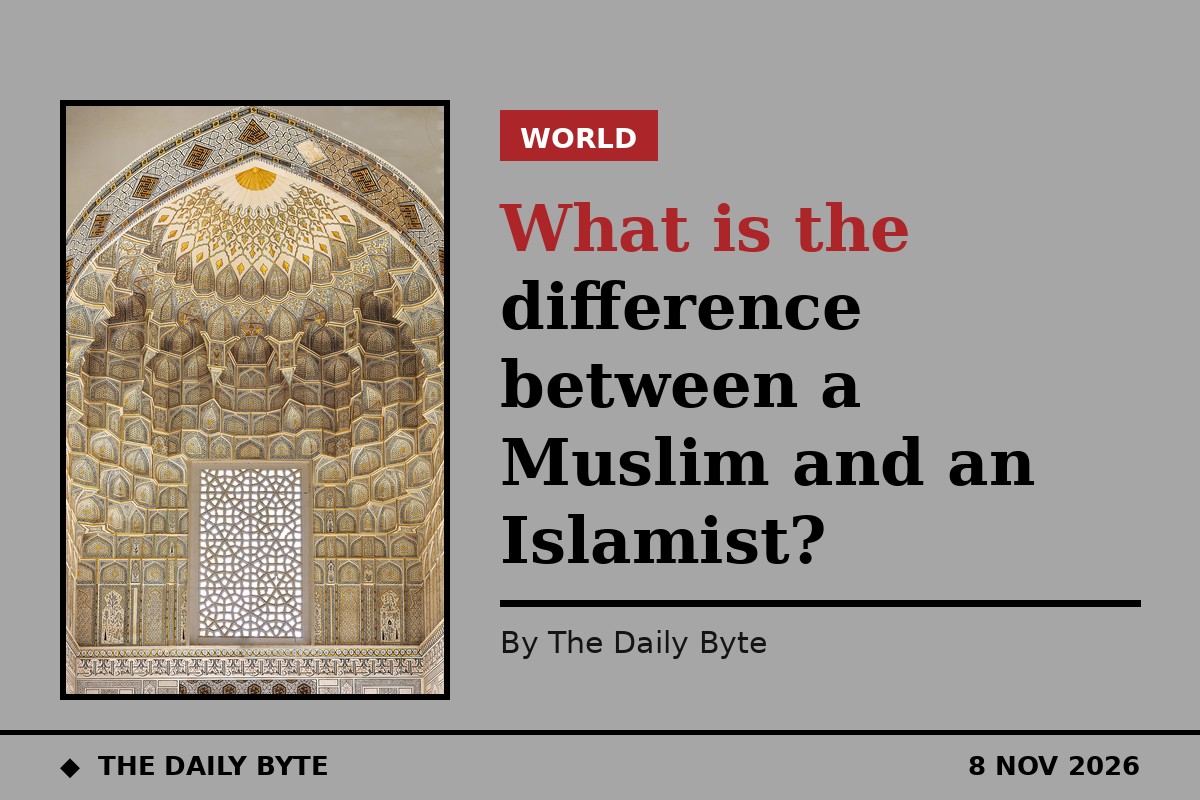
The short answer is that the two words describe different kinds of things. A Muslim is a person who follows the religion of Islam. An Islamist is a person who holds a particular political ideology: the belief that Islamic principles, and in most definitions Islamic law, should shape government and public life. Every Islamist is a Muslim, in the sense that Islamism grows out of the Islamic tradition, but most Muslims are not Islamists, and many Muslims actively oppose Islamist politics. The confusion comes from using a religious word and a political word as if they meant the same thing.
What a Muslim is
Islam is a monotheistic religion followed by nearly two billion people around the world, according to Encyclopaedia Britannica. A Muslim is someone who follows that faith, centred on belief in one God and on the prophethood of Muhammad and the teachings of the Quran. That identity covers a very wide range of people: different countries, languages, cultures, schools of law and political views. Muslims may support secular democracies, monarchies, or governments shaped by Islamic values, or they may have no strong view about the political system at all. Being a Muslim says something about a person's faith and practice, such as prayer, fasting and charity, and it does not by itself say anything about what political system that person wants.
It is also worth noting that most of the world's Muslims do not speak or read Arabic as a first language, and Islamic practice varies considerably across regions and traditions. Sunni and Shia Muslims, and the different legal schools within those branches, have disagreed for centuries about questions of law and interpretation, and that diversity is part of the religion's history rather than an exception to it.
What an Islamist is
Islamism is a political ideology, not a religion. Britannica defines it as a broad set of political ideologies that use Islamic symbols and traditions in pursuit of a sociopolitical objective, and describes it as a reform movement advocating for the reorganisation of government and society according to Islamic law. The Associated Press stylebook definition, widely quoted in reference works, calls an Islamist an advocate or supporter of a political movement that favours reordering government and society in accordance with the laws prescribed by Islam. The common thread in these definitions is the move from personal faith to public power: an Islamist believes that Islam should guide not only private life but also law, institutions and the state.
The term itself has a complicated history. In the 18th and 19th centuries, writers in European languages used "Islamism" simply as a synonym for the religion of Islam, much as "Christianism" was once used for Christianity. Its modern political meaning developed much later, in the 20th century, as movements emerged that sought to apply Islamic principles to government. That older usage is one reason the word still causes confusion today.
Islamists are not all the same
One of the most important points in the reference literature is that Islamism covers a wide spectrum, and treating it as a single movement is misleading. Britannica notes that the groups described as Islamist range from reformist movements such as the Muslim Brotherhood, which have contested elections and taken part in parliamentary politics, to transnational jihadist movements such as al-Qaeda and the Islamic State, which pursue their aims through armed violence. Some Islamists work through preaching, schools, charities and elections; others seek an Islamic state or caliphate by force. What they share is the political goal, not the method, and the methods differ so sharply that scholars and journalists often distinguish between reformist, or participatory, Islamism and militant Islamism.
The distinction matters because the word "Islamist" is often used in news coverage as shorthand for "militant" or "extremist", which misdescribes the large number of Islamists who operate within democratic politics and reject violence. It also matters in the other direction: describing a violent group simply as "Muslim" misdescribes it too, because its defining feature is a political programme, not its members' religion.
Why the two are confused
Several things blur the line. First, the words sound alike, and "Islamic" and "Islamist" are often used interchangeably in everyday speech, even though they mean different things: "Islamic" is a neutral adjective for anything relating to Islam, from art to law, while "Islamist" carries a specifically political meaning. Second, Islamists themselves claim to speak for Islam, and their opponents sometimes accept that claim at face value. The Washington Institute's Soner Cagaptay has argued that Islamism is not a form of the Muslim faith or an expression of Muslim piety, but a political ideology that strives to derive legitimacy from Islam, and points to cases where Muslims have opposed Islamists, including a Nigerian father who reported his own son's slide into Islamist ideology to the authorities. Third, political debates about Islam often collapse a religion of nearly two billion people into a single political position, which no faith of that size holds.
There is also a genuine grey area that honest definitions acknowledge. Some Muslims hold that their faith has implications for public life without supporting any Islamist movement, and some Islamist parties have moderated their programmes once in government. Scholars disagree about where the boundary falls, and about whether the term "Islamism" is useful at all. What is not in serious dispute among reference sources is the basic distinction: Islam is the religion, and Islamism is a modern political ideology that draws on it.
The difference in one paragraph
A Muslim is someone whose religion is Islam. An Islamist is someone who believes Islam should determine how a state is governed. A Muslim may or may not be an Islamist; an Islamist, by definition, holds a political view that most Muslims do not share. Knowing which word applies is not a matter of politeness but of accuracy: it determines whether you are describing a person's faith, which is a matter of belief and practice, or a person's politics, which is a matter of how they think power should be organised. When the two are kept apart, the conversation becomes clearer, and when they are mixed up, both Muslims and Islamists are misdescribed.
[Source: Encyclopaedia Britannica](https://www.britannica.com/topic/Islamism) | [Source: The Washington Institute](https://www.washingtoninstitute.org/policy-analysis/muslims-vs-islamists)