What Is the Digital Euro? Launch Date and Rules
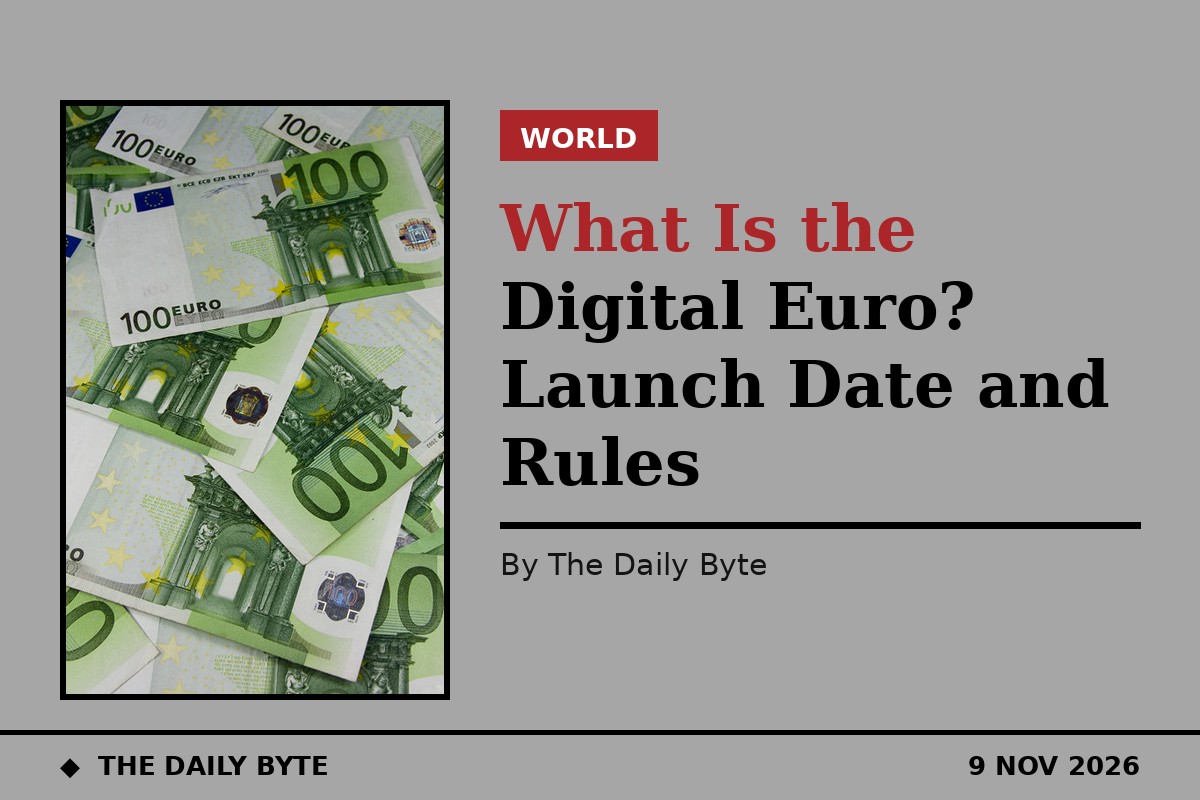
Europe is building a digital version of the euro, and the project is now moving from speeches and studies into contracts, pilots and law. Finance ministers in the Eurogroup are discussing the digital euro today, 9 November 2026, as part of a wider debate about defence funding and Europe's financial independence. Yet despite the headlines, there is still no digital euro to download, no wallet to open and no date on which you will be paid in one. This guide explains what the digital euro is, how it would work, when it could arrive, and what it would mean for your cash, your bank and your privacy.
The simplest definition is the one the European Central Bank itself uses. The digital euro would be a digital form of central bank money, issued by the Eurosystem, which is the ECB and the national central banks of the euro area. In plain terms, it would be electronic cash. Today, the only central bank money available to ordinary people is physical: banknotes and coins. Everything else in your current account is commercial bank money, a claim on your bank rather than on the central bank. The digital euro would change that by giving the public a second form of central bank money, one that works online, in shops and between individuals across the whole euro area.
That distinction matters because it is the reason the project exists at all. Cash cannot be used for an online purchase, and Europe has no single digital payment method that works everywhere in the currency area. Payments remain fragmented along national lines, and the ECB has pointed out that 13 euro area countries rely entirely on non-European companies for in-store card payments. The digital euro is meant to close that gap with a public payment rail that every bank and payment provider in the euro area could build on.
So how would you actually use it? You would hold digital euro in a wallet provided through your bank or another supervised payment service provider. Your bank would remain your point of contact: it would distribute the digital euro and handle customer service, while the Eurosystem would run the underlying platform. You could pay in shops, buy things online and send money to another person, much as you do with a card or a payment app today. The difference would be behind the scenes. The money would be a direct claim on the central bank, and the Eurosystem has said it would charge no scheme or processing fees, which should mean savings for banks, merchants, especially small ones, and ultimately consumers.
One of the most talked-about features is offline payment. The digital euro is designed to work without an internet connection, by holding two devices close together, in a way that resembles handing over a banknote. That matters in a power cut, in a rural area with poor signal, or anywhere a card terminal cannot connect. The ECB says offline payments would offer cash-like privacy, because the personal details of the transaction would be known only to the payer and the payee. For online payments, the Eurosystem says it would not be able to identify the people involved, although your bank or payment provider would still see transaction data so it can meet its anti-money-laundering duties, just as it does for cards and instant payments today.
Basic use would be free for consumers. That is a firm commitment in the ECB's design: no fees for everyday payments, and no interest paid on the balance. The digital euro is deliberately designed as a means of payment, not as a savings account. That is why there would be a limit on how much of it any one person can hold. The exact figure has not been set, and the draft law leaves it blank, but the ECB has modelled hypothetical ceilings of up to 3,000 euros per person and concluded that everyday use at that scale would not threaten financial stability.
A holding limit sounds restrictive, but it is designed not to limit what you can spend. The system would use what the ECB calls a waterfall. If you hold 2,900 euros in your digital euro wallet and make a 400 euro purchase, the 300 euro shortfall would be pulled automatically from your linked bank account so the payment goes through. If money arrives that would take you above the limit, the excess would be swept back into your bank account. In practice the cap would limit stored balances, not purchasing power. The point is to stop large sums moving out of bank deposits and into central bank money all at once, which banks warn could raise their funding costs and feed through to mortgage and loan pricing.
The question most people ask first is whether the digital euro would replace cash. The official answer is no, and the ECB has been unambiguous about it. Its own frequently asked questions page states that the digital euro would complement cash, not replace it, and euro banknotes would remain legal tender. The Council of the European Union agreed its negotiating position on the digital euro in December 2025 as part of a package that also included measures to protect the acceptance of, and access to, cash. That pairing was deliberate. The ECB's own study of payment attitudes, covering 2024, found that cash was still used for 52 percent of point-of-sale transactions by number across the euro area, and 62 percent of respondents said having cash as a payment option was important or very important. At the same time, the ECB is modernising banknotes themselves: almost ten million people took part in a public survey this summer on ten shortlisted designs for the next generation of notes, and the new banknotes are expected to enter circulation gradually from the early 2030s, while existing notes remain valid.
Privacy is the other question that dominates the debate, and the ECB has answered it in unusually direct terms. The digital euro would never be programmable money, meaning no government or authority could decide what you spend it on. What would be possible are conditional payments that you set up yourself, such as money that is only released when a delivery is confirmed. The European Parliament's negotiating mandate adds privacy-by-design and privacy-by-default requirements, and restricts offline payments to transfers between devices held close together, a limit justified on money-laundering grounds. There is one practical consequence worth knowing: money stored offline sits on your device, so if you lose the device, that money is gone, with no refund mechanism. An offline wallet should be treated like a physical purse, not like a bank balance.
The digital euro is not a cryptocurrency and it would not run on a blockchain. It would run on a central Eurosystem platform, not a shared ledger, and it would be legal tender, just like cash. It is also not a rival to private payment services. The ECB's stated aim is to provide a common public foundation on which banks and payment firms can compete and innovate at European scale, rather than displacing them. The 36 payment service providers selected for the pilot, chosen from more than 50 applicants, will test exactly that: how their own services sit on top of the shared infrastructure.
Why is Brussels in a hurry now? The acceleration is driven less by consumer demand than by sovereignty. ECB President Christine Lagarde has repeatedly warned that dollar-backed stablecoins, which she has put at around 98 percent of the stablecoin market, risk a form of digital dollarisation that would erode Europe's monetary sovereignty. The digital euro is presented as the public alternative: European money, under European governance, for a digital economy. That argument has gained force as geopolitical fragmentation has made governments more concerned about who controls critical payment infrastructure.
The timeline is the part most often misunderstood. There is no launch in 2026, and the ECB has never promised one. The legislative process is still under way: the Council agreed its position in December 2025, the European Parliament adopted its position in July 2026, and the two sides have been negotiating the text in trilogue talks since 13 July 2026. A sixth political trilogue took place on 5 November 2026, and the European Council has called for the negotiations to be concluded by the end of this year. If the law is adopted during 2026, the ECB aims to be ready for a possible first issuance during 2029, but the Governing Council would only vote on issuing the digital euro after the Regulation is adopted. Before that, a twelve-month pilot is planned to start in the second half of 2027, involving the 36 selected payment service providers and merchants testing real payment journeys.
While the law is still being negotiated, the machinery is already being built. On 30 October 2026 the ECB awarded two ten-year network contracts for the infrastructure that would carry digital euro traffic: one to Nexi Payments with Deutsche Telekom, whose contract has been running since 28 September 2026, and one to Telefonica with Indra's technology unit Minsait, due to go live in May 2027. The ECB's published cost estimates for the project are around 1.3 billion euros in development costs and about 320 million euros a year in operating costs once the digital euro is issued. That gap between procurement and legislation is the real story of this autumn: the technical risk has largely been retired, and the remaining risk is legal and political.
What should you do now? Nothing, in practical terms. No digital euro can be issued before the Regulation is adopted, and the earliest stated issuance window is 2029. Any product marketed to you today as a digital euro wallet is not one. The date to watch is the end of 2026: if political agreement slips past December, the 2027 pilot and the 2029 issuance target would both move, because the ECB has tied its readiness to the law being adopted in the course of 2026. For people outside the euro area, including in the UK, the project still matters, because the standards and rulebook the ECB is writing could become a blueprint for other countries considering their own digital currencies, and because a free, universally accepted public digital option in Europe would reshape competition in payments across the continent.
The digital euro, then, is best understood as a long-term upgrade to public money rather than a new app. Cash stays, banks stay as your point of contact, and nothing changes for your day-to-day payments until the law is passed, the pilot is run and the Governing Council votes to issue. What changes, if the project succeeds, is the foundation underneath those payments: a European digital currency, issued by the central bank, free for basic use, usable offline, and available everywhere the euro is used.