What Is the House of Commons? How the UK Commons Works
The House of Commons is the elected lower house of the UK Parliament. It is made up of 650 Members of Parliament, known as MPs, each elected to represent one constituency. The Commons makes laws, approves taxes and public spending, and holds the government to account, and the government of the day must keep its support to stay in office. This guide explains how the House of Commons works, how MPs are elected, how a bill becomes a law, and what the Commons does day to day, based on official Parliament material as it stands on 23 November 2026.
What is the House of Commons?
The House of Commons is the elected chamber of the UK Parliament, which meets in the Palace of Westminster in London. As the UK Parliament's own learning material puts it, this is where MPs debate important issues, make and review laws, represent the public and hold the government to account. Parliament has two houses: the Commons, whose members are elected, and the House of Lords, whose members are appointed. Of the two, the Commons is the dominant chamber. The government is primarily responsible to the Commons, and the prime minister stays in office only as long as they retain its support.
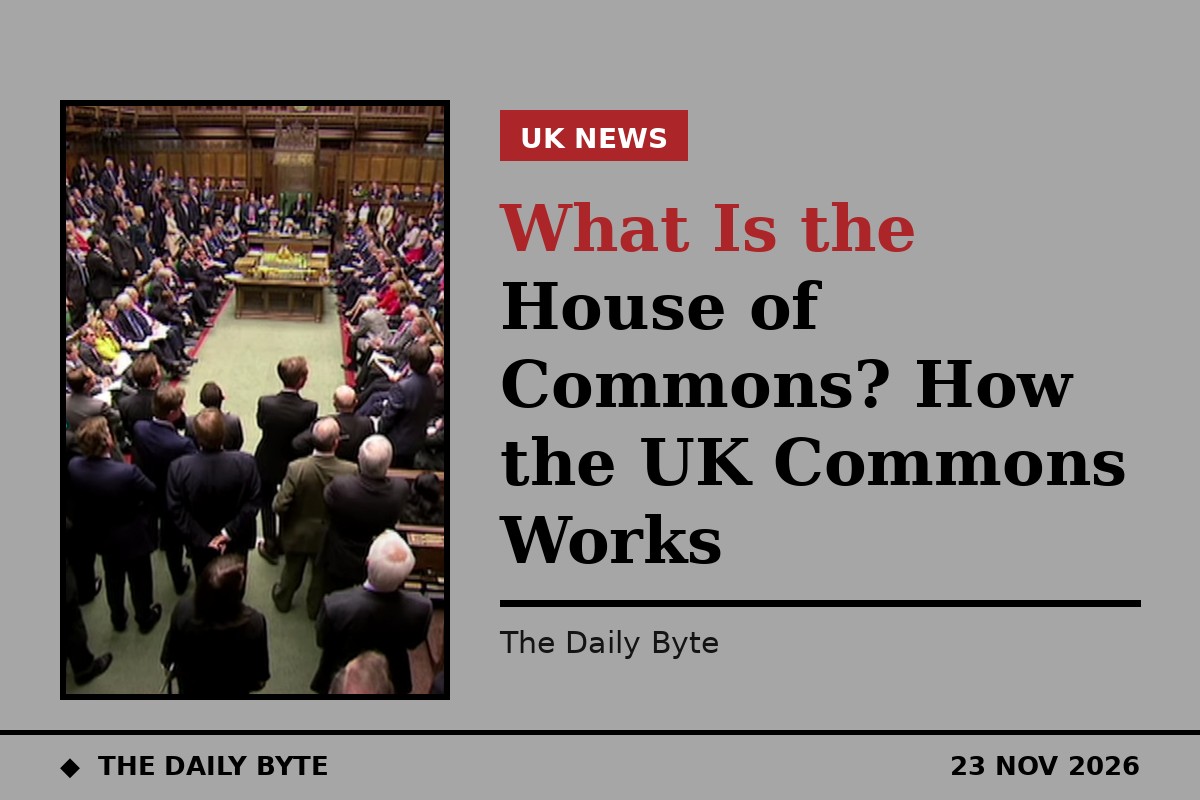
The Commons chamber itself is famously small and modestly decorated in green, with government MPs sitting on one side and opposition MPs facing them from the other. The Speaker sits at the head of the room and chairs debates, keeping the House in order.
How are MPs elected?
There are 650 MPs, each representing a different area of the UK known as a constituency. They are elected by the public in a general election, using the first-past-the-post system: the candidate with the most votes in a constituency wins the seat, even without an overall majority of the votes cast. Parliament normally sits for a maximum term of five years, so a general election must be held at least that often. MPs generally belong to a political party, but some are independent.
To stand for election as an MP, a candidate must be at least 18 years old and a British citizen, a citizen of the Republic of Ireland, or a Commonwealth citizen with indefinite leave to remain in the UK or who does not require leave to enter. Some people are disqualified from standing, including holders of certain civil service and Crown posts, people subject to a bankruptcy restrictions order, and people serving a prison sentence of a year or more.
After a general election, the leader of the party with the most MPs becomes prime minister. The prime minister leads the government and appoints around 20 senior ministers to form the cabinet, which coordinates the work of the government departments. If no single party holds a majority, two or more parties can form a coalition government.
What does the House of Commons do?
The Commons has three main jobs. First, it makes and shapes laws. Second, it approves taxation and public spending: the government cannot make new laws or raise new taxes without Parliament's agreement. Third, it scrutinises the government, checking what ministers do and how public money is spent.
MPs split their time between the House of Commons and their constituency. In their constituencies they hold surgeries, where members of the public can visit their offices and raise concerns, so MPs can learn how policies and new laws affect the people they represent, including those who voted for someone else or did not vote at all.
How does a bill become a law?
An idea for a new law is called a bill, and each bill must go through a set sequence of stages before it can become law. In the House of Commons, the First Reading is purely procedural, a formal notice that the bill exists, with no debate. At the Second Reading, the whole chamber debates the bill's general principles and votes on it. If it survives, it moves to Committee Stage, where a smaller group of MPs works through the text line by line and proposes amendments. Report Stage brings the amended bill back before the whole House for further changes, and the Third Reading is the final vote on the completed text.
The bill then goes through the same stages in the House of Lords. At the end of the process the final wording must be agreed by both Houses. It is then passed to the monarch, who gives formal approval, known as Royal Assent, and the bill becomes an Act of Parliament.
Government and Opposition
Inside the chamber there are two sides. On one side sit the government MPs, who run the country; on the other sit the opposition parties, who check and challenge the government's work. Behind the scenes, party whips organise their party's contribution to parliamentary business, make sure members turn up for votes, and negotiate scheduling with the other parties through informal cross-party channels known as the usual channels.
The Speaker is elected by MPs and chairs debates impartially. The Speaker decides who may speak, keeps order in the chamber, and protects the rights of backbench MPs to question the government.
How does the Commons hold the government to account?
Prime Minister's Questions and ministerial questions give MPs from all parties the chance to raise issues and challenge government policy in the chamber. MPs can also ask for an urgent question on a topical event; if it is granted, the minister responsible is summoned to the House to make a statement. Away from the chamber, many MPs sit on cross-party select committees. Most select committees mirror a government department, for example the Home Affairs Committee, which scrutinises the work of the Home Office. Select committees review policies and government spending by holding inquiries that look at specific issues in detail, a process called scrutiny.
The Commons and the House of Lords
A bill must normally pass both Houses before it can become law, but the Commons has the final say. Under the Parliament Act 1911, the Lords' power to reject legislation was reduced to a delaying power, so the elected Commons prevails over the appointed Lords. The Commons also has sole control over financial legislation: the Lords cannot block bills about taxation and public spending. This is why the Commons is described as the dominant chamber, and why the government is answerable to it rather than to the Lords.
How much are MPs paid?
MPs' pay and business costs are set and regulated by the Independent Parliamentary Standards Authority, known as IPSA, rather than by MPs themselves. The basic annual salary for an MP from 1 April 2026 is £98,599, according to IPSA. IPSA also administers the budgets MPs use for staffing, office costs and travel, and publishes spending data every two months so the public can see where the money goes.
Frequently asked questions
How many MPs are there in the House of Commons? There are 650 MPs, one for each constituency in England, Scotland, Wales and Northern Ireland.
How often are general elections held? Parliament normally sits for a maximum term of five years, so a general election must be held at least every five years.
What happens if no party wins a majority? If no single party holds a majority of seats, two or more parties can form a coalition government, or a party can govern as a minority government.
What is the difference between the House of Commons and the House of Lords? The Commons is elected and is the dominant chamber; the Lords is appointed and can delay, but not ultimately block, most legislation.
Sources: UK Parliament, The House of Commons learning material and EBSCO Research Starters, House of Commons.