What is the Stormont Brake? NI veto explained
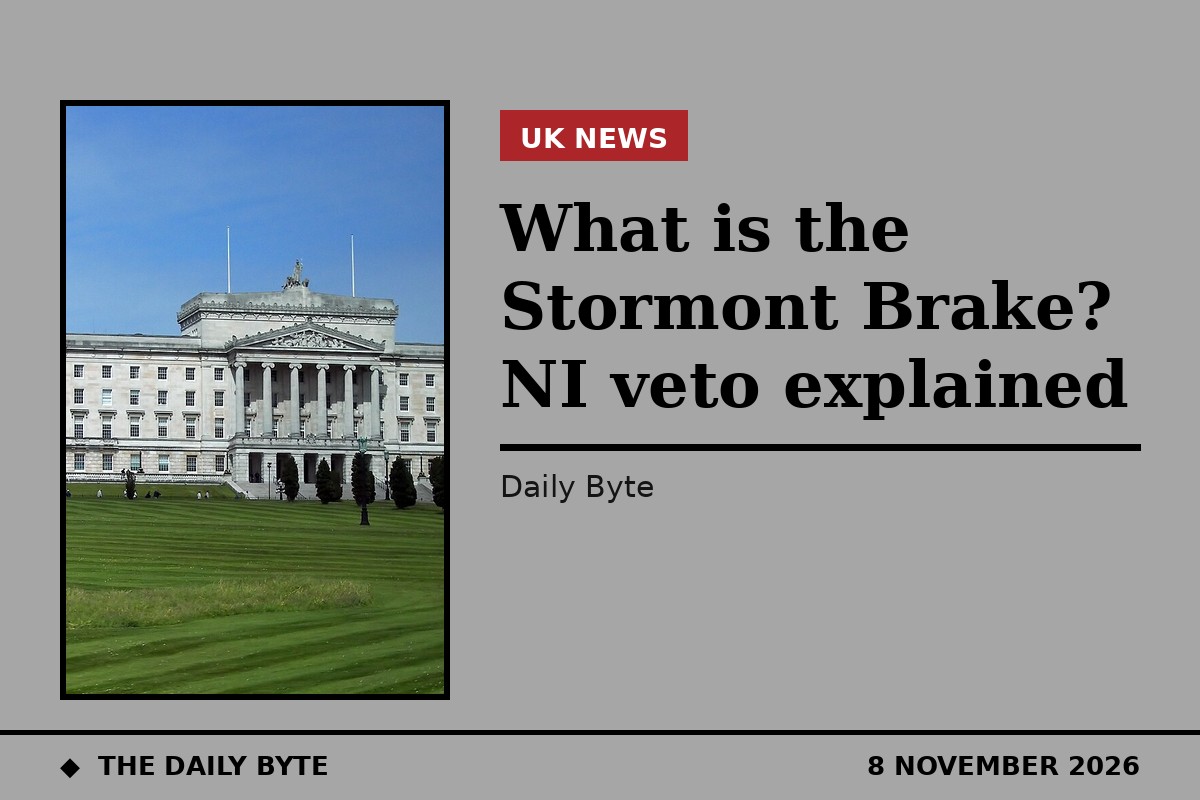
The Stormont Brake is a mechanism that lets the Northern Ireland Assembly object to changes in European Union laws that still apply in Northern Ireland after Brexit. If at least 30 Members of the Legislative Assembly (MLAs) from two or more parties formally object, the UK Government must consider whether to stop the updated EU rule from taking effect in Northern Ireland. It is not a veto that Stormont can use on its own: the final decision rests with the UK Government in London.
The brake exists because Northern Ireland still follows some EU rules on goods, so that there is no hard border on the island of Ireland. It was created by the Windsor Framework, the agreement reached by the UK and the EU in February 2023 to revise the Northern Ireland Protocol, and it became operational in February 2024, when the Northern Ireland Executive and Assembly were restored. Unionist MLAs asked for it to be used for the second time in early November 2026, in a row over changes to the EU customs code.
Why does the Stormont Brake exist?
When the UK left the EU, Northern Ireland was given a special arrangement. To avoid customs posts and checks along the border with the Republic of Ireland, Northern Ireland kept following a set of EU rules covering goods, while the rest of the UK did not. That arrangement, first set out in the Northern Ireland Protocol, meant that when the EU updated one of those rules, the updated version would automatically apply in Northern Ireland too, even though Northern Ireland's elected politicians had no vote in Brussels.
Unionist politicians in particular argued that this left Northern Ireland subject to laws it had no say over. The Windsor Framework, agreed in February 2023 and formally adopted in March 2023, was designed to soften the Protocol's operation, easing checks on goods crossing the Irish Sea from Great Britain. As part of that deal, it introduced the Stormont Brake: a way for the Northern Ireland Assembly to raise a formal objection when an updated EU rule changes significantly, and to ask the UK Government to stop it applying in Northern Ireland.
The brake is deliberately narrow. It applies only to EU acts that amend or replace laws already applying in Northern Ireland under the Windsor Framework. Entirely new EU laws are dealt with separately, through a process known as an applicability motion, under which the Assembly votes on whether the new law should apply at all.
How does the Stormont Brake work?
The process starts in the Northern Ireland Assembly. At least 30 MLAs, from at least two different parties, must sign a formal notification to the UK Government saying they want the brake pulled on a particular amended or replaced EU law. The Speaker and Deputy Speakers do not count towards the 30. The Assembly's Speaker then writes to the Secretary of State for Northern Ireland.
The notification must be made no later than ten working days before the end of a two-month scrutiny period, which runs from the date the EU law is published in the EU's Official Journal. It must include a detailed, publicly available written explanation showing that the conditions for using the brake have been met. The Assembly's Windsor Framework Democratic Scrutiny Committee, set up in February 2024, helps MLAs examine new and updated EU laws that fall within the scope of the Framework.
Once the notification reaches London, the Secretary of State must decide whether the legal conditions for pulling the brake have been met. If the Government agrees they have, it notifies the EU in writing through the UK-EU Joint Committee, the body that oversees the Brexit deal. From that point, the updated EU law does not apply in Northern Ireland in its new form. The older, unamended version of the law keeps applying instead. The rule is then discussed in intensive consultation in the Joint Committee.
At the end of that process, the Government must not agree to add the law to the Windsor Framework so that it applies in Northern Ireland unless the Assembly has shown cross-community support for it by passing an applicability motion. The only exceptions are in what the rules describe as exceptional and other highly limited circumstances.
What conditions must be met to pull the Stormont Brake?
The bar is high, and that is deliberate. The MLAs asking for the brake must show that they are acting in what the rules call the most exceptional circumstances and as a last resort, having used every other available mechanism. They must also explain how the amended or replaced EU law significantly differs in its content or scope from the original law, and how applying it would have a significant impact specific to the everyday life of communities in Northern Ireland in a way that is liable to persist.
Before notifying the Government, the MLAs must also have sought prior substantive discussion with the UK Government and within the Northern Ireland Executive, consulted businesses, other traders and civic society affected by the EU act, and made all reasonable use of the consultation processes the EU provides for new Union acts. The House of Commons Library has noted that these conditions are demanding, and that critics argue they make the brake very difficult to apply in practice.
It is also worth noting what the brake does not cover. According to the Commons Library's briefing, the brake mainly relates to goods rules, but not to amended or replaced laws concerning state aid, the Single Electricity Market, or most of the EU's customs code. That scope question matters for the latest request, which concerns changes to the EU customs code, and it is one of the things the Secretary of State will have to weigh.
Has the Stormont Brake ever been used before?
The brake has been formally requested once before. In December 2024, 35 unionist-designated MLAs notified the Speaker that they wanted the brake pulled to block the application of Regulation (EU) 2024/2865, an updated EU regulation on the classification, labelling and packaging of hazardous substances. It was the first request made since the mechanism became operational in February 2024.
On 20 January 2025, the then Secretary of State for Northern Ireland, Hilary Benn, rejected the request. He decided that the conditions for pulling the brake had not been met. The updated regulation therefore applied in Northern Ireland as the EU had adopted it. The episode showed that a request backed by more than the minimum 30 MLAs is not enough on its own: the Government applies the statutory tests, and it can say no.
What is happening with the Stormont Brake now?
In early November 2026, unionist MLAs formally asked the UK Government to pull the Stormont Brake for a second time. Assembly Speaker Edwin Poots wrote to the Northern Ireland Secretary, Sir Chris Bryant, after MLAs from several unionist parties requested that the UK pull the brake to block changes to the EU customs rules that apply in Northern Ireland. The notification was signed by members of the Democratic Unionist Party, the Ulster Unionist Party, Traditional Unionist Voice and the independent unionist Claire Sugden.
The objection relates to a major overhaul of the EU customs code, intended to digitise and streamline customs processes across the European Union. The Assembly confirmed the request, and Sir Chris Bryant must now decide whether the statutory tests for triggering the brake have been met. It is the second time politicians at Stormont have sought to deploy the mechanism.
One detail of the customs dispute has already been settled separately. The EU customs rules update could have meant a two-euro handling charge on parcels sent from Great Britain to Northern Ireland, but that charge has been avoided after an agreement between the UK and the EU. Cabinet Office minister Hamish Falconer has said parcels moving under Windsor Framework facilitation schemes will not be impacted and will pay no fees or charges, a point the Government has repeated in statements this week.
What the Stormont Brake is not
It is not a general veto over EU law in Northern Ireland. It cannot be used against laws that are entirely new to Northern Ireland, and it cannot be used to remove Northern Ireland from the EU goods rules altogether. It does not give the Assembly the power to rewrite EU law, and it does not hand the final say to Stormont: the UK Government decides whether the conditions are met, and the UK Government notifies the EU.
Nor does triggering the brake require cross-community consent. The 30 MLAs who sign a notification do not need support from both unionists and nationalists to make the request. Cross-community support does, however, come into the picture at the end of the process, when the question is whether the updated law should eventually apply in Northern Ireland. That is a deliberate feature of the design: the brake can be raised by one side of the community, but the law can only be added back with broader backing in the Assembly.
What happens next?
Sir Chris Bryant has not indicated how he will reach his decision, or how long it will take. If he judges that the statutory tests have been met, the UK would notify the EU, which would trigger an intensified period of consultation and discussion in the Joint Committee established under the Windsor Framework. If he judges that the tests have not been met, the updated customs rules would apply in Northern Ireland as adopted, as happened with the hazardous substances regulation in January 2025.
Either way, the episode is a test of a mechanism that was central to the political argument for the Windsor Framework. When the Framework was agreed, the brake was presented as the democratic safeguard that gave Northern Ireland a say over EU rules it must follow. Its critics have always said the conditions are so strict that it would rarely, if ever, be used. With a second request now on the Secretary of State's desk, that argument is being tested again.
Frequently asked questions
What is the Stormont Brake in simple terms? It is a procedure that lets at least 30 MLAs from two or more parties ask the UK Government to stop an updated EU goods rule from applying in Northern Ireland, if the change would significantly affect everyday life there.
Who decides whether the Stormont Brake is pulled? The Secretary of State for Northern Ireland decides whether the statutory conditions have been met. The Assembly can request the brake, but only the UK Government can pull it.
How many MLAs are needed to request the Stormont Brake? At least 30 MLAs from at least two parties, not counting the Speaker and Deputy Speakers. The first request, in December 2024, was signed by 35 MLAs and was still rejected.
Does the Stormont Brake apply to the EU customs code? That is disputed. The Commons Library briefing says the brake mainly relates to goods rules and does not cover most of the EU's customs code, so whether it can be used against customs code changes is part of what the Secretary of State must decide in the current case.
What happens to the old EU law if the brake is pulled? The updated version does not apply in Northern Ireland, and the older, unamended version keeps applying while the UK and EU consult in the Joint Committee.
Sources: the Northern Ireland Assembly's official guide to the Stormont Brake and the House of Commons Library briefing on the brake in action. The latest request was reported on 8 November 2026, when Assembly Speaker Edwin Poots wrote to Northern Ireland Secretary Sir Chris Bryant.