What is the Strait of Hormuz and why does it matter?
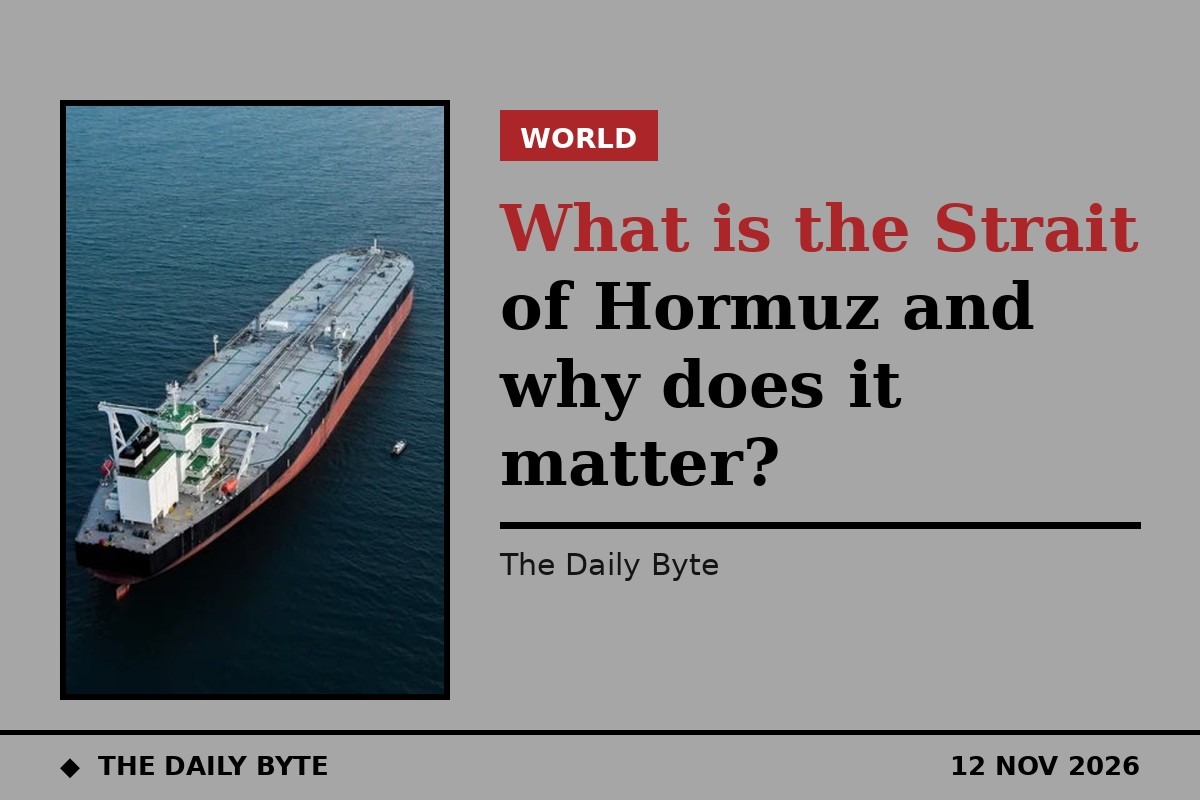
The Strait of Hormuz is the narrow stretch of water between Iran and Oman that links the Persian Gulf to the Arabian Sea, and it is the only sea route by which oil from the Gulf reaches the open ocean. About a fifth of the oil the world consumes passes through it, which is why any disruption there moves global oil prices within hours.
On Thursday 12 November 2026, four oil tankers were hit by explosions in the strait, according to Iran’s military, in the latest attack on shipping in the waterway this year. This explainer sets out where the strait is, what passes through it, and why it matters so much.
Where is the Strait of Hormuz?
The strait lies between Iran to the north and Oman’s Musandam Peninsula to the south. It connects the Persian Gulf with the Gulf of Oman and the Arabian Sea beyond, making it the only maritime exit for the Gulf’s oil-exporting states.
At its narrowest point the strait is about 33 kilometres (21 miles) wide, according to the US Energy Information Administration (EIA). Shipping moves through two traffic lanes, each two miles wide, separated by a two-mile buffer zone. The narrowness is the point: every tanker leaving the Gulf must pass through this single gap, and there is no alternative sea route.
How much oil and gas passes through it?
The EIA, which publishes the most widely cited flow estimates, put total oil flows through the strait at 20.9 million barrels a day in the first half of 2025. That is about 20 per cent of global petroleum liquids consumption and roughly a quarter of all the oil traded by sea.
| What passes through Hormuz | Volume | Share |
|---|---|---|
| Total oil (crude, condensate and products) | 20.9 million barrels a day (first half of 2025) | About 20% of world oil consumption |
| Crude oil and condensate | 14.7 million barrels a day | About 89% goes to Asian markets |
| Petroleum products | 6.1 million barrels a day | Around a quarter of seaborne oil trade |
| Liquefied natural gas (LNG) | 11.4 billion cubic feet a day | More than 20% of global LNG trade |
Source: US Energy Information Administration, World Oil Transit Chokepoints (figures for the first half of 2025).
The gas matters almost as much as the oil. Nearly all of the LNG comes from Qatar, the world’s second-largest LNG exporter, and about 83 per cent of the LNG passing through the strait is bound for Asian markets. China, India, Japan and South Korea together take about three-quarters of the crude oil that transits the strait.
Why is it so hard to go around?
There is no way to move Gulf oil by sea without using the strait, and the overland alternatives are far too small. Pipelines that bypass Hormuz — principally Saudi Arabia’s East-West pipeline to the Red Sea and the United Arab Emirates’ pipeline to Fujairah on the Gulf of Oman — could move only about 4.7 million barrels a day between them, according to the EIA. That is less than a quarter of the volume that normally passes through the waterway.
The limits of those alternatives have been on display this year. The EIA estimated that oil flows through the strait had fallen to 4.9 million barrels a day by the second quarter of 2026, down from 21.6 million in the last quarter of 2025, after military action between the United States, Israel and Iran began on 28 February 2026.
What happened in the strait on 12 November 2026?
Four tankers were hit by explosions in the strait on 11 and 12 November, according to statements from Iran’s military reported by Reuters. Iran’s Revolutionary Guards Navy said two supertankers carrying more than four million barrels of oil between them were disabled by explosions on Wednesday night after they ignored warnings against using what Iran calls an unauthorised southern shipping route. Iranian state media said the vessels had struck naval mines.
Iran’s army then said two more tankers had hit mines on Thursday afternoon while sailing through the eastern strait, after switching off their radar systems. The United Kingdom Maritime Trade Operations agency (UKMTO) reported separately that a vessel was hit by an unidentified projectile about 14 nautical miles north-west of the UAE emirate of Ras Al-Khaimah on Wednesday, causing a fire in its engine room. Reuters said it could not immediately verify the Iranian account.
The incidents fit a pattern that has built up through the autumn. At least 10 ships were hit in the first 10 days of November, after 37 attacks in October — the highest monthly tally since the conflict began in late February, according to data from the Washington Institute for Near East Policy cited by Reuters. Brent crude rebounded above $93 a barrel on 12 November as traders priced in the risk.
Why do oil prices react so quickly?
Oil prices react to Hormuz because the market cannot quickly replace the barrels at stake. A fifth of world consumption and a quarter of seaborne trade cannot be rerouted overnight, so any threat to the strait adds a risk premium to every barrel, even before any physical supply is lost.
The effect is magnified by the concentration of buyers. Because almost nine in ten barrels of crude passing through the strait go to Asia, refiners there must compete for the same alternative cargoes, pushing up prices globally. Shipping costs rise too, as insurers raise premiums for vessels entering the Gulf.
Could the strait be closed?
Iran has not closed the strait outright, but it has imposed its own controls. Iranian forces say they require prior authorisation for transit, have confined safe passage to designated northern corridors, and have declared southern routes near Omani waters unauthorised and mined.
A full closure would be a far bigger step, and one Iran has threatened but not carried out. It would cut off the Gulf’s oil exports almost entirely, damage Iran’s own remaining oil trade, and almost certainly draw a military response from the United States and its allies. For now, the strait remains open but dangerous: traffic continues, at sharply reduced levels, while attacks go on and shippers weigh the risk of each transit.
Frequently asked questions
How wide is the Strait of Hormuz?
About 33 kilometres (21 miles) at its narrowest point, according to the US Energy Information Administration. Shipping uses two lanes of two miles each, separated by a two-mile buffer.
Which countries’ oil passes through the strait?
Oil from Saudi Arabia, Iraq, the United Arab Emirates, Kuwait, Qatar and Iran all leaves the Gulf through Hormuz, along with much of the region’s liquefied natural gas, principally from Qatar.
Is the Strait of Hormuz closed now?
No. Tanker traffic continues, but at sharply reduced levels compared with 2025, and attacks on shipping are ongoing. Iran says only its designated northern corridors are safe, and vessels using other routes have been hit.
Sources: Reuters, “Four tankers struck by explosions in Strait of Hormuz, Iran says”, 12 November 2026; US Energy Information Administration figures via Geopolitiki, Strait of Hormuz explained.