What Is the Trump BBC Lawsuit? $10bn Case Explained
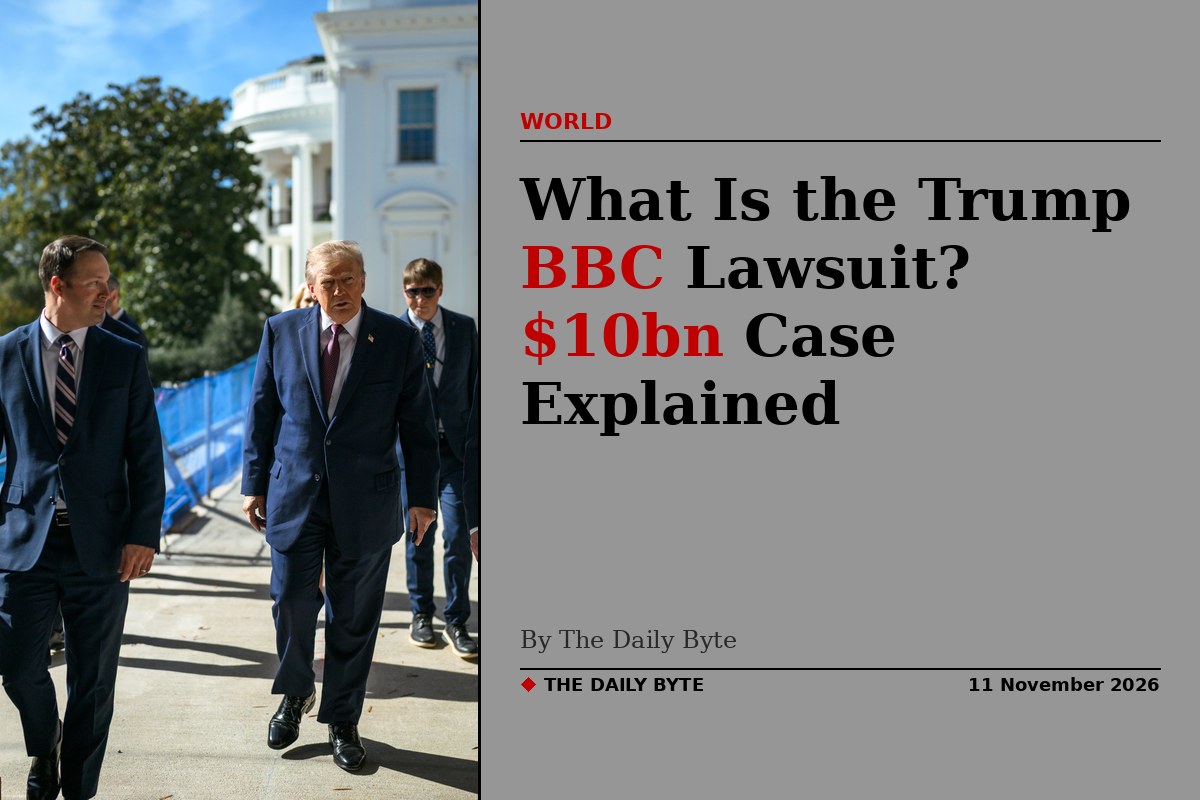
The Trump BBC lawsuit is Donald Trump's $10 billion defamation claim against the BBC over a misleadingly edited clip of his 6 January 2021 speech in a BBC Panorama documentary. On 10 November 2026, a federal judge in Florida refused to dismiss the defamation claim, so the case will proceed, although the ruling does not find that the BBC defamed Mr Trump or that he is owed any money. The BBC must now file its formal answer to the claim by 1 December 2026.
The case matters in both Britain and the United States because it pits a sitting US president against Britain's publicly funded national broadcaster, and because it has already cost the BBC its two most senior leaders. This explainer sets out what the lawsuit is, what the Panorama programme did, what the judge actually decided, and what happens next.
What is the Trump BBC lawsuit?
The lawsuit is President Donald J. Trump v. British Broadcasting Corp., filed in the US District Court for the Southern District of Florida. Mr Trump first sued in December 2025, and the amended complaint seeks $10 billion in damages. The dispute centres on Trump: A Second Chance?, an episode of the BBC's Panorama programme broadcast on 28 October 2024, a week before the US presidential election, which Mr Trump went on to win.
Mr Trump alleges that the programme defamed him by splicing together two separate passages from a speech he gave on 6 January 2021, before his supporters marched on the US Capitol in Washington. The two passages were delivered about 55 minutes apart. In the broadcast they were presented in a way that made it appear, Mr Trump says, that he directly urged supporters to storm the Capitol. One passage had him telling supporters to march on the Capitol; the other had him saying they should "fight like hell".
The BBC has admitted that the edit was misleading and has apologised for it, describing it as an "error of judgment" and accepting that the editing gave "the impression of a direct call for violent action". At the same time, the broadcaster denies that the edit amounts to defamation and maintains that there is no legal basis for the claim. That distinction, between an admittedly misleading edit and a legally defamatory one, is at the heart of the case.
Mr Trump is one of several public figures to have sued news organisations in the United States, and the case is one of a series of lawsuits he has brought against media outlets he regards as biased against him since returning to the White House. The BBC case is the most prominent of them in Britain because the defendant is the UK's national broadcaster, funded largely by the licence fee paid by British households.
What did the Panorama programme do?
Panorama is the BBC's long-running current affairs programme. The episode at issue, Trump: A Second Chance?, examined Mr Trump's political comeback ahead of the 2024 election. In a 12-second segment, the programme used two sections of his 6 January 2021 speech in Washington and joined them together so that they appeared to form a single continuous statement.
The problem, as the BBC itself later accepted, was that the two sections were not continuous. They came from different points in a long speech, delivered nearly an hour apart, and the edit removed the context that separated them. Critics of the edit also pointed out that the broadcast version omitted a passage in which Mr Trump urged supporters to protest peacefully. The result, Mr Trump argues, was a false impression that he had directly called for the violent attack on the Capitol that followed his speech.
The edit came to wider attention after an internal BBC memo, written by former BBC adviser Michael Prescott, criticised the programme's editing and raised wider concerns about bias in the corporation's coverage. The memo's leak, and the row that followed, led to the resignations of the BBC's director-general and its head of news, as explained below.
It is important to be precise about what is and is not in dispute. Nobody in the case disputes that Mr Trump gave the speech, or that his supporters went on to storm the Capitol on 6 January 2021. The dispute is narrower: whether the BBC's decision to join two distant passages into what looked like one statement was defamatory, and whether Mr Trump can prove that it damaged his reputation and that the BBC acted with the state of mind the law requires.
What did the judge decide on 10 November 2026?
On Tuesday 10 November 2026, US District Judge Jeffrey T. Kuntz issued a 40-page order granting in part and denying in part the BBC's motion to dismiss the case. The BBC had asked the court in August 2026 to throw the case out entirely, arguing that the Florida court had no jurisdiction over it and that the complaint failed to state a valid defamation claim.
The judge rejected the core of that application. He held that Mr Trump had plausibly alleged a defamation claim, including an allegation of reputational harm, and that the Florida court has personal jurisdiction over the BBC. In the ruling, Judge Kuntz wrote that Mr Trump had "plausibly alleged a comprehensive framework of actual malice" over the edit, "along with a long list of circumstantial evidence to support a showing of actual malice".
Actual malice is the key legal test here. Because Mr Trump is a public figure, US defamation law requires him to prove not only that the broadcast was false and damaging, but that the BBC knew it was false or acted with reckless disregard for whether it was false. The judge's ruling means only that Mr Trump has cleared the first hurdle by pleading a case that could, if proved, meet that test. As Judge Kuntz put it, whether Mr Trump can prove his claims and establish damages at a later stage is "left for another day".
The BBC did win on one point. The judge dismissed Mr Trump's second claim, brought under Florida's Deceptive and Unfair Trade Practices Act, holding that the Panorama documentary was editorial content rather than commercial speech, so the consumer-protection law did not apply. The case therefore continues on the defamation claim alone.
| Claim | Judge's decision on 10 November 2026 |
|---|---|
| Count I: defamation | Motion to dismiss denied; the claim proceeds |
| Count II: Florida Deceptive and Unfair Trade Practices Act | Motion to dismiss granted; the claim is dismissed |
| BBC's answer to the defamation claim | Due by 1 December 2026 |
Mr Trump welcomed the ruling, calling it a "huge victory" in a social media post. The BBC has not conceded the case and will now have to file a formal answer admitting or denying each allegation and setting out its defences.
Why did the BBC want the case dismissed?
The BBC first moved to dismiss the lawsuit in March 2026. Its central argument was jurisdictional: the broadcaster argued that the Florida court had no authority over it because the Panorama documentary was not distributed in the United States. The BBC also argued that the complaint failed to state a valid defamation claim and that allowing the case to proceed would have a "chilling effect" on robust reporting about public figures and events.
Judge Kuntz rejected both arguments at this stage. He found that the court does have personal jurisdiction over the BBC and that the complaint plausibly alleges defamation. The judge also addressed the nature of the edit itself, holding that a spliced sentence that was never spoken as a single statement is a statement of fact, not protected opinion. That finding matters because opinion is far more strongly protected under US free-speech law than a false statement of fact.
Judge Kuntz is a former Florida appeals judge who was nominated to the federal bench by Mr Trump and confirmed by the US Senate by 51 votes to 46, a fact the BBC itself reported when he took over the case in August 2026. The case had previously been assigned to a different judge, Judge Roy Altman, before being reassigned to Judge Kuntz.
What happened to the BBC's leadership?
The Panorama edit has already had major consequences inside the BBC, separate from anything a court decides. On 9 November 2026, the day before Judge Kuntz's ruling, the BBC's director-general, Tim Davie, and the chief executive of BBC News, Deborah Turness, both resigned over the row. Mr Davie, 58, had led the corporation since September 2020, and Ms Turness had run BBC News and Current Affairs since 2022. It was the first time the BBC's two most senior leaders had stepped down on the same day.
Their resignations followed weeks of mounting pressure after the leak of the Prescott memo, which alleged serious and systemic editorial failings at the BBC, including the misleading Trump edit and wider concerns about bias in coverage of Israel and Gaza. BBC chairman Samir Shah described Mr Davie's departure as a "sad day for the BBC". Mr Davie said he was stepping down after reflecting on the intense personal and professional demands of the role.
The resignations came at a sensitive moment for the BBC, which is preparing for negotiations with the government over its next Royal Charter, the agreement that determines how the corporation is funded and regulated. The current charter is due to expire at the end of 2027.
What happens next in the Trump BBC lawsuit?
The next steps are procedural, and the case still has a long way to run. The BBC must file its answer to the surviving defamation claim by 1 December 2026. After that, the case will move into discovery, the pre-trial process in which each side obtains evidence from the other, including documents and witness testimony.
One early test will fall on Mr Trump himself. A magistrate judge has ordered him to sit for a sworn deposition, a formal recorded interview under oath, by 11 December 2026, and has warned of sanctions if he does not, which could include dismissal of his own case. His lawyers had previously cancelled a deposition date in October, which is why the order was made.
A two-week trial has been provisionally scheduled for February 2027, with Mr Trump having requested a jury trial. That date is provisional: pre-trial disputes, further applications and the pace of discovery can all move it. At trial, Mr Trump would have to prove the defamatory meaning of the edit, its falsity, actual malice on the BBC's part, and the damages he claims. The 10 November ruling decided none of those questions; it decided only that he is entitled to try.
| Date | What happened |
|---|---|
| 6 January 2021 | Mr Trump gives the speech in Washington before supporters storm the US Capitol |
| 28 October 2024 | Panorama broadcasts Trump: A Second Chance? with the spliced clip |
| December 2025 | Mr Trump files the defamation lawsuit in Florida |
| March 2026 | The BBC first moves to dismiss the case |
| August 2026 | The case is reassigned to Judge Jeffrey T. Kuntz; the BBC's dismissal motion is filed |
| 9 November 2026 | BBC director-general Tim Davie and BBC News chief Deborah Turness resign |
| 10 November 2026 | Judge Kuntz refuses to dismiss the defamation claim; dismisses the trade-practices claim |
| 1 December 2026 | Deadline for the BBC to file its answer |
| 11 December 2026 | Deadline for Mr Trump to sit for a sworn deposition |
| February 2027 | Two-week jury trial provisionally scheduled |
Frequently asked questions
Has the BBC been found guilty of defamation? No. The 10 November 2026 ruling decided only that Mr Trump's claim is plausible enough to proceed. No court has found that the BBC defamed him, and no damages have been awarded.
How much money is Mr Trump seeking? The amended complaint seeks $10 billion in damages. That is the amount claimed, not an amount awarded, and Mr Trump would have to prove his losses at trial.
Did the BBC admit the edit was wrong? Yes. The BBC apologised for the edit, called it an "error of judgment" and accepted that it gave "the impression of a direct call for violent action". It denies, however, that the edit amounts to defamation under the law.
When will the case be decided? A two-week trial is provisionally scheduled for February 2027, but that date may move. Before then, the BBC must answer the claim by 1 December 2026 and Mr Trump must give a deposition by 11 December 2026.
Sources: Reuters, "US judge says Trump's $10 billion BBC defamation case can proceed", 10 November 2026; Merito News, "Trump's BBC defamation case allowed to proceed in Florida", 11 November 2026.


