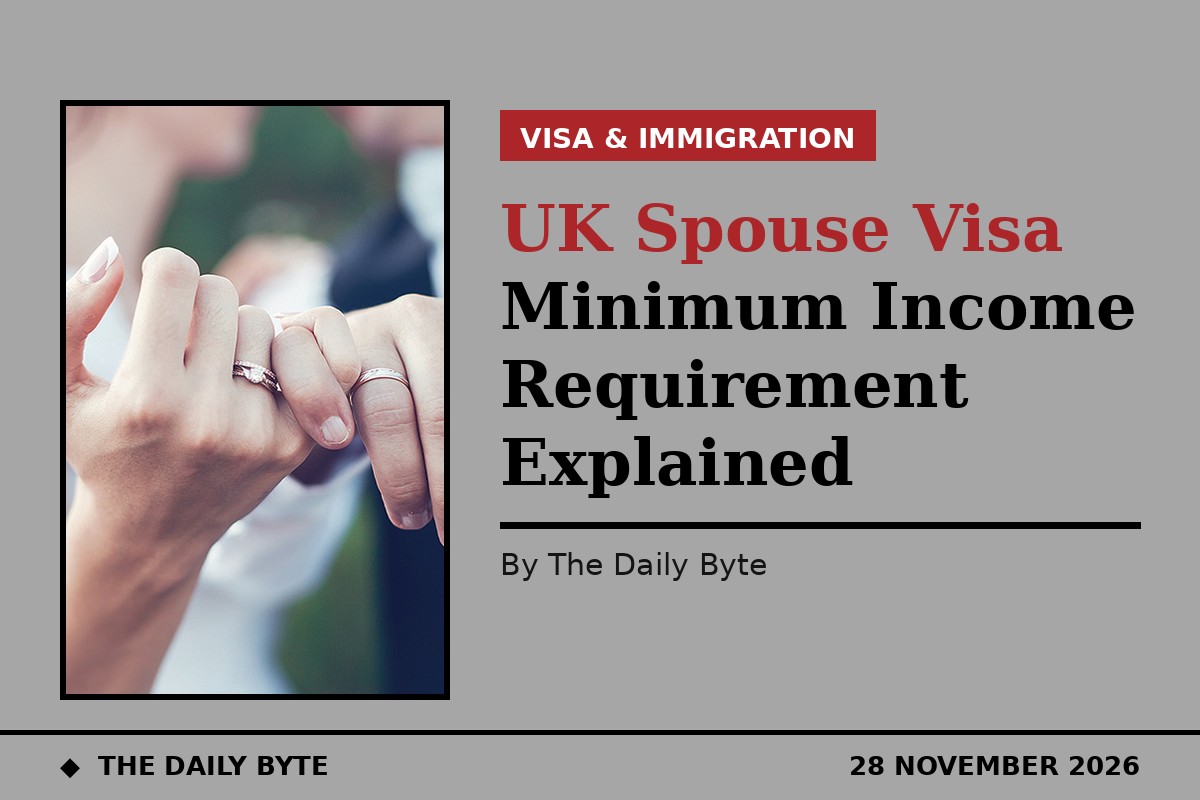
UK Spouse Visa Minimum Income Requirement Explained
The UK spouse visa minimum income requirement is £29,000 a year for most people applying for the first time on or after 11 April 2024. You and your partner must usually show a combined gross annual income of at least £29,000, or enough cash savings to cover any shortfall, using only the income sources and evidence the Immigration Rules allow. This guide explains who the £29,000 figure applies to, what counts towards it, how savings work, and what happens if you cannot meet it. It is general information, not personal immigration advice: immigration rules change, so always check the official GOV.UK page linked below before you apply.
The minimum income requirement is the financial test for most partner visas under Appendix FM of the Immigration Rules. It applies when a person applies to join, or remain with, a partner who is British or settled in the UK. The idea behind the rule is that the couple can support themselves without relying on public funds. The test is strict in form: the Home Office accepts only specified sources of income, and only evidence in the exact format set out in Appendix FM-SE, the specified-evidence appendix to the Rules. Couples who earn comfortably above the threshold can still be refused if their documents do not match the format the Rules require, which is why the evidence rules matter as much as the headline figure.
Who has to meet the £29,000 figure?
The figure that applies depends on when the applicant first entered the partner route. For a first application as a partner on or after 11 April 2024, the gross annual income needed is £29,000. That covers people applying from outside the UK to join a partner, and people already in the UK applying to stay with a new partner. There are no extra amounts for children under the £29,000 threshold: unlike the old rules, the current figure does not rise if the couple have children. A lower, transitional figure applies to people who first applied as a partner before 11 April 2024 and are now extending their visa with the same partner. They must show a combined income of at least £18,600 a year, plus £3,800 a year for the first child and £2,400 a year for each further child, capped at £29,000 in total. Partners of serving members of HM Armed Forces face a different threshold under the armed forces rules: £23,496 for new applications made on or after 11 April 2024.
| Situation | Gross annual income needed |
|---|---|
| First partner application on or after 11 April 2024 | £29,000, no extra for children |
| Extending with the same partner, first applied before 11 April 2024 | £18,600, plus £3,800 first child, £2,400 each further child, capped at £29,000 |
| Partner of a serving member of HM Armed Forces | £23,496 |
| Partner receiving a specified disability or carer's benefit | Adequate maintenance test instead (see below) |
The £29,000 figure replaced the old £18,600 threshold on 11 April 2024. The government had announced a staged plan to raise it further, to £34,500 and then £38,700, but those rises were shelved and never took effect. In June 2025 the Migration Advisory Committee, the independent body that advises the government on migration, published its review of the family visa financial requirements, and the threshold in the Rules remains £29,000. Any future change would come through a change to the Immigration Rules, not overnight, but applicants should still plan against the current wording of Appendix FM and check GOV.UK before applying.
What counts as income?
Only the sources listed in the Rules count, and the couple's combined income is what matters. The applicant's own employment income counts only if they are already in the UK and working legally; income from a job outside the UK does not count towards the requirement. GOV.UK lists the following as income that can count: income from employment before tax and National Insurance, evidenced by a P60 or payslips, where only income earned in the UK can be used; income from self-employment or as a director of a limited company in the UK, shown on a Self Assessment tax return; cash savings above £16,000; money from a pension; and non-work income such as property rentals or dividends. The Home Office's caseworker guidance groups the permitted sources into seven categories. Category A covers salaried or non-salaried employment held for six months or more with the current employer, where the lowest payslip in the six months sets the annualised figure. Category B covers employment held for less than six months, or a 12-month test where income varies. Category C covers non-employment income such as rent, dividends and interest. Categories D, E, F and G cover pensions, self-employment and company directorships, with self-employed sponsors generally using the last full tax year, or the average of the last two years. What does not count is equally important: loans do not count, and benefits such as Universal Credit, Child Benefit and tax credits do not count as income for this test.
How do cash savings work?
Cash savings can cover a shortfall in income, or replace income entirely, but only savings above £16,000 count, and the amount above £16,000 is divided by 2.5 at the visa stage. The formula is: (savings minus £16,000) divided by 2.5 equals the income the savings can provide. The division by 2.5 reflects the 2.5-year length of the visa granted. To meet the £29,000 requirement from savings alone, a couple would need £88,500 in savings: £16,000 plus 2.5 times £29,000. Under the old £18,600 threshold the savings-only figure was £62,500. The savings must have been held for at least six months before the application, and they must be immediately available to the couple, in an account they control. Worked examples make the arithmetic concrete. A couple with £24,000 of income and £36,000 of savings held for six months can count (£36,000 minus £16,000) divided by 2.5, which is £8,000, giving a total of £32,000 and meeting the requirement. A couple with no qualifying income and £50,000 of savings can count (£50,000 minus £16,000) divided by 2.5, which is £13,600, and would fall short. Savings and income can also be combined in other proportions, but every pound of savings used must be evidenced with bank statements covering the six-month period, and the Home Office checks the source of the savings as well as the balance.
What if your partner receives disability or carer's benefits?
You do not need to meet the minimum income requirement if your partner receives one of a list of specified disability or carer's benefits. The list includes Personal Independence Payment, Carer's Allowance, Attendance Allowance, Disability Living Allowance, Severe Disablement Allowance, Industrial Injuries Disablement Benefit, and certain other disability and carer benefits. Instead of the £29,000 test, the couple must meet an "adequate maintenance" test: they need to show that they and their family have enough money to house and support themselves without relying on additional public funds. The caseworker looks at the couple's income after housing costs, and considers their income and housing costs together, rather than applying a fixed figure. This is a genuinely different test, not a lower threshold, and it still needs evidence: proof of the benefit, proof of income, and proof of housing costs such as rent or a mortgage. The full list of qualifying benefits is on the GOV.UK family visa page, and it is worth checking the current list there because benefit names and eligibility change.
What evidence do you need?
Evidence is where most spouse visa applications succeed or fail, so the Rules are precise about it. If you or your partner are employed, you will typically need bank statements showing the income, six months of payslips counting back from the day you apply, and a letter from the employer, dated and on headed paper, confirming what you earn before tax and National Insurance, how long you have been paid at that rate, and that the payslips are genuine. If either of you is self-employed, you will need to base the income on the last full tax year, or the average of the last two, evidenced with Self Assessment tax returns, SA302 tax calculations, tax year overviews, business bank statements and accounts. Pension income needs the pension award letter and bank statements showing the payments. Rental income needs the tenancy agreement and bank statements showing the rent received. Cash savings need bank statements covering at least six months, showing the money held throughout. Every document must cover the right dates, be in the right format, and be in English or Welsh, or accompanied by a certified translation. The Home Office will tell you exactly which documents to provide when you apply online, but it is the applicant's responsibility to make sure the evidence matches Appendix FM-SE. A single missing payslip or a bank statement that ends a week too early can be enough for a refusal.
What else does a spouse visa application require?
Money is only one part of a partner visa application. Both partners must be 18 or over, and the relationship must be genuine: a marriage or civil partnership recognised in the UK, or a relationship in which the couple have lived together for at least two years. The couple must intend to live together permanently in the UK after the application. The applicant must also prove knowledge of English, at least at level A1 of the Common European Framework of Reference for Languages for a first application, speaking and listening. A fiancé, fiancée or proposed civil partner must show that the couple plan to marry or enter into a civil partnership in the UK within six months of arriving, and that any previous marriages or civil partnerships have ended. If the application is approved, a partner visa usually allows the holder to stay in the UK for up to 2 years and 9 months, with the right to work or study. The financial requirement is then tested again when the visa is extended, and again when the applicant applies for indefinite leave to remain, so the £29,000 figure is not a one-off hurdle but a test that recurs at each stage of the five-year route to settlement.
What happens if you cannot meet the financial requirements?
If you cannot meet the financial requirements, you may still be able to apply, but on a different basis. GOV.UK explains that applicants who do not meet the requirement may still be able to apply for a visa or extend their stay if there are exceptional circumstances, for example where refusing the application would breach the right to respect for private and family life. In that case the applicant is normally placed on the 10-year route to settlement, rather than the five-year route, and the earliest they can apply to settle is after 10 years in the UK. That is a materially longer and more expensive path, with more applications and more fees along the way, so it is not a shortcut around the income test. Applicants in this position should get regulated immigration advice before applying, because the exceptional-circumstances argument is fact-specific and the evidence needed is different from the standard financial-requirement evidence. There is also a separate question for couples where the British or settled partner earns the required income but the evidence is not in the specified format: in most cases the Home Office will not overlook a formatting failure, which is why checking the evidence rules in Appendix FM-SE before applying matters so much.
Check the official rules before you apply
Immigration rules change, and the figures in this guide are the position as published on GOV.UK on 28 November 2026. The authoritative source is the GOV.UK family visa guide, "Financial requirements if you're applying as a partner or spouse", which states the £29,000 figure, the transitional £18,600 figure, the adequate maintenance test and the evidence requirements. The Immigration Rules themselves, Appendix FM and Appendix FM-SE, set out the law in full, and the Home Office's caseworker guidance explains how decision-makers apply it. Before you apply, check the GOV.UK page, confirm the current fee and the Immigration Health Surcharge, and check whether anything has changed since this article was published. This article is general information about how the rules work. It is not personal immigration advice, and it cannot tell you whether your own circumstances meet the requirement. If your case involves savings held overseas, self-employment income, a recent change of employer, or a partner receiving benefits, consider speaking to a regulated immigration adviser.
Frequently asked questions
Q: What is the UK spouse visa minimum income requirement in 2026? A: £29,000 a year in combined gross income for most people applying for the first time on or after 11 April 2024. There are no extra amounts for children under this threshold.
Q: Can cash savings meet the spouse visa income requirement? A: Yes. Only savings above £16,000 count, and the amount above £16,000 is divided by 2.5. Savings alone must total £88,500 to meet the £29,000 requirement, and the savings must have been held for at least six months.
Q: What income counts towards the £29,000? A: Employment income earned in the UK, self-employment and company director income, pensions, rental income, dividends and interest, and cash savings above £16,000. Loans, Universal Credit, Child Benefit and tax credits do not count. The applicant's overseas employment income does not count.
Q: What if we applied as partners before 11 April 2024? A: If you first applied before 11 April 2024 and are extending with the same partner, the transitional threshold of £18,600 a year applies, plus £3,800 for the first child and £2,400 for each further child, capped at £29,000.
Q: Does the requirement apply again when I extend my visa? A: Yes. The financial requirement is tested again at every extension and again when you apply for indefinite leave to remain, so you need to meet it at each stage, not just the first time.