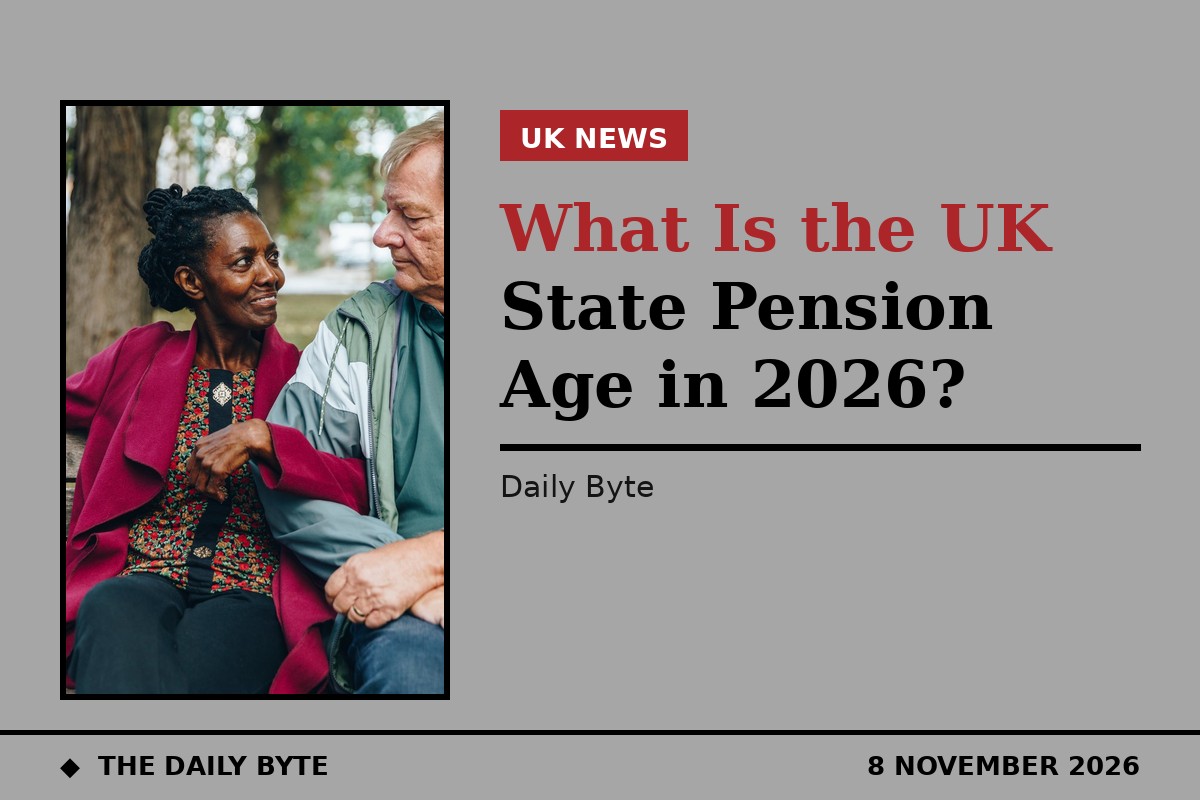
What Is the UK State Pension Age in 2026?
The UK State Pension age in 2026 is 66 for people born before 6 April 1960, and it is rising in stages to 67 for everyone born on or after that date. The change is being phased in month by month between 2026 and 2028 under the Pensions Act 2014, so your exact State Pension age depends on your date of birth. Anyone born on or after 6 March 1961 has a State Pension age of 67. You can confirm your own date with the GOV.UK State Pension age checker, which asks for your date of birth.
State Pension age is the earliest age at which you can start receiving your State Pension. It is the same for men and women. It is not the same as retiring: you can stop work before or after State Pension age, and it is not the same as the age at which you can access a private or workplace pension, which is currently 55 and rises to 57 from 6 April 2028.
State Pension age by date of birth
The timetable published by the Department for Work and Pensions (DWP) sets out the current law. If you were born between 6 October 1954 and 5 April 1960, your State Pension age is your 66th birthday. If you were born between 6 April 1960 and 5 March 1961, your State Pension age is 66 plus a set number of months, rising with your date of birth. If you were born between 6 March 1961 and 5 April 1977, your State Pension age is 67.
The phasing works month by month. Someone born between 6 April and 5 May 1960 has a State Pension age of 66 years and one month, and each following month of birth adds another month, up to 66 years and 11 months for people born between 6 February and 5 March 1961. The first people affected reached their State Pension age on 6 May 2026, and the whole transition to 67 is complete by March 2028, when the first people born on or after 6 March 1961 reach 67.
There is a further rise already in law. For people born from 6 April 1977, the State Pension age is legislated to rise again to 68, between 2044 and 2046. That timetable has not changed, although it is subject to periodic government review.
How much is the State Pension in 2026/27?
The full new State Pension is £241.30 a week in 2026/27, which is £12,547.60 a year. That is the amount for people who reached State Pension age on or after 6 April 2016 with a full National Insurance record; what you actually get depends on your own National Insurance record, so the figure is a maximum rather than a guarantee for everyone.
The State Pension is uprated each year under the triple lock, which means it rises by the highest of earnings growth, price inflation or 2.5%. The 2026/27 rate rose by 4.8% under that guarantee. If you want to know what you are on track to receive, the GOV.UK State Pension forecast service shows your projected amount and whether you have gaps in your National Insurance record.
How do I check my exact State Pension age?
The quickest way is the GOV.UK State Pension age checker, which gives a personalised date from your date of birth. The checker also shows your Pension Credit qualifying age, which moves with your State Pension age. The State Pension forecast service, also on GOV.UK, shows when you can get your State Pension, how much you could get and whether you can increase it, and you may need photo ID to prove your identity when you use it.
It is worth checking rather than guessing, because the month-by-month phasing means two people born a few weeks apart can have State Pension ages a month apart, and a few birth dates fall on days that do not exist in the target month, so the timetable fixes those cases individually. For example, someone born on 31 July 1960 reaches State Pension age on 30 November 2026.
Do I get my State Pension automatically?
No. The State Pension is not paid automatically, so you need to claim it. The DWP sends an invitation letter as you approach State Pension age, and you can claim online, by phone or by post. You can also choose to delay, or defer, claiming: your payments start after you reach State Pension age, and deferring can increase the amount you eventually receive.
Reaching State Pension age does not mean you have to stop working. You can keep working and claim your State Pension, or keep working and defer it. What matters is the date, not your employment status.
What else changes when State Pension age rises?
Several other entitlements move with State Pension age. Pension Credit, the benefit for people on a low income in retirement, has a qualifying age tied to State Pension age, so it rises too. The DWP has also confirmed that eligibility for a free bus pass in England moves with State Pension age, which means people born after 6 April 1960 wait longer for their pass as well as for their pension.
That is why the rise matters beyond the pension itself. A delay of a few months changes when other support starts, and for people born in the phased group the wait is measured in months, not years: at the 2026/27 full rate of £241.30 a week, each month of delay is worth roughly £1,046 of pension.
Will the State Pension age rise to 68?
A rise to 68 is already legislated for 2044 to 2046, affecting people born from 6 April 1977. Whether that timetable stays as it is, or changes, is under review. The government launched the third review of State Pension age on 21 July 2025, as the Pensions Act 2014 requires a review every six years, and the review is led by Dr Suzy Morrissey. A government decision is expected by March 2029.
The debate is live. A House of Commons Work and Pensions Committee report published on 11 July 2026 questioned whether the increase to 67 is fair, and the review is examining whether future rises should be linked automatically to life expectancy. As of now, no change to the legislated timetable has been announced, and the rise to 68 remains set for 2044 to 2046. Anyone planning retirement should check GOV.UK for the latest position, because the timetable can change after a review.
Frequently asked questions
I was born in 1960. What is my State Pension age? It depends on your birth month. If you were born before 6 April 1960, it is 66. If you were born between 6 April 1960 and 5 March 1961, it is 66 plus between one and eleven months, rising with your birth month. If you were born on or after 6 March 1961, it is 67.
Can I take my State Pension early? No. You cannot claim the State Pension before you reach State Pension age. You can, however, choose to defer it and claim later.
Does the rise affect my workplace pension? No. Workplace and private pensions are separate. You can normally access those from age 55, rising to 57 from 6 April 2028, regardless of your State Pension age.
Where do I check my date? Use the GOV.UK State Pension age checker for your exact date, and the GOV.UK State Pension forecast for how much you are on track to receive.