What Is Trident? UK Nuclear Deterrent Explained
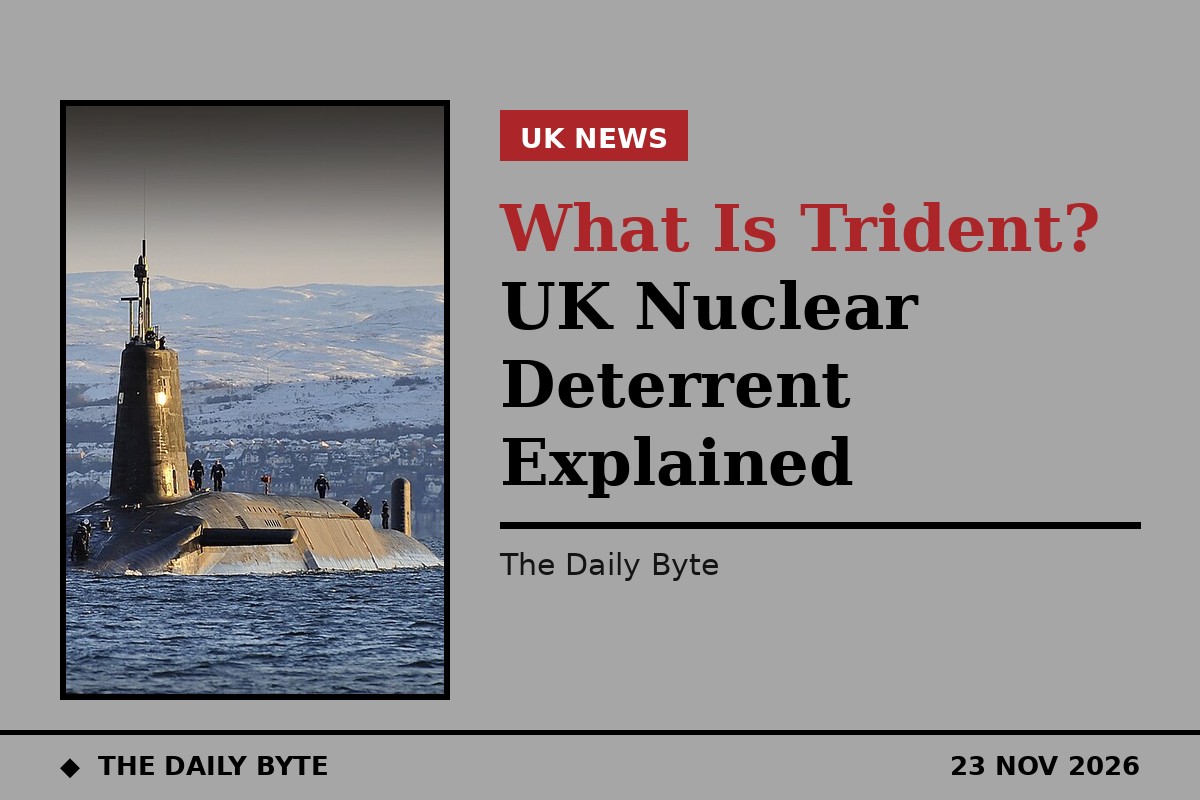
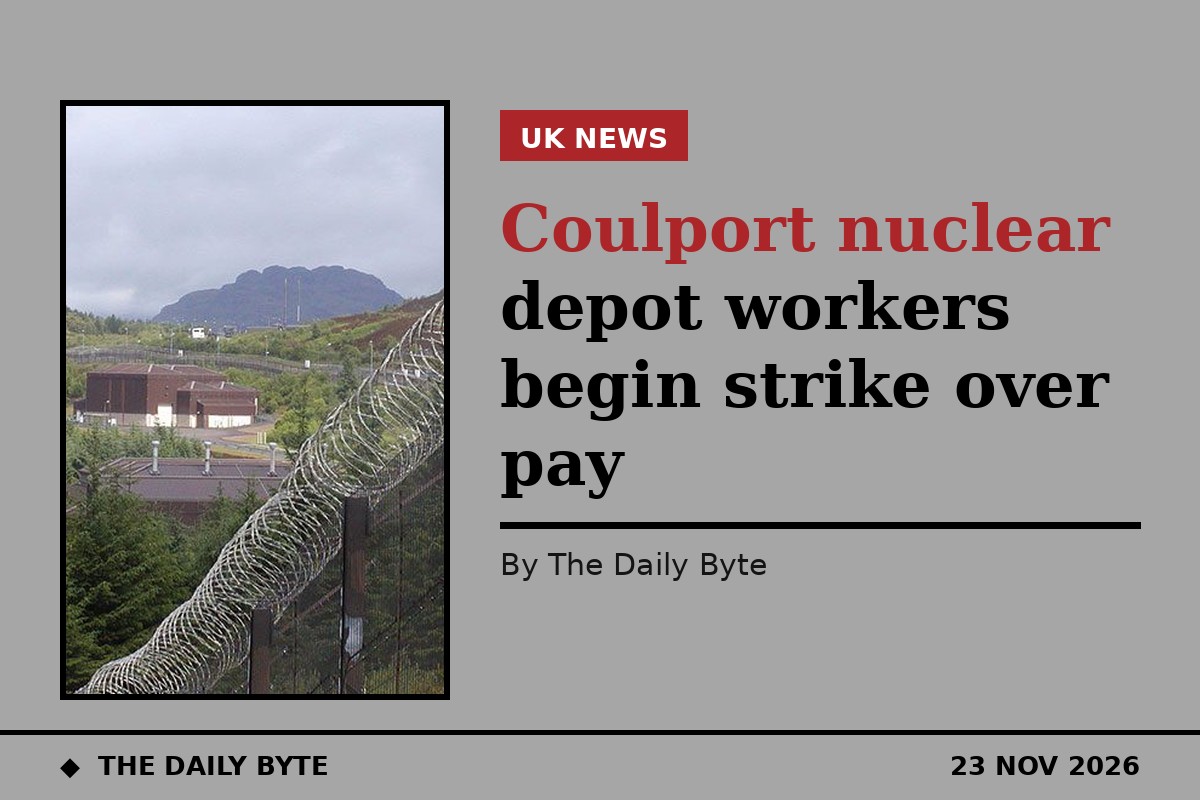
Trident is the UK's nuclear deterrent. It is the system of four Royal Navy Vanguard-class submarines armed with Trident II D5 ballistic missiles, kept on patrol so that at least one submarine is always at sea. Its stated purpose, according to the Ministry of Defence, is to deter the most extreme threats to the UK's national security. The question is back in the news on 23 November 2026 because workers at the Coulport depot that supports the system have begun strike action in a pay dispute.
Trident is often talked about as if it were a single weapon. In fact it has three parts: the submarines, the missiles and the warheads, plus the shore bases that support them. The House of Commons Library briefing on replacing Trident sets out how the three parts fit together, and the Royal Navy operates the system from HM Naval Base Clyde on the west coast of Scotland.
What are the four Vanguard submarines?
The four boats are HMS Vanguard, HMS Victorious, HMS Vigilant and HMS Vengeance. They are nuclear-powered ballistic missile submarines, known as SSBNs, and they entered service between December 1994 and February 2001. Each submarine can carry up to 16 Trident missiles. Trident patrols began in 1994 and the system fully replaced the earlier Polaris submarine fleet in 1996.
The submarines are based at Faslane, on the Gare Loch near Helensburgh. The nuclear warheads are stored, processed and fitted to the missiles at the Royal Naval Armaments Depot at Coulport, a few miles away. Warhead production and maintenance is carried out by the Atomic Weapons Establishment at Aldermaston and Burghfield in Berkshire.
What is continuous at-sea deterrence?
Continuous at-sea deterrence, often shortened to CASD, means that at least one of the four submarines is always on patrol, a routine the Royal Navy calls Operation Relentless. While one boat is at sea, the others are typically in port, on training or undergoing maintenance. The idea is that the deterrent is always available and cannot be wiped out in a single surprise attack, and that the UK does not have to send a submarine to sea in a crisis, which could itself be read as an escalation.
The missiles are not aimed at specific targets while on patrol. They are held at several days' notice to fire, with target coordinates programmed in if the Prime Minister ever ordered a launch. The decision to fire a Trident missile would be a political decision taken by the Prime Minister, not by the submarine's commanding officer acting alone.
Where do the missiles and warheads come from?
The Trident II D5 missile is made in the United States by Lockheed Martin. The UK holds title to 58 missile bodies, which are held in a communal pool at the Strategic Weapons Facility at Kings Bay in Georgia, USA. The warheads themselves are designed and manufactured in the UK by the Atomic Weapons Establishment. This arrangement is why Trident is sometimes described as an independent deterrent that still depends on American missiles and on cooperation with the United States.
What is the Dreadnought replacement?
The Vanguard submarines were designed for a service life of about 25 years, but they are now serving well beyond that. In July 2016 the House of Commons voted by a large majority to build a new fleet of four Dreadnought-class submarines to replace them. The Dreadnought boats will carry the same Trident II D5 missile, which is being kept in service under a US life-extension programme until the early 2040s. The replacement programme is about the submarines, not a new missile.
Why is Trident in the news on 23 November 2026?
Around 70 workers at the Royal Naval Armaments Depot at Coulport, employed by AWE plc, Babcock Marine and Lockheed Martin through the ABL Alliance, have begun strike action after rejecting a pay offer, according to Unite the Union. AWE workers are striking on 23 November, Lockheed Martin members on 24 November and Babcock Marine members on 26 November, with further action planned for 30 November, 1 December and 3 December. An overtime ban and work to contracted hours has been in place since 9 November. Unite says the workers provide care and maintenance for the weapons systems on the submarine fleet and has warned the action could affect the UK's nuclear and defence response capabilities. The strike is a pay dispute with the ABL Alliance employers, not a dispute about the deterrent itself.
Frequently asked questions
Is Trident a single missile? No. Trident is the name for the whole UK nuclear deterrent system: four Vanguard-class submarines, Trident II D5 missiles and British-built warheads, supported by the Faslane and Coulport bases.
How many submarines does the UK have for Trident? Four: HMS Vanguard, HMS Victorious, HMS Vigilant and HMS Vengeance. At least one is always on patrol.
Where is Trident based? At HM Naval Base Clyde in western Scotland. The submarines are based at Faslane and the warheads are handled at Coulport.
What is replacing Trident? The Vanguard submarines are being replaced by four new Dreadnought-class submarines, approved by Parliament in 2016. The Trident II D5 missile is being kept in service.
Does the Coulport strike stop the deterrent? The strike involves around 70 maintenance and support workers in a pay dispute. Unite has warned it could affect response capabilities, but the submarine on patrol at sea is not directly affected by shore-based industrial action.