When activism becomes a crime: Mahrang Baloch and the cost of speaking up.
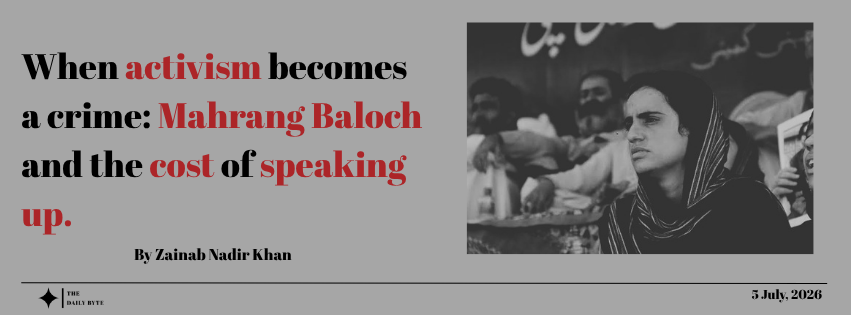
Who is Mahrang?
Mahrang baloch, a trained medical doctor turned to a full time human rights activist who campaigns against enforced disappearances and extrajudicial killings in Balochistan. She is the organizer of the Baloch Yakjehti Committee (BYC) and was internationally recognized as one of the BBC 100 Women in 2024. Her entry into human rights activism did not start in protest tents or on social media. It started with loss, after the enforced disappearance and killing of her father, Abdul Qadir Baloch, in 2009. He was allegedly detained by security forces and later found dead. For her family and for many in Balochistan, it was not an isolated case. "Enforced disappearances" have been a recurring grievance raised by Baloch rights groups for over two decades.
Mahrang’s journey gained national and international attention because of the following main factors;
a) She centred women and families. Unlike older male-dominated narratives, Baloch Yakjehti committee mobilizations under her leadership put mothers, sisters and wives at the front. The 2023-2024 Islamabad long march of Baloch families, which she helped lead became one of the most visible campaigns on the issue in years. For many, it was the first time they spoke publicly, faced media, and addressed crowds.
b) She has repeatedly framed the movement as constitutional and human rights-based, citing Pakistan's own laws and international human rights commitments. Her protests have always been non-violent and rights based instead of being party based.
c) As a young, educated woman from Balochistan, she challenged stereotypes about who leads political movements in the province and became inspiration for many women to get educated in a province like Balochistan.
d) Mahrang also brought children into the narrative, not as participants in protests but as the reason for them. In rallies and interviews, she highlighted kids who grew up without fathers, brothers or uncles and students whose education was disrupted by fear and insecurity.
Balochistan’s loudest voice is now in custody.
What speaking up for rights costed Mahrang:
Her activism has led to repeated detentions, police action and FIRs. She was arrested on March 22, 2025, by police in Quetta during a peaceful sit-in protest against security force violations and enforced disappearances.
Sentenced to life imprisonment:
In June 2026, Dr. Mahrang Baloch and BYC leader Sibghitullah Shahjee were sentenced to life imprisonment by an Anti-Terrorism Court in Quetta.
These charges are politically motivated. The state is using accusations of incitement and terrorism to imprison Baloch protesters and silence their voices, rather than address the underlying grievances. Baloch activists and their supporters say these cases are an attempt to prevent both international media and people across Pakistan from learning about the cruelty of the state and the reality of enforced disappearances in Balochistan. Sentencing Mahrang and baloch protestors is less about the July
2024 Gwadar protest and more about shutting down a movement that has made missing persons and state accountability a national conversation.
Mahrang; A hope for Balochs.
Beyond organizing protests, Mahrang Baloch gave a voice to a province that has suffered for decades at the hands of the state. Balochistan, long marked by conflict, neglect and silence, found in her someone who spoke not only as a daughter seeking justice for her father but for every family that lost husbands, sons, fathers and brothers. She turned individual grief into collective courage.
By bringing women and children to the forefront, she changed the mentality of the province itself, replacing fear with hope and silence with speech. In doing so, she gave people who had been told to stay quiet for years the confidence to stand up, to demand answers and to believe that change in Balochistan is possible.
The price of speaking up:
The same story repeats across Pakistan, people who step forward to defend human rights or advocate for their communities are answered with cruelty. Activists like Dr. Mahrang Baloch find themselves facing terrorism charges, prolonged detention and trials under anti-terror laws, not for violence they committed but for the act of speaking up. When a community demands to know where their missing people are or why their rights are ignored, the state frequently responds by labeling that demand a threat and accuses them of terrorism. In that environment, activism becomes dangerous and the message sent is clear; raising your voice for your people can cost you your freedom.