When Do the Clocks Go Forward in 2027? UK Dates Explained
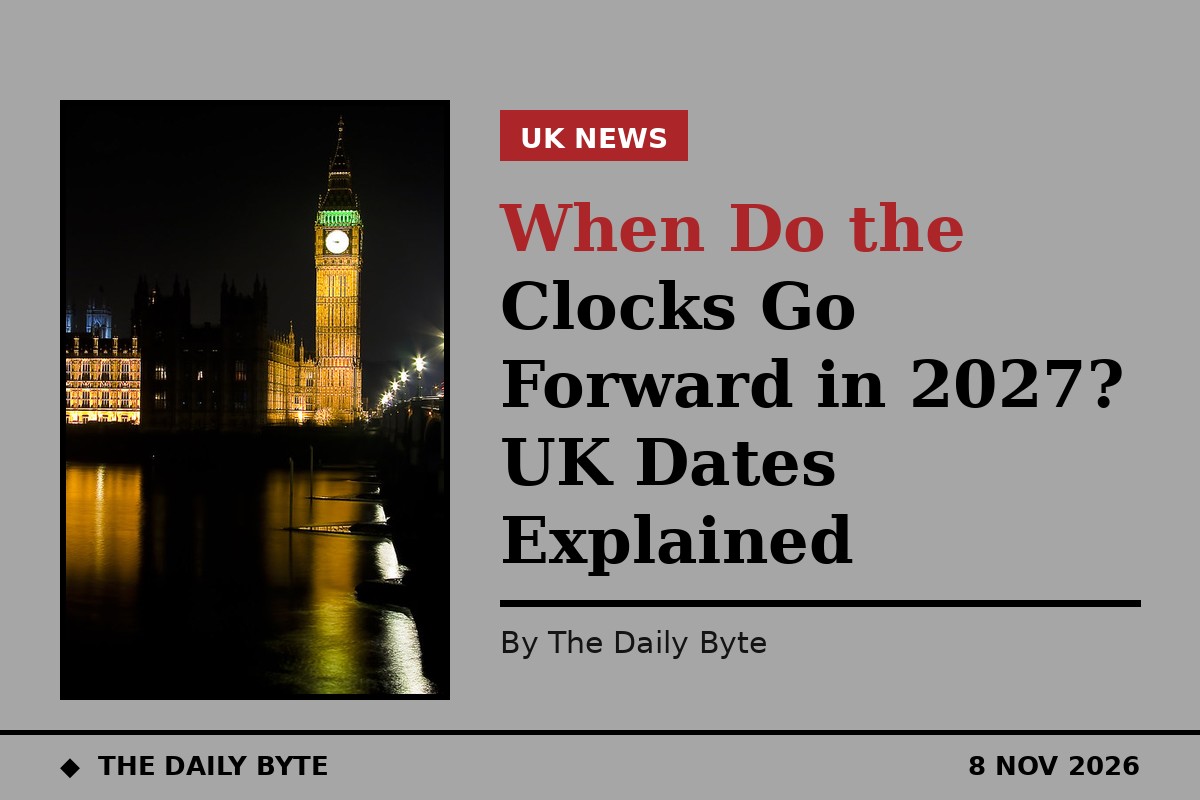
The clocks in the UK go forward on Sunday 28 March 2027. At 1am, the time jumps forward by one hour to 2am, and British Summer Time (BST) begins. The UK then stays one hour ahead of Greenwich Mean Time (GMT) until the clocks go back again on Sunday 31 October 2027.
If you are searching for the date because the clocks have just gone back, the short answer is that the next change is the spring one: Sunday 28 March 2027, at 1am. That is the last Sunday in March, which is the rule the UK follows every year.
When do the clocks change in 2027?
GOV.UK lists the clock-change dates for 2027 as 28 March, when the clocks go forward, and 31 October, when they go back. The pattern is fixed by law: the clocks go forward one hour at 1am on the last Sunday in March, and back one hour at 2am on the last Sunday in October.
In 2027, that means the spring change falls on Sunday 28 March, when 1am becomes 2am, and the autumn change falls on Sunday 31 October, when 2am becomes 1am. The period in between, when the clocks are one hour ahead, is called British Summer Time. When the clocks go back, the UK returns to Greenwich Mean Time.
The dates for the following year are already published too. In 2028, the clocks go forward on Sunday 26 March and back on Sunday 29 October. The 2026 changes, for comparison, were 29 March and 25 October.
What happens when the clocks go forward?
When the clocks go forward, the UK loses an hour. The night of Saturday 27 March into Sunday 28 March 2027 is one hour shorter than usual, because the hour between 1am and 2am does not exist on the clock. Anyone working a night shift that night works one hour less on paper, and anyone travelling in the early hours should check timetables, because trains and flights are scheduled around the change.
The trade-off is lighter evenings. From 28 March, sunset comes about an hour later by the clock than it did the day before, and sunrise is also about an hour later. That is the whole point of the exercise: the change moves an hour of daylight from the early morning, when most people are asleep, to the evening, when people are out and about.
Most connected devices handle the change on their own. Phones, tablets, computers and smart watches update automatically, because they take the time from the network. Clocks that need a manual change include oven clocks, car dashboard clocks, some central-heating timers and older alarm clocks. It is worth checking those on the Saturday evening, or first thing on the Sunday morning, so nothing runs an hour out.
Why do the clocks change?
The UK changes its clocks twice a year to make better use of daylight. In summer, the days are long, so shifting the clocks forward means the extra daylight falls in the evening rather than in the very early morning. In winter, when the days are short, the clocks go back so that mornings are lighter, which matters most for the school run and the morning commute.
The idea was first promoted in Britain by the builder William Willett, who published a pamphlet called The Waste of Daylight in 1907. Willett had noticed that blinds were still drawn in the houses of Petts Wood in Kent on bright summer mornings, and argued that the nation was wasting daylight while it slept. His original proposal was more complicated than the system we have now: he wanted the clocks advanced by 80 minutes in four steps of 20 minutes on successive Sundays in April, and reversed the same way in September.
Parliament rejected his bill several times. It was the First World War that finally made the idea law. With coal in short supply and factories working around the clock, Germany introduced summer time in April 1916 to save fuel, and Britain followed. The Summer Time Act was passed on 17 May 1916, and the clocks went forward for the first time on Sunday 21 May 1916. Willett himself did not live to see it: he died of influenza in 1915, aged 58.
The arrangement was renewed each year and then made permanent in 1925. During the Second World War, Britain went further, introducing double summer time, with clocks two hours ahead of GMT in the summer, to save fuel and make the most of daylight. The modern rules were consolidated in the Summer Time Act 1972, which remains the basis of the system today.
Has the UK ever tried stopping the clock change?
Yes, once. Between 1968 and 1971, Britain experimented with staying on British Summer Time all year round, in an arrangement sometimes called British Standard Time. The experiment ended after a vote in the House of Commons in December 1970, and the clocks went back to the twice-yearly change. Opposition was particularly strong in the north of the UK, where winter mornings would have stayed dark much later.
The debate has never fully gone away. Supporters of permanent summer time argue that lighter evenings could cut evening road accidents and give people more daylight after work. Supporters of the current system point to dark winter mornings, particularly in Scotland and the north of England, and to the disruption a change would cause for businesses that work across time zones.
For now, nothing is changing. The Government confirmed in a written parliamentary answer on 30 October 2026 that it believes the current arrangements represent the best use of the available daylight across the UK, and that it has no plans to introduce single summer time, double summer time or any other change. A House of Commons Library briefing published in March 2026 reached a similar conclusion, noting that the evidence on the effects of daylight saving is mixed and that the original wartime energy-saving argument should not be treated as proof of a straightforward modern saving. The same briefing recorded a 2024 poll in which 46% of people were in favour of British Summer Time and 42% were in favour of ending it.
The European Union has also debated the issue. The European Parliament voted in 2019 in favour of ending seasonal clock changes, but the proposal stalled, and EU member states still change their clocks on the same dates as the UK: forward on the last Sunday in March and back on the last Sunday in October. In 2027, that means the EU also moves forward on 28 March and back on 31 October, at the same moment as the UK.
What should you do before the clocks go forward?
There is very little to do, because the change is automatic for most people. The practical checklist is short: check any manual clocks on the Saturday evening, including the oven, the microwave, the car and the heating timer, and remember that the night is an hour shorter, so an early start on the Sunday may feel harder than usual.
Parents often find that children take a day or two to adjust, and the same is true of anyone with a fixed medication or feeding routine tied to the clock. Shifting bedtime by a few minutes over the days before the change can make the jump easier, but there is no rule that works for everyone, and most people settle within a couple of days.
One thing worth knowing is that the spring change is the one that catches people out. The autumn change gives an extra hour in bed and is easy to welcome. The spring change takes an hour away, and it is the one that produces missed alarms, missed appointments and confusion over meeting times. If you have an early flight, a shift or an appointment on Sunday 28 March 2027, it is worth setting a reminder the night before.
Clocks in the rest of the world
Not every country changes its clocks, and those that do rarely change on the same dates as the UK. The United States and Canada, for example, move their clocks forward on Sunday 14 March 2027 and back on Sunday 7 November 2027, two weeks earlier than the UK in spring and a week later in autumn. That creates a short period each year when the time difference between London and New York is four hours instead of the usual five.
Many countries near the equator do not change their clocks at all, because the length of the day barely varies through the year. Others, including Japan, India and China, do not observe daylight saving. Anyone arranging calls or travel across time zones around the end of March should check the local dates rather than assuming every country moves together.
The key dates
The clocks go forward at 1am on Sunday 28 March 2027, when British Summer Time begins, and they go back at 2am on Sunday 31 October 2027, when the UK returns to Greenwich Mean Time. In 2028, the changes fall on Sunday 26 March and Sunday 29 October. The Government has confirmed there are no plans to change the system, so those dates stand. If you only remember one of them, remember the spring date: Sunday 28 March 2027, when the clocks go forward and the lighter evenings begin.