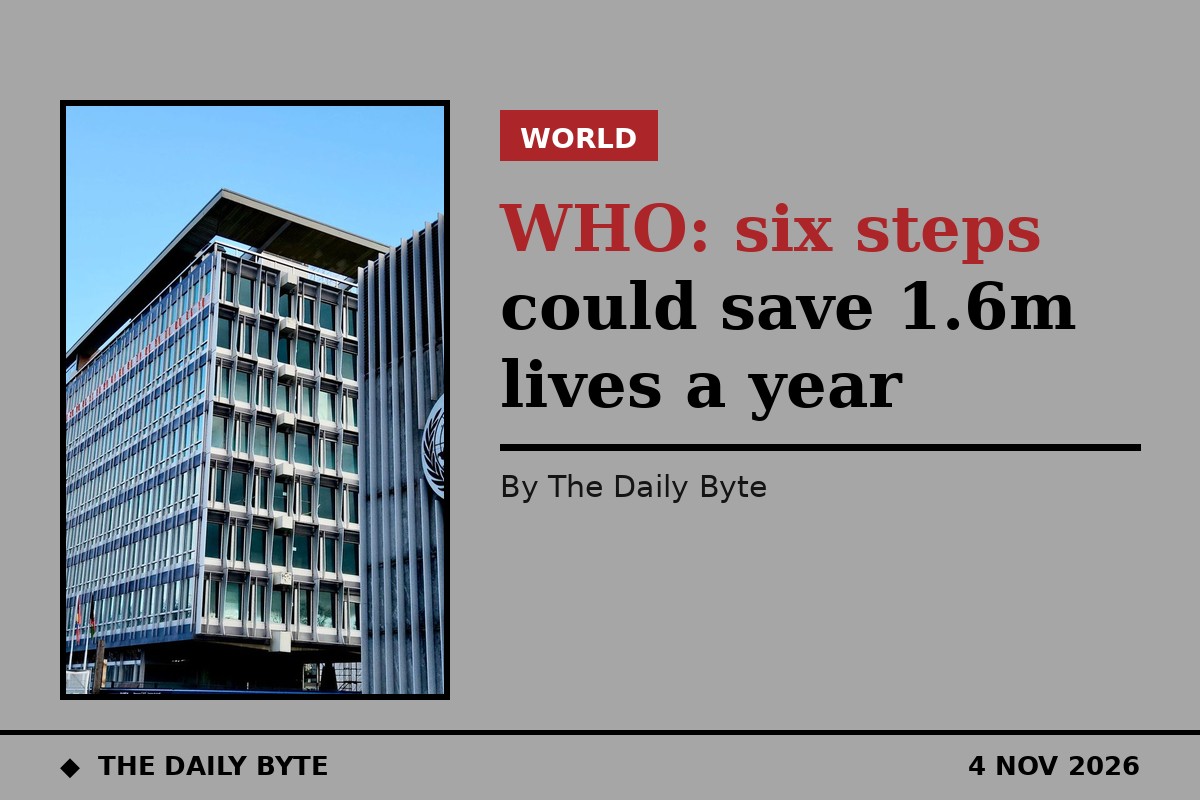
WHO: six steps could save 1.6m lives a year
Six proven climate and health measures could save 1.6 million lives a year, the World Health Organization (WHO) says in a new report released on Wednesday 4 November 2026, ahead of the COP31 climate talks in Antalya, Turkey, from 9 to 20 November. The WHO urges countries to scale up the measures, which it says could also cut emissions and generate trillions of dollars in economic and fiscal benefits.
The six measures
The report, titled Global Benefits and Costs of Prioritized Actions on Climate Change and Health, identifies heat-health warning systems, climate-resilient drinking water services, basic sanitation, hygiene and handwashing facilities, cleaner household fuels and technologies for cooking and heating, and efficient fossil fuel pricing policies. Together, the WHO estimates, the measures could prevent approximately 1.6 million deaths every year, equivalent to one in every 40 deaths on its modelled projections, and avoid 16.7 billion tonnes of carbon dioxide emissions a year, about 31% of global annual greenhouse gas emissions when emissions from land use are excluded.
The money and the biggest lever
The WHO estimates the measures could generate 3.9 trillion dollars a year in economic welfare benefits and a further 5.4 trillion dollars a year in fiscal benefits. Efficient fossil fuel pricing is estimated to deliver the largest share, preventing 1.2 million deaths a year from reduced air pollution, according to UN News, while heat-health warning systems are described as particularly cost-effective, with one estimate putting the return at 835 dollars in benefits for every dollar invested. WHO Director-General Dr Tedros Adhanom Ghebreyesus said many of the health consequences of climate change could be prevented using existing solutions, and urged governments to put health protection at the centre of climate action at COP31.
A modelled estimate, not a counted result
The WHO itself acknowledges that its projections are based on ambitious global implementation scenarios and are subject to data gaps, limitations in the available evidence and uncertainties in long-term estimates. The 1.6 million figure is therefore a modelled estimate of what full global rollout could prevent, not a count of lives already saved, and the rollout timeline and funding sources for that scale of implementation remain unspecified in the reporting.
Sources: UN News, UN News Today 04 November 2026, 4 November 2026; Phys.org, Six measures could save 1.6 million lives a year: WHO, 4 November 2026; The Trumpet, WHO: 6 climate health measures could save 1.6m lives yearly, 4 November 2026.