Why Are Measles Cases Rising in the US?
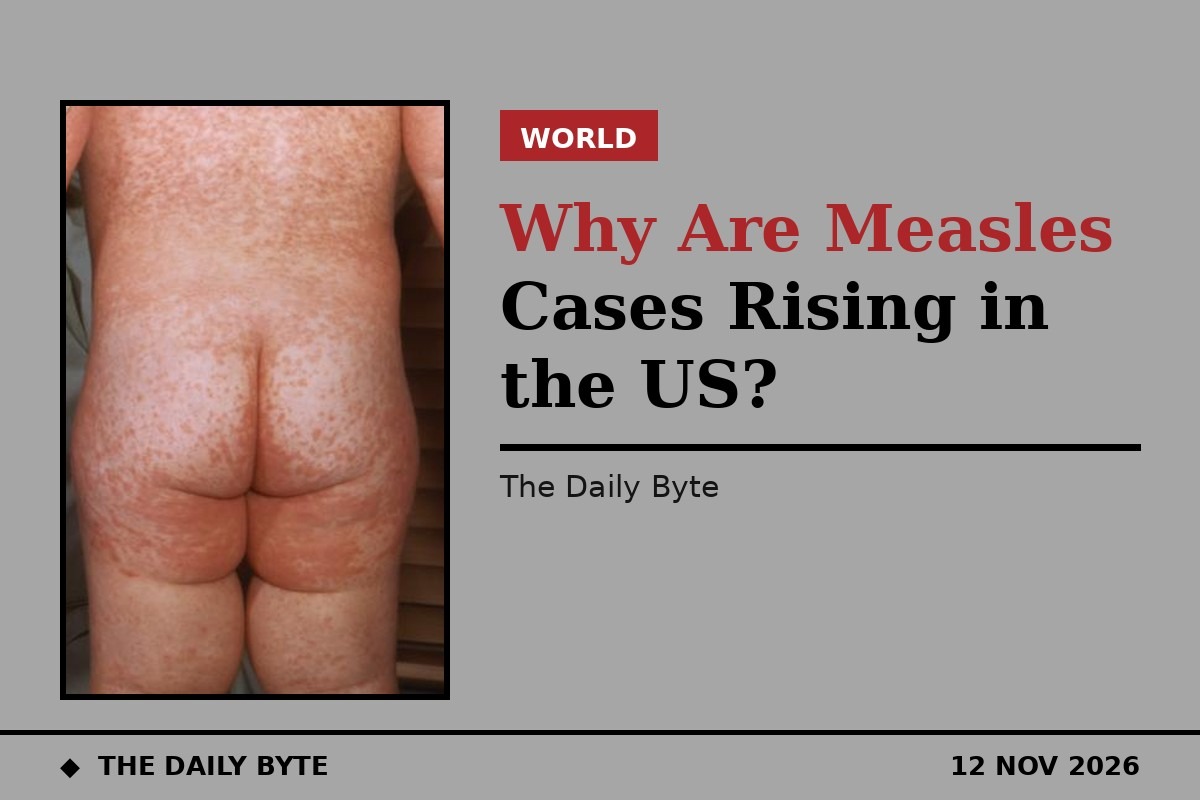
Measles cases are rising in the United States because vaccination coverage has fallen below the level needed to stop the virus spreading. The US Centers for Disease Control and Prevention (CDC) recorded 5,182 confirmed cases in 2026 as of 5 November, more than double the 2,289 cases reported in the whole of 2025 and the highest annual total since 1991. Almost all of the cases are in people who were not vaccinated, and almost all are linked to outbreaks in communities where too few people are protected.
Measles was declared eliminated in the United States in 2000, meaning the virus was no longer spreading continuously within the country. That achievement is now at risk. A regional health body is meeting this week to decide whether the United States has lost its elimination status, after genetic analysis showed the same strain of the virus circulating without interruption for more than a year. This explainer sets out the numbers, why coverage has fallen, what the disease does, and what it means for families in the US and in the UK.
How bad is the 2026 outbreak in numbers?
The CDC's figures, updated on 6 November 2026, show 5,182 confirmed measles cases reported in the United States in 2026 as of 5 November. Cases were reported by 47 jurisdictions, from Alabama to Wyoming, plus 18 cases among international visitors. There have been 43 new outbreaks this year, and 96 per cent of confirmed cases — 4,993 of the 5,182 — are linked to outbreaks. Of those, 3,608 cases came from outbreaks that started in 2026 and 1,385 from outbreaks that began in 2025 and carried over.
The scale of the rise is clear from the year-by-year comparison. In 2023 the United States recorded 59 confirmed cases. In 2024 there were 285 cases across 16 outbreaks. In 2025 the total jumped to 2,289 cases across 48 outbreaks. In the first ten months of 2026 alone, the count reached 5,182 — more than double the whole of 2025. Reporting by the Seoul Economic Daily, citing the New York Times, describes it as the worst year for measles in the United States in 35 years.
The human cost is also rising. According to CDC data, 562 people — about 11 per cent of cases — had been hospitalised, and four people had died. For comparison, as of 22 October the CDC had recorded 4,588 cases, 479 hospitalisations and three deaths, so the totals were still climbing into November. Most cases are in children and teenagers, and hospitalisation rates are highest in children under five.
| Year | Confirmed cases | Outbreaks |
|---|---|---|
| 2023 | 59 | 4 |
| 2024 | 285 | 16 |
| 2025 | 2,289 | 48 |
| 2026 (to 5 November) | 5,182 | 43 |
Source: CDC, Measles Cases and Outbreaks, updated 6 November 2026.
Why is measles spreading again?
The short answer is that too few children are vaccinated. Measles is one of the most contagious viruses known. It spreads through the air when an infected person coughs or sneezes, and a person can catch it simply by being in a room where someone with measles has been. Because it is so infectious, around 95 per cent of people in a community need two doses of the MMR vaccine to stop it spreading — a level known as herd immunity.
That threshold is no longer being met in the United States. The CDC reports that MMR coverage among kindergarten children fell from 95.2 per cent in the 2019–20 school year to 92.4 per cent in 2025–26, leaving about 280,000 kindergartners at risk. National averages hide much lower coverage in particular communities, and the CDC warns that pockets of unvaccinated people can exist even in states where overall coverage looks high. When measles reaches one of those pockets, it spreads fast.
Exemptions from school vaccination requirements have also risen. CDC data reported in a joint NBC News and Stanford University investigation published on 11 November 2026 put exemptions among kindergartners at 4.2 per cent in the 2025–26 school year, up from 3.6 per cent the year before — the highest level recorded. The same investigation found that about 83 per cent of US counties had recorded significant falls in routine childhood immunisation coverage.
The result is visible in who is getting ill. About 96 per cent of cases reported in 2026 involved people who were unvaccinated or whose vaccination status could not be confirmed, according to CDC figures. Only a small share of cases are in people who received two doses of the vaccine, which is what would be expected: two doses of MMR are 97 per cent effective at preventing measles, and one dose is 93 per cent effective.
Global conditions are making the problem worse. Measles activity is increasing worldwide, so there are more chances for an unvaccinated traveller to be infected abroad and bring the virus home. The CDC notes that measles is brought into the United States every year by travellers, usually unvaccinated US residents returning from overseas. This year, though, very few cases have been among international visitors — the virus is now spreading within American communities, not just arriving from abroad.
What is herd immunity and why does 95 per cent matter?
Herd immunity, also called community immunity, is the protection that arises when enough people in a population are immune to a disease that it cannot find new people to infect. Each infected person meets mostly immune people, so chains of transmission die out. For measles, the threshold is unusually high — about 95 per cent with two doses — because the virus spreads so easily. One person with measles can infect between 12 and 18 others in a population with no immunity, far more than for flu or Covid-19.
That is why small falls in coverage have large consequences. A national figure of 92.4 per cent sounds close to 95 per cent, but it means hundreds of thousands of unprotected children, and coverage in some counties and schools is far lower. Measles exploits exactly those gaps: the CDC defines an outbreak as three or more related cases, and notes that most outbreaks in the United States are small, often within a single household — but when the virus reaches a community with low vaccination rates, it can spread quickly and cause much larger outbreaks.
What does measles do to the body?
Measles is far more than a childhood rash. Symptoms typically include a high fever, cough, runny nose, sore red eyes and a red blotchy rash that spreads across the body. The illness can lead to pneumonia, swelling of the brain, and death. Before the measles vaccine was introduced, an estimated 48,000 people were hospitalised and 400 to 500 people died in the United States each year from measles, according to the CDC.
Children under five are at the greatest risk of serious illness, and so are adults over 20, pregnant women and people with weakened immune systems. The vaccine is the only effective protection: the CDC says two doses of the MMR vaccine are 97 per cent effective at preventing measles. Breakthrough infections in vaccinated people are uncommon, accounting for roughly 10 per cent of infections, and are usually milder.
Could the US lose its measles elimination status?
Yes, and a decision is expected within days. The Pan American Health Organization's regional commission on measles elimination is meeting from 10 to 13 November 2026 to review whether the virus has been transmitted continuously in the United States for 12 months or longer. A final decision is expected to be announced on 17 November.
Genetic analysis of recent samples, reported by the New York Times, indicates the virus is now circulating continuously in the United States, much like an endemic disease. Outbreaks in Utah and Arizona in July were linked to an epidemic that began in Texas a year earlier. If the commission finds continuous transmission for a year or more, the United States would lose the elimination status it has held since 2000 — a status that took decades of vaccination work to achieve.
Losing the status would be a major public health setback, but it would not change the practical advice. The CDC's message is unchanged: the best protection against measles is the MMR vaccine, and anyone planning to travel should talk to a healthcare provider about their vaccination status first.
What about the UK?
The United Kingdom has its own measles problem. According to the Local Government Association, the UK lost its measles elimination status in 2026, and four children have died from the disease since it began to resurge after the Covid-19 pandemic. England's 2024 outbreak, with about 2,900 cases, was the largest in more than two decades.
Coverage in England is also below the 95 per cent target. UK Health Security Agency figures for October to December 2025 put uptake of the first MMR dose at age five at about 92.3 per cent, and the second dose at age five at only 84.4 per cent. England has not met the World Health Organization's 95 per cent uptake target for any routine childhood vaccination since 2020–21.
The NHS schedule changed on 1 January 2026: the combined MMRV vaccine, which also protects against chickenpox, replaced MMR in the routine childhood programme. Children born on or after 1 January 2025 are offered two doses of MMRV, at 12 months and at 18 months. The second dose was brought forward from three years and four months to 18 months for children born on or after 1 July 2024. A selective catch-up programme is running from 1 November 2026 to 31 March 2028 for children born between 1 January 2020 and 31 August 2022 who have not had chickenpox or two doses of varicella vaccine. Parents who are unsure whether their child is fully protected are urged to check their child's Red Book record or ask their GP.
Frequently asked questions
Is measles dangerous? Yes. Measles can cause pneumonia, brain swelling and death. In the United States in 2026, about 11 per cent of cases needed hospital treatment and four people died. Before vaccination, measles killed 400 to 500 people a year in the United States.
Why are cases rising now? Vaccination coverage has fallen below the 95 per cent needed to stop the virus spreading. US kindergarten MMR coverage dropped from 95.2 per cent in 2019–20 to 92.4 per cent in 2025–26, exemptions have reached a record 4.2 per cent, and global measles activity is rising, bringing more imported cases into under-vaccinated communities.
Do I need the MMR vaccine if I had it as a child? Two doses of MMR give long-lasting protection for most people, and breakthrough infections are uncommon. Anyone who is unsure of their vaccination history, especially before travelling, should check their records with a healthcare professional.
Can vaccinated people still catch measles? Rarely. Two doses are 97 per cent effective, so a small number of vaccinated people can still be infected, usually with milder illness. About 96 per cent of cases in the 2026 US outbreak were in people who were unvaccinated or whose status was unknown.
Sources: CDC, Measles Cases and Outbreaks; Medical Daily; Seoul Economic Daily; UK Health Security Agency.