Why Do We Wear Poppies? Remembrance Explained
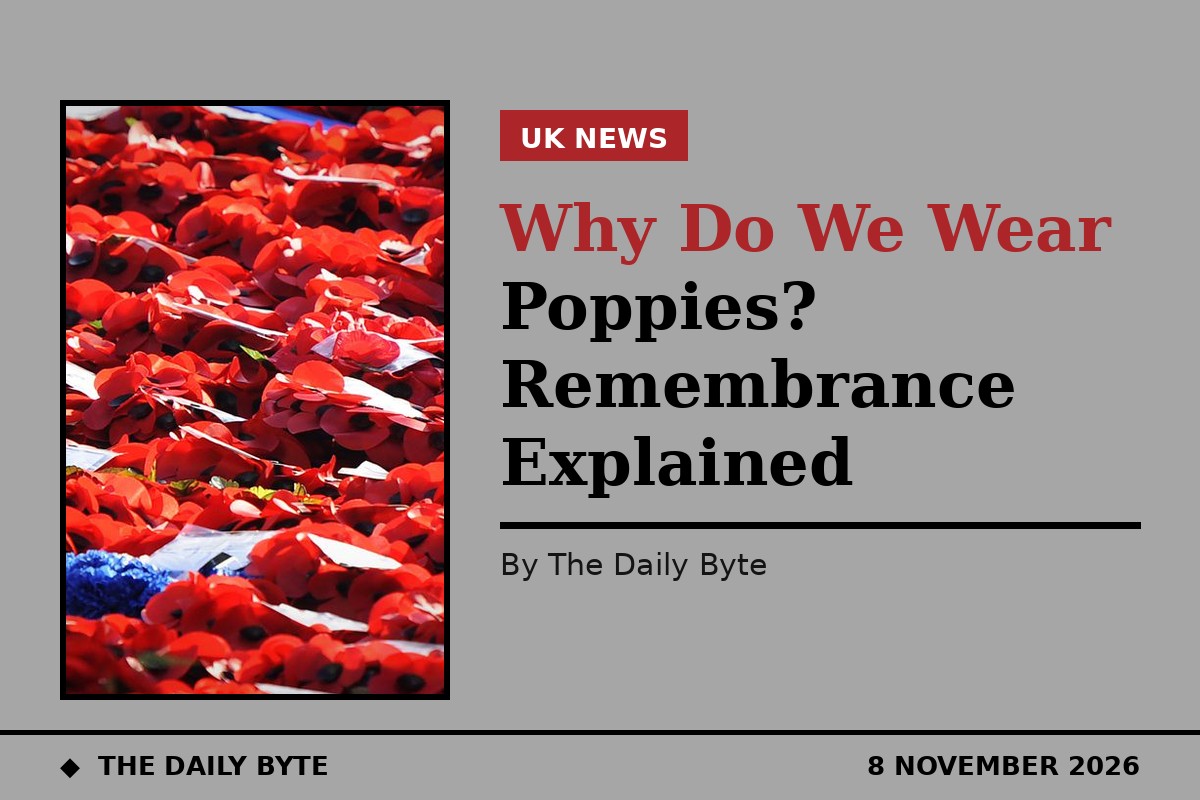
We wear a red poppy to remember the men and women of the Armed Forces who have died in war. The flower became a symbol of remembrance after the First World War, when poppies grew across the battlefields of Belgium and northern France, and it was adopted by the Royal British Legion in 1921. Today, 8 November 2026, is Remembrance Sunday, when the King led the nation in a two-minute silence at the Cenotaph in London and around 10,000 veterans took part in the march past. This explainer sets out where the tradition came from, what the poppy means, and how it is worn.
Why a poppy?
The link between poppies and remembrance begins with a poem. In May 1915, during the Second Battle of Ypres in Belgium, Canadian army doctor Lieutenant Colonel John McCrae was serving at a dressing station on the Ypres Salient. A close friend, Lieutenant Alexis Helmer, had been killed by a shell, and McCrae had conducted the burial himself. The next day, looking out from an ambulance at churned-up ground where wild poppies were already flowering between the graves, he wrote “In Flanders Fields”. Published in Punch magazine in December 1915, it became the most widely read poem of the war, and its image of poppies blowing between the crosses fixed the flower in the public mind as a symbol of the fallen.
The poppy was a fitting choice for another reason. The flower thrives in disturbed soil, and the constant shelling of the Western Front, together with lime from rubble and nitrogen from explosives, created exactly the conditions in which poppies flourish. After the war, visitors to the former battlefields found them covered in red flowers, and the colour came to stand for the bloodshed itself.
How did the poppy become Britain’s symbol?
The idea of wearing a poppy as a sign of remembrance was first taken up by Moina Michael, an American academic who read McCrae’s poem in 1918, wrote a reply called “We Shall Keep the Faith”, and vowed always to wear a red poppy. A French woman, Anna Guérin, carried the idea further, selling artificial poppies to raise money for war orphans and for the widows and children of the dead.
In 1921 Guérin travelled to London and persuaded Field Marshal Earl Haig, founder of the British Legion, to adopt the poppy as the Legion’s emblem. The first Poppy Appeal that November sold nine million poppies and raised £106,000, a vast sum at the time, which went to veterans struggling to find work and homes. The following year, the Disabled Society was set up to employ disabled former servicemen to make the poppies, a tradition of veteran-made poppies that continues today at the Poppy Factory in Richmond.
| Date | What happened |
|---|---|
| May 1915 | John McCrae writes “In Flanders Fields” at Ypres |
| December 1915 | The poem is published in Punch magazine |
| 11 November 1918 | Armistice ends the First World War |
| 11 November 1921 | First Poppy Appeal sells nine million poppies |
| 1933 | White poppy introduced by the Peace Pledge Union |
| 22 October 2026 | 2026 Poppy Appeal launched |
| 8 November 2026 | Remembrance Sunday, National Service at the Cenotaph |
| 11 November 2026 | Armistice Day, two-minute silence at 11am |
What happens on Remembrance Sunday?
Remembrance Sunday is held on the second Sunday of November, the Sunday closest to Armistice Day on 11 November, the anniversary of the end of the First World War in 1918. The National Service of Remembrance takes place at the Cenotaph in Whitehall, London, where the King, members of the Royal Family, the Prime Minister, senior politicians and faith representatives lay wreaths. The nation observes a two-minute silence at 11am, marking the hour, day and month the Armistice came into effect.
After the official wreaths are laid, veterans march past the Cenotaph in a parade organised by the Royal British Legion. This year around 10,000 veterans took part, representing more than 300 Armed Forces and civilian organisations, while 6,500 UK Armed Forces personnel remained deployed on operations and at overseas bases. Services are also held in towns and cities across the country, and the national event is broadcast live on television.
The two-minute silence is also observed on Armistice Day itself, 11 November, at 11am. Remembrance Sunday and Armistice Day are distinct occasions: the Sunday is the national act of remembrance, while 11 November marks the precise anniversary of the 1918 Armistice.
When should you wear a poppy?
According to the Royal British Legion, there is no “correct” time to start or stop wearing a poppy, and no set way to wear one. Most people choose to wear one during the remembrance period, which begins with the launch of the Poppy Appeal in late October — this year’s appeal was launched on 22 October — and continues through Armistice Day on 11 November and Remembrance Sunday. Many people remove their poppy after the main commemorative events have passed.
The most common choice is to pin the poppy to the chest, on either the left or the right side. Some people position the leaf at 11 o’clock, associating it with the hour, day and month the Armistice took effect in 1918. The Legion describes the red poppy as having no political or religious meaning, and says the decision to wear one is a matter of personal choice.
What about white and purple poppies?
The red poppy is not the only one. The white poppy has been sold by the Peace Pledge Union since 1933. It represents remembrance of all victims of war, including civilians, and a commitment to peace. It is worn alongside or instead of the red poppy by people who wish to remember in that way.
A purple poppy is also sometimes worn to remember the animals that served and died in warfare, from horses and dogs to pigeons. It is a more recent addition and is less widely seen than the red or white poppy. The different colours are a matter of personal choice, and the Royal British Legion’s appeal itself is built around the red poppy.
Where does the money go?
Buying a poppy is also a donation. The Poppy Appeal raises funds to support veterans of the British and Commonwealth Armed Forces and their families at times of need, including help with housing, rehabilitation, counselling and financial and legal advice. The appeal raises tens of millions of pounds each year — more than £49 million in the most recent year reported — and the paper poppies themselves are made at the Poppy Factory in Richmond, which employs disabled veterans. Around 30 million poppies are produced each year, using miles of coloured paper.
The poppy is the trademark of the Royal British Legion, and the appeal remains the charity’s best-known fundraising drive more than a century after the first one. What began as a poem written in an ambulance at Ypres has become the symbol through which Britain remembers its war dead each November.
Frequently asked questions
Do you have to wear a poppy? No. The Royal British Legion says wearing a poppy is a matter of personal choice, and the red poppy has no political or religious meaning.
Which side should a poppy be worn on? There is no set rule. Most people pin it to the left or right of their chest. Some position the leaf at 11 o’clock to mark the 11am Armistice.
When should you take your poppy off? There is no official date. Most people wear one from the launch of the Poppy Appeal in late October until after Remembrance Sunday and Armistice Day on 11 November.
What is the difference between Remembrance Sunday and Armistice Day? Armistice Day, 11 November, is the anniversary of the end of the First World War in 1918. Remembrance Sunday, the second Sunday in November, is the national day of commemoration, centred on the service at the Cenotaph.
What does the white poppy mean? The white poppy, sold by the Peace Pledge Union since 1933, remembers all victims of war and stands for a commitment to peace. It is worn as an alternative or addition to the red poppy.
Sources: Royal British Legion and House of Commons Library.