Why Does Islamabad Keep Shaking? Quakes Explained
A magnitude 5.3 earthquake shook Islamabad late on Sunday, 15 November 2026, sending residents out of their homes and into the streets — and it was far from the first time the capital has trembled. The quake struck at 10:49pm, with its epicentre in the Hindu Kush region of Afghanistan, and was felt across the capital and several cities in Khyber Pakhtunkhwa. The short answer to why Islamabad keeps shaking is geology: the capital sits at the edge of the collision zone where the Indian tectonic plate is still pushing north into Eurasia, and the Hindu Kush above it produces some of the deepest earthquakes on Earth.
Understanding that geology explains almost everything about the night of 15 November — why the shaking was felt hundreds of kilometres from the epicentre, why there was no serious damage despite the strength of the tremor, and why nights like this one will keep happening. This explainer sets out what happened, why the Hindu Kush is so earthquake-prone, and what the history of quakes in northern Pakistan tells us about the risk.
What happened on 15 November 2026?
According to the Pakistan Meteorological Department's Seismological Centre, the earthquake struck at 10:49pm on Sunday, 15 November 2026, and measured 5.3 on the Richter scale. Its epicentre was in the Hindu Kush region of Afghanistan, and the Seismological Centre put its depth at 84 kilometres. Tremors were felt in Islamabad as well as in Swabi, Shabqadar, Chitral, Lower Dir and nearby areas of Khyber Pakhtunkhwa. Initial reports from the administration and rescue agencies said no casualties or property damage had been reported from any part of the country.
Other seismic data put the quake at a slightly lower magnitude. Data cited by Kashmir Life recorded a 5.1 magnitude tremor at 10:48pm, with the epicentre at 35.998 degrees north and 70.942 degrees east in Afghanistan, at a depth of 131 kilometres. Small differences like this are normal: agencies use different networks of seismometers and different methods, so their first readings often disagree slightly. The Seismological Centre's figure of 5.3 remains the official Pakistani reading.
| Fact | Detail |
|---|---|
| Date and time | 10:49pm, Sunday 15 November 2026 |
| Magnitude | 5.3 (Seismological Centre); 5.1 in other seismic data |
| Depth | 84 km (Seismological Centre); 131 km in other data |
| Epicentre | Hindu Kush region, Afghanistan |
| Areas where felt | Islamabad, Swabi, Shabqadar, Chitral, Lower Dir and nearby areas |
| Casualties and damage | None reported, according to initial official reports |
Why is the Hindu Kush so earthquake-prone?
Pakistan lies where two of the planet's great tectonic plates meet. The Indian plate, carrying Punjab and Sindh, is moving north into the Eurasian plate, on which western Balochistan and parts of Khyber Pakhtunkhwa sit. The collision began roughly 55 million years ago and is still going on. It created the Himalaya, the Karakoram and the Hindu Kush, folded the ranges of Balochistan, and makes the north and west of Pakistan among the most seismically active parts of South Asia.
The movement has not stopped. The Indian plate continues to push northwards at roughly 3 centimetres a year, and that steady pressure loads the faults beneath the mountains and valleys of the north. When the stress on a fault exceeds the strength of the rock, the fault slips suddenly and the stored energy is released as an earthquake. The Hindu Kush has its own distinctive seismic signature: earthquakes that start at great depth. Beneath the range, a slab of the Earth's crust is sinking deep into the mantle, and quakes can begin 100, 200 or even 250 kilometres below the surface — far deeper than the shallow quakes that occur along most faults.
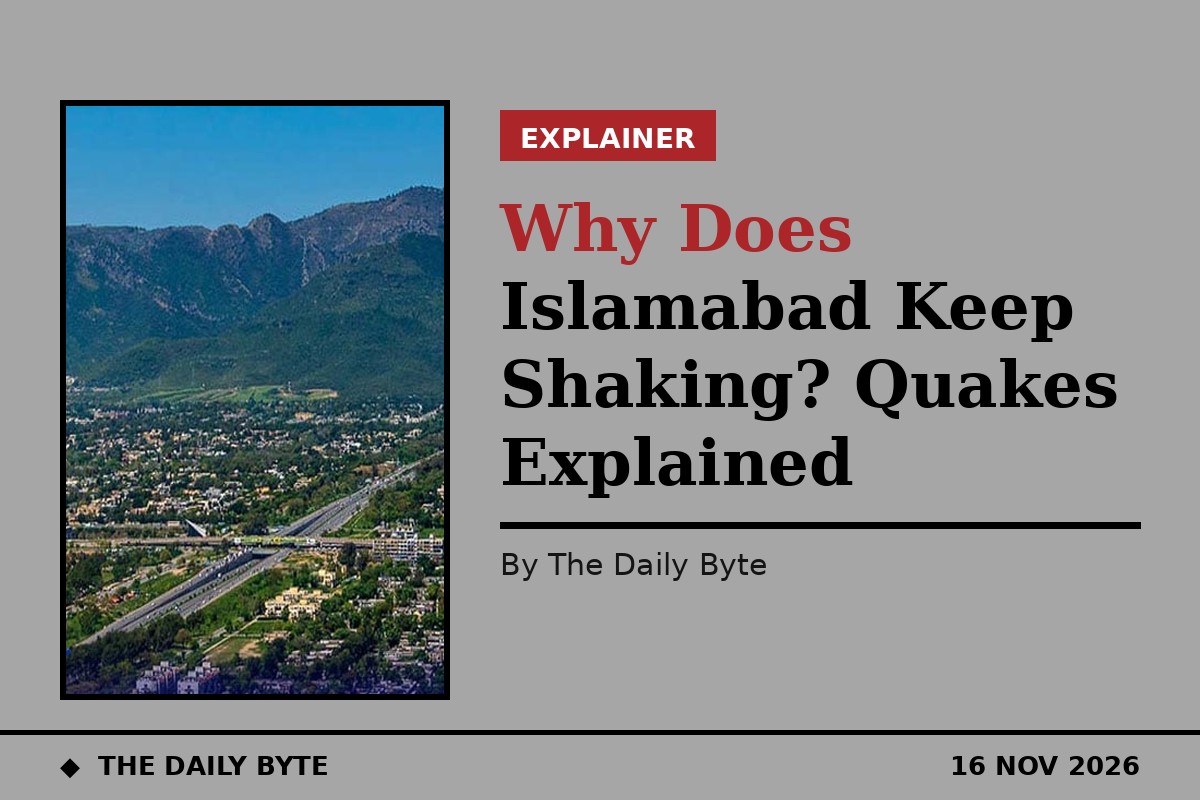
Islamabad sits at the foot of the Margalla Hills, in the foothill belt of this collision zone, roughly 300 kilometres or more from the Hindu Kush epicentres that shake it. That distance is no protection. Seismic waves from a deep Hindu Kush quake travel efficiently through the crust, which is why a tremor centred in Afghanistan can rattle windows in the capital, in Peshawar and in the valleys of Khyber Pakhtunkhwa at the same time.
Why do deep earthquakes shake such a wide area?
Depth is the key to understanding the night of 15 November. A shallow earthquake concentrates its energy near the surface, so it can be devastating close to the epicentre but fades quickly with distance. A deep earthquake releases its energy far below ground, so the shaking is spread over a much wider area — but by the time the waves reach the surface they have travelled a long way, and the shaking at any one place is usually less violent than a shallow quake of the same magnitude would produce.
The Hindu Kush is one of the best examples of this in the world. The magnitude 7.5 earthquake of 26 October 2015, centred in the Afghan Hindu Kush at a depth of more than 200 kilometres, was felt across Pakistan, India, Nepal, China and Central Asia. Pakistan's National Disaster Management Authority reported 280 deaths in Pakistan — a serious toll, but far lower than a shallow quake of that size would have caused. The same pattern applied on 15 November 2026: a magnitude 5.3 quake at 84 kilometres depth was widely felt, frightened residents across several cities, and caused no reported damage.
That is also why magnitude alone does not tell you how dangerous a quake will be. A magnitude 5.3 quake at 10 kilometres depth under a city would be a very different event from the same magnitude at 84 or 131 kilometres depth under a mountain range in another country. Depth, distance and the strength of local buildings matter as much as the number on the scale.
Has Islamabad had worse earthquakes before?
Yes — far worse. The most destructive earthquake in Pakistan's history struck on 8 October 2005, when a magnitude 7.6 quake centred about 19 kilometres north-east of Muzaffarabad killed more than 80,000 people and left about 4 million homeless. That quake was shallow, with a focal depth of about 16 kilometres, and it devastated Muzaffarabad, Balakot, Bagh and towns across Kashmir and northern Pakistan. It was caused by the same collision of the Indian and Eurasian plates, on faults in the Kashmir-Hazara zone where the Himalayan arc meets the Karakoram, Pamir and Hindu Kush ranges.
The 2005 disaster is the reason building standards and disaster planning in northern Pakistan changed, and it remains the benchmark against which every later tremor is measured. By comparison, the quakes Islamabad feels most often are the deep Hindu Kush events: strong enough to send people into the streets, but deep enough that they rarely damage well-built structures. The 2015 Hindu Kush quake, the 5.3 magnitude tremor of 15 November 2026, and the smaller quakes that follow the same pattern are all part of the same long seismic story — a collision zone that has been active for 55 million years and shows no sign of stopping.
Can earthquakes in Pakistan be predicted?
No — not in the way people usually mean. Scientists cannot predict the date, time and magnitude of a specific earthquake. What they can do is map the hazard: identify which faults are active, estimate how often large quakes occur on them, and say which areas face the greatest risk over years and decades. Northern Pakistan, including Islamabad, sits in one of the highest hazard zones in the country, and that assessment is based on the long record of quakes along the collision belt.
That is why the practical advice after a tremor is about preparation rather than prediction. Buildings in Islamabad are expected to follow seismic design standards, and residents are advised to know what to do when the ground moves. Claims circulating on social media that a specific quake is about to strike on a given date have no scientific basis and should not be relied on. The Seismological Centre and the Pakistan Meteorological Department are the official sources for earthquake readings in Pakistan.
What should you do when the ground shakes?
The standard advice from disaster agencies around the world is to drop, cover and hold on: get down on your hands and knees, take cover under a sturdy table or desk, and hold on until the shaking stops. Stay indoors if you are inside, away from windows and heavy objects that could fall, and do not use lifts during or immediately after a quake. If you are outside, move away from buildings, trees and power lines. Running out of a building during the shaking is one of the commonest causes of injury, because of falling debris at entrances and facades.
After the shaking stops, check for injuries and for damage to gas lines and wiring, and be ready for aftershocks, which are smaller quakes that can follow a larger one. In the case of the 15 November 2026 tremor, no significant aftershock sequence had been reported in the sources reviewed at the time of writing. Anyone who felt the quake and noticed cracks in walls or damage to a building should have it checked before re-entering, and should follow the instructions of the local administration and rescue services.
Frequently asked questions
What was the magnitude of the Islamabad earthquake? The Seismological Centre recorded it at 5.3. Other seismic data put it at 5.1.
When did the earthquake strike? It struck at 10:49pm on Sunday, 15 November 2026.
Where was the epicentre? In the Hindu Kush region of Afghanistan, at a depth of 84 kilometres according to the Seismological Centre.
Was anyone hurt? No casualties or property damage had been reported, according to initial reports from the administration and rescue agencies.
Why was it felt so far away? Because it was a deep earthquake. Quakes that start deep in the Hindu Kush spread their shaking over a very wide area, so tremors are felt hundreds of kilometres from the epicentre.
Will there be aftershocks? Aftershocks are common after earthquakes and are usually smaller than the main shock. No significant aftershock sequence had been reported in the sources reviewed at the time of writing.
Sources: Feature Pakistan, reporting the Seismological Centre's reading and the areas where tremors were felt; Pakistan Point, reporting the time, magnitude, depth and epicentre; DailyLife.pk, for the geology of Pakistan, the India-Eurasia collision, the 2005 Kashmir earthquake and the 2015 Hindu Kush earthquake.