Why Is Eskom Paying Solar Farms to Switch Off in South Africa?
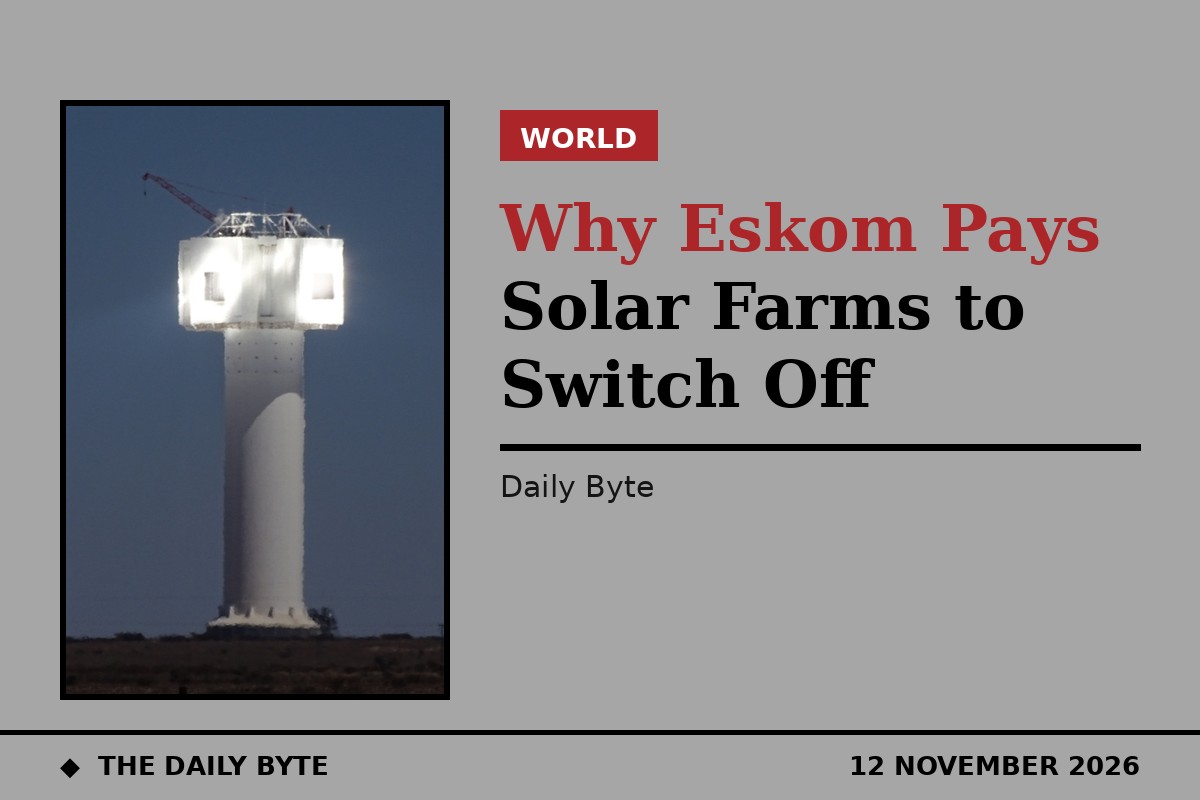
South Africa finally has enough electricity — and that is the problem. Eskom, the state power utility, expects to pay about 4 billion rand in the current financial year to solar and wind farms for power it told them not to produce. Rooftop solar has grown so fast that at certain times of day there is more electricity on the grid than anyone can use, and the utility is paying renewable generators to switch off. It is a strange reversal for a country that spent years rationing power through rolling blackouts, and it raises a simple question: how can a country with too much power be paying for power nobody uses?
The short answer is that electricity grids must balance supply and demand at every second, and the contracts Eskom signed with renewable generators say it must pay them even when it cannot take their power. The longer answer involves a rooftop solar boom, coal plants that cannot be switched off quickly, and a set of rules that has not caught up with the new reality.
What is curtailment?
Curtailment is the instruction to a wind or solar plant to stop generating because the system cannot absorb its output. Supply and demand on the grid have to match at all times, because failing to balance them could cause the entire grid to collapse. When there is too much power, the system operator — the National Transmission Company of South Africa, or NTCSA, which is still part of Eskom — tells renewable generators to reduce their output.
The catch is that for projects in the government's renewable energy procurement programme, known as REIPPPP, Eskom must still pay the generator as if it had accepted the electricity. The payment is for what the industry calls deemed energy: power the plant was ready to supply but was told not to generate. Eskom also loses the revenue it would have earned selling those units had it taken the electricity. Private projects are different: there, the curtailment risk is dealt with in the contract between the parties, and the generator does not necessarily get paid.
The scale of the bill has grown quickly. Keith Bowen, a senior manager for the market operator at the NTCSA, said the curtailment bill was expected to reach 4 billion rand this financial year, after the number of curtailment instructions increased dramatically since late last year as solar installations multiplied. The figure was disclosed during a panel discussion hosted by consultancy Cresco and law firm Fasken in Sandton.
How did South Africa end up with too much power?
For years the problem was the opposite. Eskom could not produce enough electricity, and spent almost 24 billion rand on diesel in 2024 alone just to help keep the lights on, running expensive diesel generators to cover shortfalls from its ageing coal fleet. Households and businesses responded by installing their own solar panels, and the rush accelerated as power interruptions increased because of the deterioration of local electricity distribution networks.
By June 2026, rooftop solar installed behind the meter — panels on homes and business premises that generate power for the owner's own use — had reached 9,107 megawatts, up 35 percent in a year. That is almost as much capacity as Medupi and Kusile, two of Eskom's largest coal power stations, combined. At midday, when the sun is strongest, that solar power floods the grid at exactly the moment when demand from Eskom's own customers is lowest, because the people with panels are using their own electricity instead of buying Eskom's.
The result is that there are now periods of spare capacity large enough for several of Eskom's coal-fired units to be placed into cold reserve — shut down temporarily because they are not needed. A large number of solar farms are also under construction and are expected to come online in about two years, which will add to the daytime surplus.
Why can't Eskom just switch off its coal plants?
Coal power stations are not like light switches. They take hours to shut down and restart, and they need to be ready when the sun sets and people need Eskom power again to cook and heat water. In the evening, solar output falls to zero just as household demand peaks, and the grid needs every megawatt the coal fleet can provide.
So Eskom cannot simply switch off its coal-fired power stations whenever solar generation exceeds demand. The system operator instead instructs the renewable generators to curtail, because a solar farm can be switched off and on again quickly while a coal plant cannot. The irony is that the cheapest power on the system — sunshine — is the power that gets switched off, while the most expensive and most polluting power keeps running, because the grid needs the coal plants later in the day.
This is not a uniquely South African problem. Grids around the world face the same challenge as solar power grows: midday surpluses and evening peaks that do not line up. But South Africa's version is sharper, because the swing from shortage to surplus happened so fast, and because the contracts signed when renewables were scarce now require payment for power that is not needed.
Who pays the 4 billion rand?
In the end, consumers do. Energy regulator Nersa allows Eskom to recover 383 billion rand through tariffs, and next to that figure the 4 billion rand curtailment bill is not yet material, as Bowen himself noted. But electricity pricing expert Deon Conradie warns that consumers will ultimately pay for curtailment through higher electricity tariffs, and the bill is expected to increase year after year as more consumers install solar systems and use their own electricity during the day instead of Eskom generation.
That creates a difficult circle. Higher tariffs encourage more households and businesses to install solar to escape Eskom's prices, which increases the daytime surplus, which increases curtailment, which pushes tariffs higher still. Breaking that circle is now one of the central challenges for South Africa's electricity policy.
There is also a fairness question. The generators being paid not to produce are mostly large renewable projects in the government's procurement programme, which signed contracts years ago when the country was desperate for new power. Nobody expected that within a few years the problem would be too much power at midday rather than too little.
What could fix it?
There is no single fix, but the options are well understood. The first is storage: batteries that soak up surplus solar power at midday and release it in the evening would turn the problem into an asset, but battery storage at grid scale is expensive and South Africa has so far built little of it. The second is flexible generation: gas-fired plants can be switched on and off relatively quickly, making them suitable for responding to fluctuations in renewable output, but South Africa has limited gas infrastructure.
The third is changing when power is used. If consumers had a reason to use more electricity at midday — cheaper daytime tariffs, for example — the surplus would be absorbed instead of curtailed. The NTCSA and the South African Photovoltaic Industry Association have said they are working together on demand-side measures, including wholesale market mechanisms and price signals that stimulate daytime electricity demand. In plain terms, that means giving consumers a reason to run washing machines, charge cars and heat water when the sun is at its strongest.
The fourth is fixing the rules. The framework meant to manage the shift to a competitive wholesale electricity market does not deal with curtailment compensation at all, according to the regulator, and there is no settled method for recovering the cost or deciding who ultimately carries it. Until the rules catch up, the bill will keep being passed through tariffs by default.
What does it mean for households and businesses?
For households with solar panels, the immediate effect is small: the curtailment bill is spread across all electricity users through tariffs, and it is still a small share of Eskom's total revenue. But the direction of travel matters. If the bill grows as expected, it will add upward pressure to tariffs that are already high, and it will strengthen the case for the reforms — storage, flexible tariffs and market rules — that would let South Africa use the solar power it already has.
For businesses, the lesson is that the country's electricity problem has changed shape rather than disappeared. The era of load-shedding, when there was simply not enough power, has given way to a more complicated era in which there is enough power in total but not at the right time. Solving that is a matter of storage, timing and pricing, not of building more coal plants.
And for Eskom, the 4 billion rand bill is a sign of how far the system has moved. A utility that once burned billions on diesel to keep the lights on now pays billions for power it cannot use. The challenge of the next few years is to build a grid that can handle abundance as well as it once handled scarcity.
Frequently asked questions
What is curtailment? An instruction from the grid operator to a wind or solar plant to reduce or stop generating because the system cannot absorb its output. Supply and demand on the grid must match at all times.
Why does Eskom pay for power it does not use? Under the government's renewable energy procurement programme, Eskom must pay generators for deemed energy — electricity they were ready to supply but were told not to generate.
How much is the curtailment bill? About 4 billion rand in the current financial year, according to Keith Bowen of the National Transmission Company of South Africa. The figure is expected to grow as more solar capacity comes online.
Why is there suddenly too much power in South Africa? Rooftop solar reached 9,107 megawatts by June 2026, up 35 percent in a year, after households and businesses installed panels to escape load-shedding and rising tariffs. At midday, that solar power exceeds what the grid can absorb.
Sources: Moneyweb and BusinessBagel.


