Why Is Delhi's Air So Bad After Diwali? Causes Explained
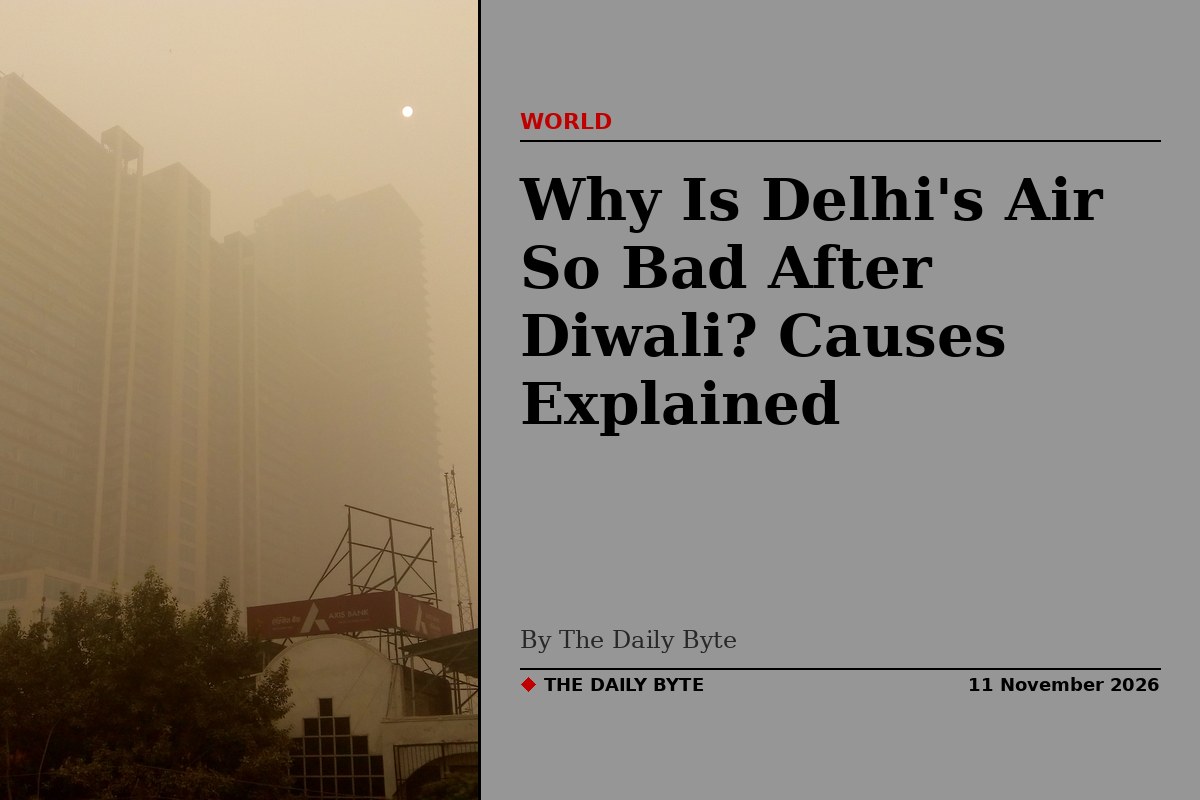
Delhi's air turns dramatically worse after Diwali because firecracker smoke is added to an already polluted mix at exactly the time of year when cold, still air traps pollution close to the ground, and smoke from stubble burning in Punjab and Haryana drifts in on north-westerly winds. On Wednesday 11 November 2026, the city's average air quality index (AQI) stood at 299 at 7am, in the 'poor' category, according to the Central Pollution Control Board (CPCB) — only one point below the threshold for 'very poor'. That was an improvement on 307 on Tuesday and 376 on Diwali day itself, Monday, but several parts of the city were still recording very poor air, and the youngest school pupils had been moved to hybrid classes. Diwali is the trigger for the sharpest spike, but it is not the whole cause: the same pattern returns every October and November, when cooler air traps pollution and crop-burning smoke drifts towards the capital.
What happened to Delhi's air this week?
Diwali fell on Sunday in 2026, and the pollution that followed was severe. On the Saturday before the festival, Delhi was ranked the world's most polluted major city, with the Swiss monitoring organisation IQAir recording a US-scale AQI of 581, while the CPCB recorded 363 on the Indian scale. By Friday morning, 6 November, before Diwali, the air was already in the severe category: the AQI across 39 monitoring stations touched 407 at 6am, and the calculated citywide hourly AQI had climbed to 453 by 10am. All 59 operational monitoring stations had remained in the severe category every hour since 8pm on Thursday. On Diwali day itself, Monday, the city's average AQI was 376. It eased to 307 on Tuesday and 299 at 7am on Wednesday 11 November, but the average hides wide differences across the city: on Wednesday morning, Chhawla recorded 396, Chandni Chowk 379, IIT Delhi 375 and ITO 366, all in the very poor range, while only Delhi Cantonment reported moderate air, with an AQI of 117. The Commission for Air Quality Management (CAQM) has invoked Stage III of the Graded Response Action Plan across Delhi and the surrounding National Capital Region, and the Delhi government has deployed water sprinklers to settle particulate matter. The India Meteorological Department (IMD) has forecast no rainfall in Delhi between 10 and 15 November, indicating little natural relief in the coming days.
| When | Delhi average AQI | Category (CPCB) | What was happening |
|---|---|---|---|
| Saturday before Diwali | 363 (CPCB); 581 (IQAir, US scale) | Very poor | Delhi ranked the world's most polluted major city |
| Friday 6 November, 10am | 453 (hourly) | Severe | Stagnant weather and rising farm fires |
| Monday, Diwali day | 376 | Very poor | Firecrackers through the night |
| Tuesday 10 November | 307 | Very poor | Pollution easing slowly |
| Wednesday 11 November, 7am | 299 | Poor | One point below 'very poor'; hybrid classes for young pupils |
What is a temperature inversion, and why does it trap pollution?
The single biggest reason Delhi's air gets worse in late autumn is the weather. In summer, warm air near the ground rises, carrying pollutants up and away. In winter, the ground cools rapidly at night, creating a layer of cold, dense air trapped beneath warmer air above. This is a temperature inversion: instead of rising, the cold air stays put, and the warmer layer above it acts like a lid. Every vehicle exhaust, every factory emission and every stubble fire's smoke gets trapped in the breathing zone, close to the ground. On 6 November, a strong temperature inversion created a shallow atmospheric boundary layer, effectively acting as a lid over Delhi. Instead of rising to around 1,300 metres under normal conditions, the boundary layer remained restricted to approximately 600 to 800 metres, concentrating emissions within a much smaller volume of air. Low wind speeds make it worse: near-zero surface wind speeds were recorded by the IMD at Safdarjung on 6 November, leaving vehicular emissions and other pollutants trapped over the city. With little horizontal movement and little vertical mixing, pollution accumulates hour after hour, which is why the worst readings come in the early morning and late evening, when the inversion is strongest, and why the air usually looks a little better in the mid-afternoon.
What role does stubble burning play?
Between mid-October and late November, farmers in Punjab, Haryana and western Uttar Pradesh burn paddy stubble to clear their fields quickly for wheat sowing. The smoke is rich in fine particulate matter (PM2.5) and black carbon, and north-westerly winds carry it directly into Delhi-NCR. Satellite observations from India's INSAT-3DS showed that farm fires increased more than four-and-a-half times between Sunday and Thursday in the week before Diwali, and upper-level north-westerly winds travelling at up to 36 kilometres per hour, at altitudes between 1,000 and 3,000 metres, were transporting agricultural smoke from Punjab and Haryana towards the national capital. The timing is what makes stubble burning so damaging: it coincides exactly with the onset of winter and the temperature inversions that trap pollutants close to the ground. Stubble burning is therefore a seasonal amplifier. It does not explain Delhi's pollution on its own — the city has vehicle exhaust, construction dust and industrial emissions all year round — but when its smoke arrives on still, cold nights, it pushes an already bad situation into the severe category. A significant number of the fires are lit between 4pm and 6pm, which also makes them harder for some satellites to monitor, since NASA's polar-orbiting satellites typically pass over the region around 2pm.
How much do firecrackers add?
Firecrackers cause a sharp, short-duration spike. They release a surge of pollutants, including sulphur dioxide, nitrogen dioxide and particulate matter, and PM2.5 and PM10 levels can jump by several hundred points within hours of peak bursting. The effect is worst on calm nights when the inversion layer is strongest, because the smoke has nowhere to go. That is what happened on Diwali night in 2026: the city's average AQI was 376 on Diwali day, after readings in the severe range in the days before, and the CPCB recorded 363 on the Indian scale on the Saturday before the festival. It is important to keep the scale of the firecracker contribution in proportion. Firecrackers are a one-night surge on top of a much larger and longer-lasting problem. The pollution was already severe before a single firecracker was lit — on Friday 6 November, the median PM2.5 concentration across monitoring stations reached 335 micrograms per cubic metre at 10am, exceeding India's prescribed national safe limit of 60 micrograms per cubic metre by more than five times, and 41 of the 59 monitoring stations recorded concentrations above 250 micrograms per cubic metre, the threshold associated with severe pollution. Restrictions on firecrackers can blunt the peak, but they cannot fix the underlying mix of traffic, dust, industry, stubble smoke and trapped winter air.
What are Delhi's everyday sources of pollution?
Even without Diwali and stubble burning, Delhi's air would be poor. The sources named in reporting on the current episode are vehicle exhaust, construction dust and smoke from agricultural residue burning, alongside industrial emissions. Vehicles contribute a substantial share of particulate matter, and congestion worsens the problem: increased festive shopping and traffic in the Diwali week added to the burden before the fireworks began. Construction and demolition work throws up dust, which is why dust-generating construction activity is one of the first things halted under the emergency response plan. Delhi's geography makes all of this harder to disperse: the city sits on a landlocked plain, so there are no coastal winds to sweep pollution away, and the surrounding region's winter weather brings the low wind speeds and inversions described above. PM2.5, fine particulate matter measuring no more than 2.5 micrometres across, is the principal pollutant driving Delhi's AQI, and it is the pollutant that matters most for health, because particles that small can settle deep in the lungs and enter the bloodstream.
What is GRAP Stage III?
The Graded Response Action Plan, known as GRAP, is Delhi-NCR's emergency protocol for air pollution, operated by the Commission for Air Quality Management (CAQM). It is triggered in stages as the AQI forecast worsens, with each stage adding stricter curbs. Stage III has now been invoked across Delhi and the surrounding National Capital Region. Under the Stage III measures now in force, dust-generating construction and demolition work has been banned, and the movement of older BS-III petrol and BS-IV diesel cars has been restricted. The Delhi government has also deployed water sprinklers and anti-smog guns to settle particulate matter on the roads. The impact is now being felt in classrooms as well: the Delhi Directorate of Education has directed all government and private schools to conduct classes up to Class 5 in hybrid mode, allowing young pupils to attend either in person or online. Schools in Noida, Greater Noida and Ghaziabad have been given the same direction. Parents have urged the authorities to declare school holidays from 10 to 15 November, arguing that schools are forced into last-minute decisions every year as pollution rises, but no order for a full closure has been issued so far. GRAP is an emergency response, not a solution: it can shave the peak off a bad episode, but it does not remove the underlying sources.
What do the AQI numbers mean?
The CPCB classifies the air quality index in six bands, and the band matters more than the precise number, because the health advice changes with it. On 11 November, Delhi's average of 299 sat at the very top of the 'poor' band, one point below 'very poor'.
| AQI range | Category | What it means |
|---|---|---|
| 0 to 50 | Good | Minimal health impact |
| 51 to 100 | Satisfactory | Minor breathing discomfort for sensitive people |
| 101 to 200 | Moderate | Breathing discomfort for people with lung or heart disease |
| 201 to 300 | Poor | Breathing discomfort on prolonged exposure |
| 301 to 400 | Very poor | Respiratory illness on prolonged exposure |
| 401 to 500 | Severe | Health impacts even for healthy people; serious effects for those with heart or lung disease |
The CPCB has also defended its practice of not showing actual pollution levels beyond an AQI of 500, saying it does not serve the purpose of showing severity — so a reading reported as 500 may in reality be higher. Private monitors using the US scale can therefore show much larger numbers for the same air: on the Saturday before Diwali, IQAir recorded a US-scale AQI of 581 while the CPCB recorded 363 on the Indian scale. The two scales measure the same pollution differently, which is why readings from different sources should not be compared directly.
When will Delhi's air improve?
There is little natural relief in the immediate forecast. The IMD has forecast no rainfall in Delhi between 10 and 15 November, and rain is the most effective natural clearer of particulate pollution, washing particles out of the air. Improvement usually comes when wind speeds pick up and the inversion weakens, allowing pollution to disperse, or when farm fires ease as the stubble-burning season passes. Until then, doctors advise residents, especially children, older people and those with breathing problems, to limit time outdoors, wear masks and keep windows closed on the worst days. The slight improvement from 376 on Diwali day to 299 on Wednesday morning offers little comfort on its own: at 299, the air is only one point below the threshold for very poor, and most monitoring stations across the city were still recording very poor air. The pattern is a recurring one. Delhi's air crisis returns every October and November, when cooler air traps pollution close to the ground and smoke from crop burning drifts towards the capital — and every year the same question follows: why does a predictable, seasonal crisis still catch the city unprepared? Sources: Zark News, 11 November 2026, reporting CPCB figures; Newspop, 6 November 2026, reporting CPCB data, IMD readings and INSAT-3DS satellite observations.
Frequently asked questions
Is Diwali the main cause of Delhi's bad air? No. Firecrackers add a sharp, short spike, but the air was already in the severe category before Diwali, with an hourly AQI of 453 on 6 November. The bigger drivers are the seasonal combination of temperature inversion, low wind, stubble burning in Punjab and Haryana, and everyday emissions from vehicles, construction and industry.
Why is the air worse in winter than in summer? In winter the ground cools at night and cold air is trapped beneath warmer air, a temperature inversion that acts like a lid. The atmospheric boundary layer shrank to about 600 to 800 metres on 6 November, instead of the normal 1,300 metres, and near-zero wind speeds meant pollution could not disperse.
Are Delhi schools closed because of the pollution? No full closure has been ordered. The Delhi Directorate of Education has directed schools to run classes up to Class 5 in hybrid mode, so young pupils can attend in person or online, and the same direction applies in Noida, Greater Noida and Ghaziabad.
Is it safe to exercise outdoors? Doctors advise residents, especially children, older people and those with breathing problems, to limit time outdoors, wear masks and keep windows closed on the worst days. Early morning and late evening are the worst times, because the inversion is strongest then.
Will rain clear the air? Rain washes particulate matter out of the air and is the most effective natural relief, but the IMD has forecast no rainfall in Delhi between 10 and 15 November, so no such relief is expected in the coming days.