WHY IS EVERYONE LEAVING PAKISTAN?
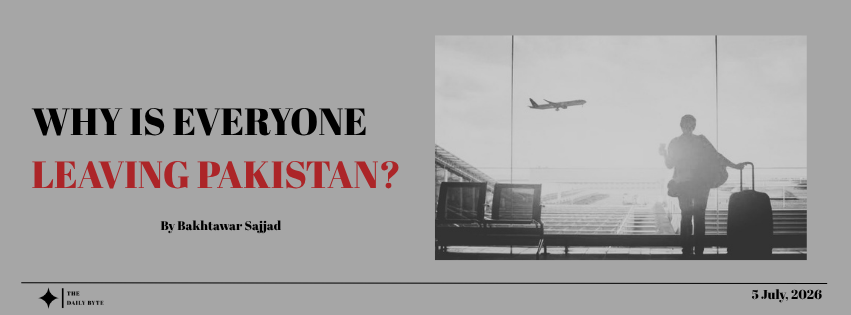
Leaving Pakistan was once a dream
for some, but today it feels like a goal for many. How did leaving Pakistan
become such a common conversation that every day we hear someone saying, "I'm applying for Dubai," "I just got my visa," or "I'm
leaving next month"? Today, the internet is filled with people posting
about their lives abroad or sharing airport farewell pictures. Even if you ask
students about their plans, most of them will say they want to move
abroad. The reason could be anything, whether it’s education or a better
future, but they are planning to leave.
Is leaving your homeland really that
easy? No, it's not. No one wants to leave the place where they spent their childhood,
where they grew up, where they have their memories and their families. Leaving
and settling abroad is never easy. It means giving up your comfort zone.
Leaving is not a choice but a hope, a
hope for a better future and a hope for a more stable life.
IS
PAKISTAN BECOMING A COUNTRY PEOPLE WANT TO LEAVE
According to official data and
research reports, over 2.2 million
Pakistanis left the country for employment between
2023 and 2025.
According to the latest data from
the Bureau of Emigration and Overseas
Employment (BEOE), over 762,499
Pakistanis were officially registered to leave the country for work in 2025 alone, up from 727,381 in 2024.
WHY
ARE PAKISTANIS LEAVING?
One of the biggest reasons many
Pakistanis consider moving abroad is economic challenges. Rising inflation has
placed a heavy burden on families. Everyday essentials such as food, fuel,
electricity, and rent continue to increase, while salaries remain almost the
same, making it difficult for many people to manage their daily expenses.
Unemployment is another major issue,
as many people find it difficult to get jobs that match their qualifications
and skills. Despite the increasing number of university graduates, there are
not enough jobs for everyone, and even when jobs are available, they often do
not match people's qualifications. Many jobs also offer low salaries, making it
difficult to manage everyday expenses.
Even those who find jobs face
challenges. In Pakistan, many people work for years without receiving
promotions, and their salaries remain unchanged. As a result, their career
growth becomes slow, and they do not get the exposure that professionals in
many other countries receive.
Many countries offer better job
opportunities, higher salaries, greater exposure, and faster career growth.
This encourages many Pakistanis to migrate in search of a better future.
Imagine working hard for years,
investing in your education, developing your skills, and doing everything
required to secure a good job, only to watch someone else get that job because
they have powerful connections. For many hardworking and talented Pakistanis,
this is the frustrating reality. It is not only unfair but also discourages
deserving people and cause them to lose faith in the system. As a result, many
people move abroad with the hope that their hard work and abilities will
finally be recognized.
In the end, Pakistan doesn't just
lose workers; it loses some of its brightest minds and most talented
individuals.
THE
COST OF LOSING OUR PEOPLE
The biggest loss isn't the number of people leaving; it's
the kind of people who are leaving.
The people leaving Pakistan are not
limited to one profession. Individuals from almost every field are building
their futures abroad. Recent figures show that nearly 6,000 engineers, 5,600 accountants, and around 3,800 doctors moved
abroad in search of better opportunities. Along with them, hundreds of thousands of skilled and unskilled workers, including
drivers, cooks, masons, and labourers, have also left the country.
Every doctor, engineer, teacher, or
software developer who leaves Pakistan takes much more than professional skills
with them.
This growing migration has led to brain drain, causing the country to
lose valuable talent and skilled workers.
Brain drain
refers to the migration of skilled and educated individuals from one country
to another in search of better opportunities. It is also known as human capital flight.
Brain drain
has a significant impact on developing
countries. It slows a country's future development because many
professionals move abroad in search of better opportunities. Skilled workers
play an important role in economic growth, and when Pakistan loses them, it
creates a gap that is difficult to fill because there may not be enough people
with similar skills to replace them.
As a result, economic growth slows
down, and the country faces shortages of skilled professionals such as doctors,
engineers and many others.
CONCLUSION
Whenever a person leaves, they don't just take a suitcase
and their CV with them. They take their skills, education, talent, knowledge,
dedication, ambition, and potential.
Migration is completely a personal
choice, and for many people, it is a step toward achieving the life they have
always wanted and securing a better future. However, while migration can
improve an individual's life, it also raises concerns about what the country
loses in return. Pakistan needs to improve its economy, provide better opportunities
and salaries, and value the talent and potential of its people. Only then can
the country move forward and grow. But the question is: if
this trend continues, can Pakistan afford to keep losing the talented people
who could help shape its future?