Why Is Gold Falling in November 2026? Explained
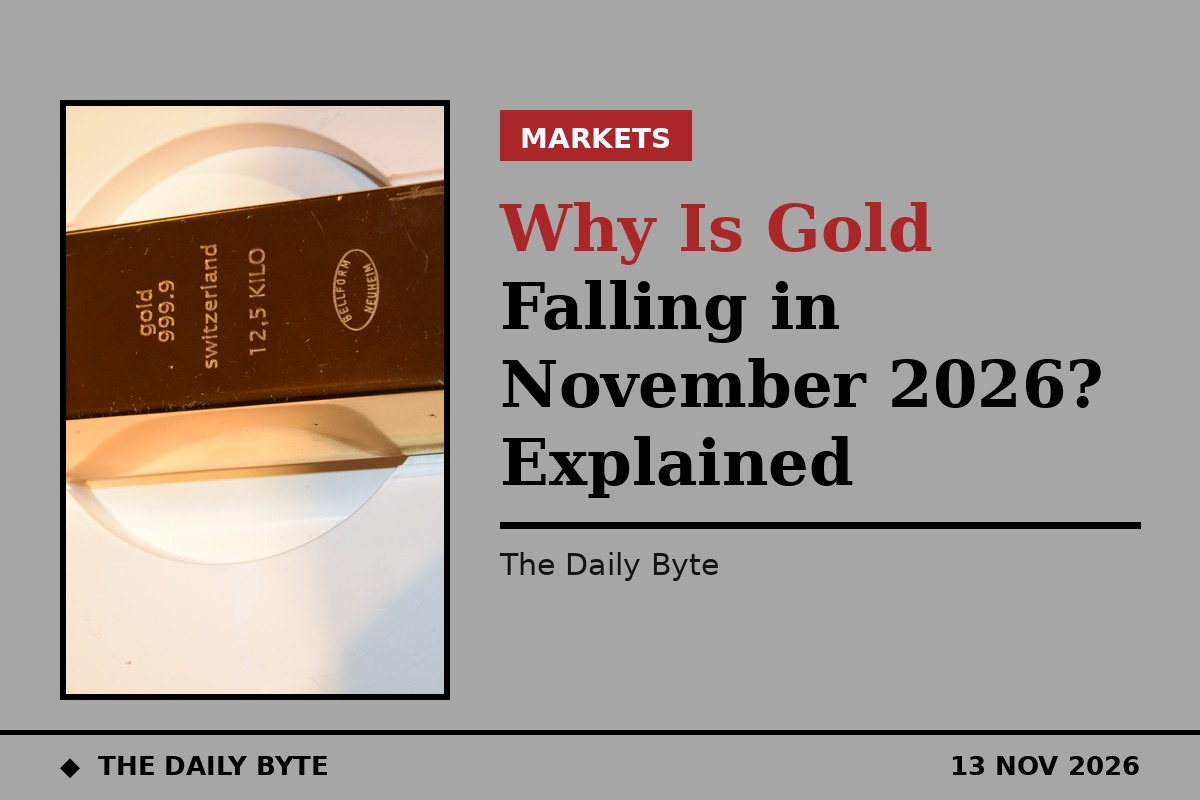
Gold is falling because the forces that usually lift it have gone into reverse: the US Federal Reserve is leaning towards higher interest rates, the dollar is near a 19-month high, Treasury yields have risen, and a slide in technology shares has forced some investors to sell gold to raise cash. The metal has dropped about 31% from its January record high and is now at its lowest level in more than a year. War in the Middle East and higher oil prices, which might once have helped gold, have instead fed inflation fears that point to tighter US monetary policy.
This explainer sets out how far gold has fallen, the six reasons behind the slide, why gold has not behaved like a safe haven, what central banks are doing, and what could turn the price around. It is for information only and is not financial advice.
How far has gold fallen?
Gold futures fell nearly 3% on Thursday, 12 November 2026, to their lowest in more than a year, retreating well below the $4,000 level. Front-month Comex gold for November delivery plunged 2.8% to $3,878.40 an ounce, its lowest settlement value since 2 October 2025. Front-month Comex silver fell 3.7% to $49.972 an ounce on the same day.
The scale of the longer decline is striking. Gold has fallen 31% from a record high of about $5,598 an ounce in January to a one-year low of around $3,870 on 30 October. October delivered gold's steepest monthly decline since 2008, and the metal is trading further below its 200-day average than at any time since 2013. There was a partial recovery in between: gold bounced to about $4,136, nearly 7% above its low, after the US midterm election results weakened the dollar. Thursday's fall wiped out much of that rebound and took the price back towards its October lows.
1. A hawkish Federal Reserve
The main reason gold is falling is the Federal Reserve. The Fed raised interest rates to 3.75% to 4.00% in September, its first increase since July 2023. On 28 October it held rates steady, but in a 10-2 vote, with Governor Lisa Cook and Cleveland Fed President Beth Hammack dissenting in favour of a quarter-point hike, and it left the door open to further increases in the near future.
Since then, the signals have only hardened. A stronger-than-expected report on US consumer prices, hawkish remarks from Fed officials and a rally in the dollar have pushed traders to price in more tightening. Traders now see an 87% chance of a 25-basis-point rate hike in December, while the probability of a larger 50-basis-point move has also increased, according to the CME's FedWatch tool. Meanwhile, inflation has remained above the Fed's 2% target for 67 consecutive months, and US real GDP grew at a 3.40% annual rate in the third quarter, according to the Bureau of Economic Analysis, giving the Fed room to keep policy tight.
Higher interest rates are gold's oldest enemy. Gold pays no interest and no dividend, so when rates rise, the cost of holding it instead of a bond or a bank deposit goes up. That relationship has dominated the gold market all year.
2. Higher yields and a stronger dollar
The second reason is closely linked to the first. The yield on 10-year US Treasury bonds surged to 5.34% in early October, and although it has eased since, yields remain high by recent standards. Higher yields increase the opportunity cost of holding gold, which does not pay interest, and they attract money into dollar assets.
At the same time, the US dollar has rallied to a near 19-month high, while the euro has fallen to an 18-month low. A stronger dollar makes gold more expensive for buyers using other currencies, which dampens demand. American Gold Exchange market analyst Jim Wyckoff said in a note that the strong consumer price report, hawkish Fed remarks and the dollar rally "are working to press the gold market lower". As the market weighs the possibility of a 50-basis-point Fed increase in December, he added, "it still provides some support for the US dollar and pushes bond yields higher, putting simultaneous pressure on gold."
3. The oil shock
The third reason is oil. The conflict between the United States and Iran has pushed Brent crude prices sharply higher, to around $112 a barrel in early November, and oil rose again on Thursday, 12 November, after President Donald Trump said the United States does not need a peace deal with Iran. Higher energy prices fuel inflation expectations, which in turn increase the likelihood that the Federal Reserve will continue raising interest rates.
That creates an unusual pattern: gold has often fallen this year when oil prices have risen, because the oil shock works through the interest-rate channel rather than the safe-haven channel. UBS analyst Giovanni Staunovo pointed to strong US GDP figures and "the increase in oil prices putting pressure on the Fed to hike". Oil prices have been volatile, falling back to $92.57 on 9 November on hopes of a deal before rebounding, but while they stay elevated, they keep the inflation and rate pressure on gold alive.
4. Forced selling when tech shares slid
The fourth reason explains the speed of the falls. On 30 October, gold prices fell nearly 3.5% in a single session as the Nasdaq also dropped 2.9%. A Commerzbank analyst told Reuters that the sharp fall in technology stocks may have led to forced selling of safe-haven assets such as gold, and margin calls.
The mechanism is straightforward. When shares fall sharply, investors who borrowed money to buy them receive margin calls demanding extra cash. To raise it quickly, they sell the most liquid asset they hold, and for many portfolios that is gold. That is why gold can fall on the same day as shares, even though it is supposed to be a refuge from them: in the early stages of a market correction, investors liquidate winning positions to cover losses elsewhere. The same dynamic was at work on 12 November, when the resignation of Nvidia chief executive Jensen Huang sent technology shares lower and gold fell with them.
5. ETF outflows and weaker jewellery demand
The fifth reason is investor flows. According to data from the World Gold Council, gold ETFs recorded net outflows of $1.21 billion in the week ended 23 October, ending a 13-week inflow streak, with US funds leading the redemptions. When ETF investors sell, the funds must sell physical gold, adding to the downward pressure in the same way that Bitcoin ETF outflows have weighed on crypto.
Physical demand has also softened in one key market. Gold jewellery consumption in China fell 33.9% year on year in the first nine months of 2026, according to Xinhua, as high prices deterred buyers. Bar and coin demand rose 26.3% over the same period, leaving total Chinese consumption nearly flat, but the jewellery decline removed an important source of support.
Why has gold not acted like a safe haven?
Many readers are puzzled: with a war under way in the Middle East, should gold not be rising? The answer is that gold responds to more than one force, and in 2026 the interest-rate force has been stronger than the fear force. When war sends energy prices higher, inflation expectations higher, and markets into pricing a tighter central bank, short-term rates and real yields rise, and those are the variables that have driven gold down.
Analysts now describe gold as behaving more like a risk asset than a refuge, with its price swings driven by interest rates, energy markets and central bank policy rather than geopolitical stability alone. Gold fell 24% in 2026 even while a war was being fought, on pace for its worst annual performance in 11 years. That does not mean gold has stopped being a store of value over long periods. It means that in the short term, the price is set by rates and the dollar, and both have moved against it.
What are central banks doing?
One group has kept buying through the sell-off: central banks. They bought a net 321 tons of gold in the third quarter, the World Gold Council reported, the fastest pace since the end of 2024, taking the year's total to about 675 tons. China added 63 tons and Poland 41 tons, the biggest disclosed buyers, and almost two-thirds of the buying went undisclosed, estimated by consultant Metals Focus from trade data.
Central bank buying is a long-term support, because reserve managers buy gold to diversify away from the dollar and hold it for decades rather than trade it. But it has not been enough to offset the selling from Western investors, ETF redemptions and forced liquidation in the short term. The World Gold Council's senior market strategist John Reade has noted that reserve managers who already expect the dollar to fall have an incentive to let short-dated Treasuries roll off and buy gold with the proceeds, which suggests the official-sector bid is likely to persist.
What could turn gold around?
Two developments would change the picture. The first is an end to the upward pressure on oil: if the Iran war winds down and oil prices ease, inflation expectations would fall and the Federal Reserve would have less reason to keep raising rates. The second is a change in the economic outlook: if the economy weakens enough to force the Federal Reserve to abandon its inflation fight, real yields would fall and gold would become more attractive.
Traders are also watching a technical level. If gold closes below $3,870, analysts say the risk of a much longer and sharper decline increases, beyond the 31% already recorded. A sustained recovery above $4,000, on the other hand, would suggest the selling has run its course. Until one of those triggers arrives, the metal remains caught between a hawkish Fed, a strong dollar, high oil prices and investors who need cash.
Key facts: gold's November 2026 fall
| Price on 12 November 2026 | $3,878.40 an ounce, lowest settlement since 2 October 2025 |
| Fall on 12 November | 2.8% in a day; silver fell 3.7% |
| January record high | About $5,598 an ounce |
| Fall from the record | About 31% to the 30 October low of $3,870 |
| Fed rate | 3.75% to 4.00% after the September hike |
| Chance of a December hike | 87% for 25 basis points, per CME FedWatch |
| 10-year Treasury yield | 5.34% in early October |
| Gold ETF outflow, week to 23 October | $1.21 billion, ending a 13-week inflow streak |
| Central bank buying, Q3 2026 | 321 tons; 675 tons in the year to date |
| China jewellery demand, Jan to Sep 2026 | Down 33.9% year on year |
Frequently asked questions
How much has gold fallen from its peak? Gold has fallen about 31% from its January record high of about $5,598 an ounce to around $3,870 on 30 October, and it closed at $3,878.40 on 12 November, its lowest settlement in more than a year.
Why do higher interest rates hurt gold? Gold pays no interest, so when rates rise, holding it instead of a bond or deposit costs more. Higher rates also tend to strengthen the dollar, which makes gold more expensive for buyers in other currencies.
Why is gold falling during a war? The war has pushed oil prices higher, which raises inflation expectations and makes the Federal Reserve more likely to raise rates. In 2026, that interest-rate effect has outweighed gold's usual safe-haven appeal.
Are central banks still buying gold? Yes. Central banks bought a net 321 tons in the third quarter of 2026, the fastest pace since the end of 2024, with China and Poland the biggest disclosed buyers.
Will gold recover? No one can predict that. The two things traders say would help most are an easing in oil prices if the Iran conflict winds down, or a weaker economy forcing the Federal Reserve to stop raising rates. A close below $3,870 would suggest further declines are possible.
Sources: TradingView News / Seeking Alpha, "Gold sinks to more than one-year low as Fed rate hike bets boost dollar, Treasury yields", 12 November 2026; Mitrade, "6 Reasons Why Gold Price Is Still Falling", 5 November 2026; World Gold Council, Federal Reserve and CME FedWatch data as cited. This article is for information only and is not financial advice.