Why Lahore Smog Gets Worse in November Explained
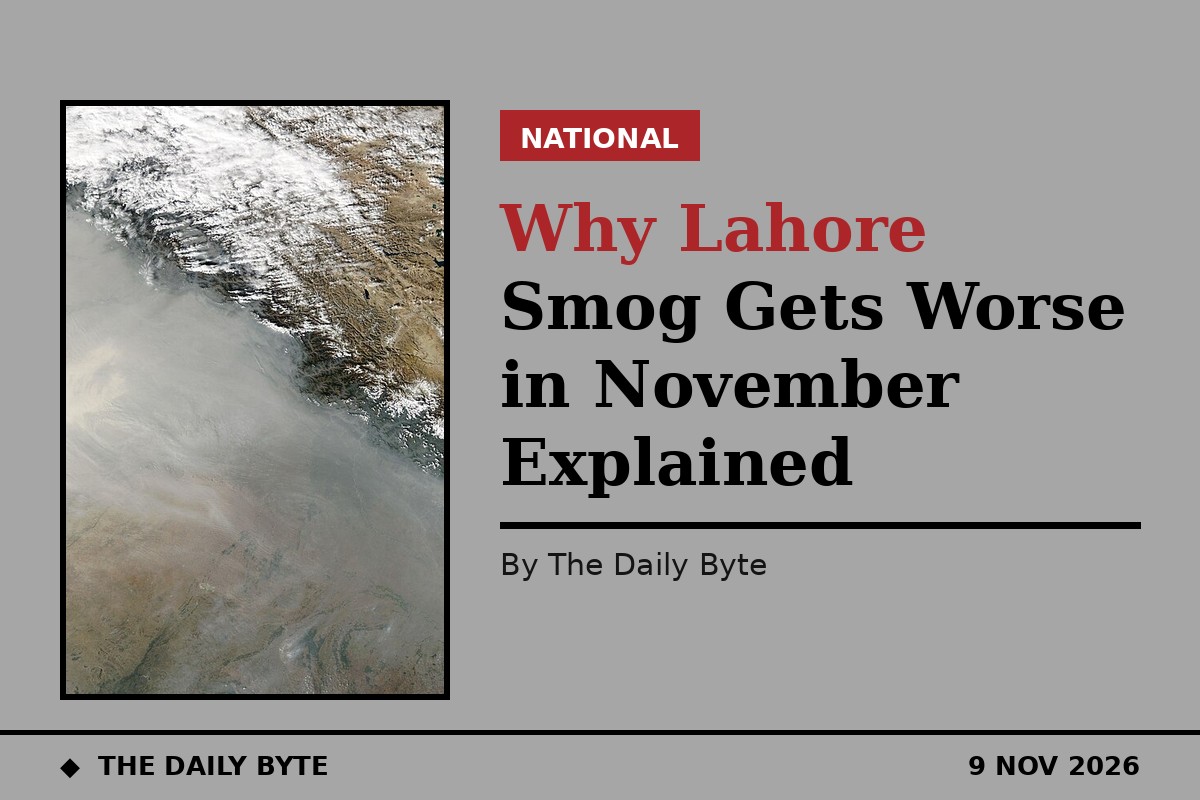
Lahore's smog gets worse in November because cold nights create a temperature inversion that traps pollution close to the ground, just as wind speeds fall to almost nothing. The smoke and dust that would normally disperse upwards has nowhere to go, so it hangs over the city in a thick, grey haze that can last for days.
That is the short answer. The longer answer involves the weather, the sources of the pollution, and why the worst weeks of the year fall between mid-November and December.
What is a temperature inversion?
Normally, air gets colder as you go higher, and warm air near the ground rises, carrying smoke and dust away with it. A temperature inversion turns that upside down: a layer of warmer air sits above colder air at ground level, acting like a lid. Pollution released below the lid cannot rise through it, so it accumulates at street level instead of dispersing.
Abdullah Nayyar Sheikh, director general of Punjab's Environment Protection Department, told Reuters that falling temperatures since early November had created exactly this effect in Lahore, and that wind speeds had been extremely low for days. At 5am on Wednesday 4 November, Lahore's wind speed was 0.3 metres per second — close to dead calm — with humidity at 86 percent and a temperature of 20C.
How bad did it get?
On the morning of Wednesday 4 November, Lahore's air quality index (AQI) reached 362, and Allama Iqbal Town recorded 722. Barki Road recorded 455, Model Town 362, DHA Phase V 282 and Bedian Road 264. The Punjab government's own dashboard showed the city at 433 on Tuesday and 378 at 5am on Wednesday. The figures vary because different networks use different monitoring stations and averaging periods, but all of them were far above the level classed as hazardous: readings above 300 on the AQI scale are considered hazardous to health.
The National Disaster Management Authority's seasonal outlook expects the smog risk to rise from mid-November into December, when nights grow colder and inversions grow stronger. In other words, early November is the start of the season, not the peak.
Where does the smog come from?
Smog is not one pollutant. It is a mixture, and Punjab's Environment Protection Department lists the main contributors as transport emissions, industry, brick kilns, crop burning, construction dust and waste burning. Still air does not create the pollution; it reveals how much of it the city produces every day, by trapping a full day's emissions in a shallow layer of air instead of letting them blow away.
That is also why the problem is worst in winter. In summer, hot ground and stronger winds mix the air. In November and December, cold nights, short days and weak winds all work against dispersal at the same time.
What is the government doing?
The province's most visible response this week was Chamkta Lahore (Shining Lahore), a cleanliness and dust-suppression campaign launched by Local Government Minister Zeeshan Rafique at Liberty Chowk on Tuesday 3 November, with water trucks and mist guns sent out to wash the city's roads. The minister said smog in November was noticeably lower than two years ago, crediting measures introduced since then. There is some support for that on the extremes: in November 2024, readings at some Lahore monitors exceeded 1,000, the government shut schools and ordered lockdowns in several cities, and about 900 patients were admitted to hospitals in Lahore in a single day.
As of Wednesday 4 November, no smog-related closure of schools or offices had been ordered. Such a step requires an order from the Environment Protection Department and a notification from the School Education Department. Schools were told last month to halt outdoor activities when readings are high.
Who is most at risk?
Smog affects everyone who breathes it, but some people feel it first and worst. Children, older people, and anyone with asthma, bronchitis or heart disease are the most vulnerable, because their lungs and hearts are already working harder. During the worst days, doctors advise these groups in particular to stay indoors, keep windows closed, and avoid outdoor exercise in the morning, when the inversion is usually strongest and the air is at its worst. Healthy adults are advised to cut back on strenuous outdoor activity too while readings stay in the hazardous range.
Frequently asked questions
What is AQI? The air quality index is a single number that summarises how polluted the air is. Higher means worse. Above 300 is classed as hazardous, when even healthy people can be affected and everyone is advised to avoid outdoor exertion.
Will schools close for smog this year? No closure had been announced as of 4 November 2026. Punjab has closed schools, shifted classes online and imposed smart lockdowns in past seasons, so parents should watch for official notifications rather than assume a closure.
What can residents do? Stay indoors when readings are high, wear a mask outdoors, avoid outdoor exercise, and report smoke sources through the Green Punjab app or the Environment Protection Department helpline, 1373. Readings and the official response are reported by LHR Times, and the pattern of past smog seasons is set out by UrduPure.