Why Polio Still Exists in Pakistan Explained
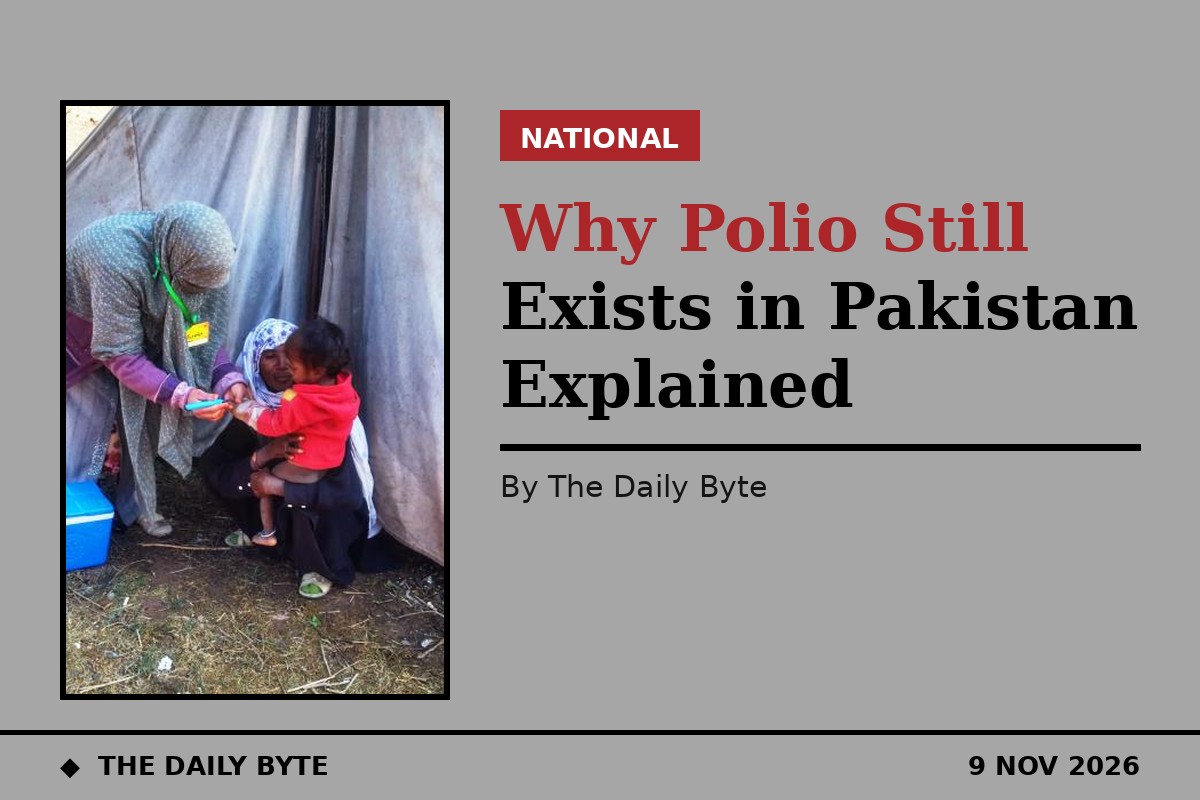
Polio still exists in Pakistan because wild poliovirus has never stopped circulating there. Pakistan and Afghanistan are the only two countries in the world where the virus is still endemic — meaning it passes from person to person in the community year after year — and every other country has interrupted transmission. Eradication is close, but the last pockets of the virus are the hardest to reach.
That is the direct answer. To understand why those pockets persist, it helps to know what polio is, how far the world has come, and what is different about the places where the virus survives.
What is polio?
Polio, short for poliomyelitis, is a disease caused by the poliovirus. It spreads mainly through contaminated water and food, and through contact with an infected person. Most people who catch it have no symptoms or only a mild illness, but in a small number of cases the virus attacks the nervous system and causes paralysis, usually in the legs. There is no cure for polio once paralysis sets in. It can only be prevented, and the vaccine is the prevention: children who receive all their doses are protected.
The vaccine is given as drops in the mouth, which is why vaccination teams go door to door. Several doses are needed because a single dose does not always produce full protection, and children need to be reached again in each campaign round.
How close is the world to eradication?
Very close. The Global Polio Eradication Initiative was launched in 1988, when about 350,000 cases were estimated each year. Since then, reported cases have fallen by more than 99 percent. Two of the three types of wild poliovirus are gone: type 2 was declared eradicated in 2015 and type 3 in 2019. Only type 1 still circulates, and only in Afghanistan and Pakistan.
Pakistan's own numbers show the same direction of travel. The country reported 74 polio cases in 2024 and 31 in 2025. So far in 2026, nine cases have been confirmed, including seven from Khyber Pakhtunkhwa and two from Sindh, according to the National Emergency Operations Centre. The ninth case, confirmed on 5 November 2026, was a seven-month-old child from Khyber district. Afghanistan, by contrast, has reported 50 cases of wild poliovirus type 1 in 2026, up from 21 in all of 2025, according to the World Health Organization's weekly update.
What does endemic mean?
Endemic means the virus circulates continuously in a place without being imported from elsewhere. The World Health Organization treats Pakistan and Afghanistan as a single epidemiological bloc for polio, because the virus keeps moving across their shared border. Genetic analysis of the virus found in all three cases reported from Khyber district this year showed links with strains circulating in Afghanistan, which is why progress in one country depends on progress in the other.
Transmission is concentrated in a small number of high-risk areas: southern Afghanistan, southern Khyber Pakhtunkhwa and Karachi. The WHO's emergency committee has estimated that about 250,000 children in South Khyber Pakhtunkhwa remain unreached, mainly because vaccinators cannot consistently get to all communities.
Why do some children still miss vaccination?
There are three main reasons. The first is access: in insecure or remote areas, teams cannot always reach every household, and campaigns are sometimes interrupted. The second is violence against the campaign itself. In the first week of November 2026 alone, two police officers guarding a vaccination team were killed in Mohmand district, four polio workers were abducted in Tank district, three more were abducted in Kurram district, and two workers abducted in Lower South Waziristan were later released. The third is mistrust: false claims that the vaccine is part of a foreign plot or causes infertility still circulate, and some parents refuse the drops.
None of these is a medical problem with the vaccine. The vaccine works. The problem is reaching every child, every time, in places where that is difficult or dangerous.
What is being done?
Pakistan runs repeated nationwide and sub-national campaigns. The campaign that began on 2 November 2026 aimed to reach about 24 million children under five across 97 districts, with more than 200,000 frontline workers going door to door. The World Health Organization continues to treat the international spread of poliovirus as a Public Health Emergency of International Concern, which keeps global attention and funding on the final two endemic countries.
Frequently asked questions
Can adults catch polio? Yes, but it mainly affects children under five. Adults who were fully vaccinated as children are protected, which is why the campaigns focus on young children.
Why do children need so many doses? Because one dose does not always give full protection, especially where children face other gut infections. Repeated doses build up immunity until the child is protected.
Is the polio vaccine safe? Yes. The oral polio vaccine has been used for decades and given in billions of doses worldwide. It is the vaccine that has brought the world to the edge of eradication.
When will polio be gone from Pakistan? There is no fixed date. The global target is to interrupt wild poliovirus transmission in 2026. Whether that happens depends on reaching the children who are still being missed. The WHO Eastern Mediterranean Region renewed its commitment to a polio-free world in October 2026, and The News reported Pakistan's ninth case of 2026 on 5 November.