World Bank approves $300m for rural Sindh water, sanitation
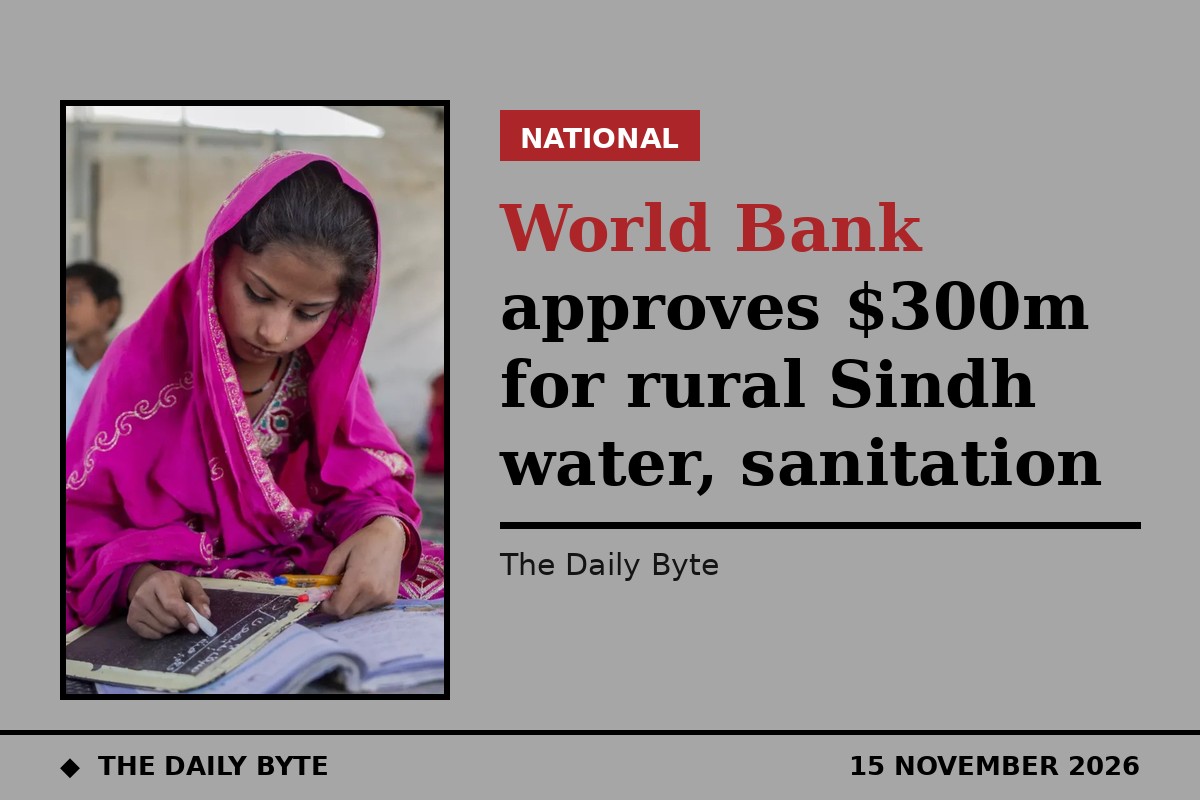
The World Bank has approved $300 million in financing to bring safe water, sanitation and hygiene services to 1.5 million people in selected rural areas of Sindh, in a project aimed at tackling one of the main drivers of child stunting in the province.
The World Bank Group’s Board of Executive Directors approved the financing on 13 November 2026 for the Sindh Transformational Accelerated Rural Water Supply, Sanitation, and Hygiene Services Phase 1 Project, known as STAR WASH-1, the bank said in a statement.
What the $540 million project will fund
STAR WASH-1 carries a total cost of $540 million. Alongside the World Bank’s $300 million, the Asian Development Bank will contribute $150 million under a recently agreed Full Mutual Reliance Framework, and the Government of Sindh will provide $90 million in counterpart funding.
The project will finance climate-resilient infrastructure, including solar-powered water supply systems and improved sanitation systems in selected rural areas. It will also run an integrated social and behaviour change programme to promote better personal and environmental hygiene, shifting the focus from building infrastructure alone to delivering a safe and sustainable rural water service.
It aims to halve water contamination at the point of use and to connect 80 per cent of targeted rural communities to a professional water and sanitation service provider.
Why clean water matters for children’s health
Unsafe water and poor sanitation cause repeated bouts of diarrhoea in young children, affecting how they absorb nutrients and limiting their physical and mental development. More than half of children under five in rural Sindh are stunted, according to the World Bank.
“Stunting is among Pakistan’s most severe and persistent human capital challenges, and unsafe water, sanitation and hygiene is a major underlying driver,” said Bolormaa Amgaabazar, the World Bank’s country director for Pakistan. Expanding these services for 1.5 million people in rural Sindh would help address one of the root causes, she said.
UNICEF has reported that about half of households in Pakistan still consume contaminated water, with women and children in rural areas often spending hours each day fetching water that may not be safe to drink.
Jobs and a new rural water utility
The project is estimated to generate more than 14,000 jobs. It will also support the formalisation of the Sindh People’s Housing for Flood Affectees as a rural water, sanitation and hygiene utility company, giving rural communities a dedicated service provider rather than relying on ad hoc arrangements.
“Investing in safe water, sanitation, and hygiene is more than building infrastructure — it is investing in human capital,” said Bekele Debele Negewo, the World Bank’s lead water resources management specialist, adding that the project was designed to transform rural water services through climate-resilient, community-centred and financially sustainable systems.
First phase of a 10-year programme
STAR WASH-1 is the first of a four-phase Pakistan Rural Water, Sanitation, and Hygiene Services Program to be implemented over 10 years. The project is closely aligned with the World Bank Group’s Water Forward initiative, which treats water security as a foundation for jobs, investment, economic growth, human development and resilience.
No start date for construction has been announced. The financing approval is the first step; procurement and implementation will follow under the bank’s and the Sindh government’s arrangements.
Sources: World Bank; 365 News.