World Bank approves $500 million more for Nigeria climate resilience
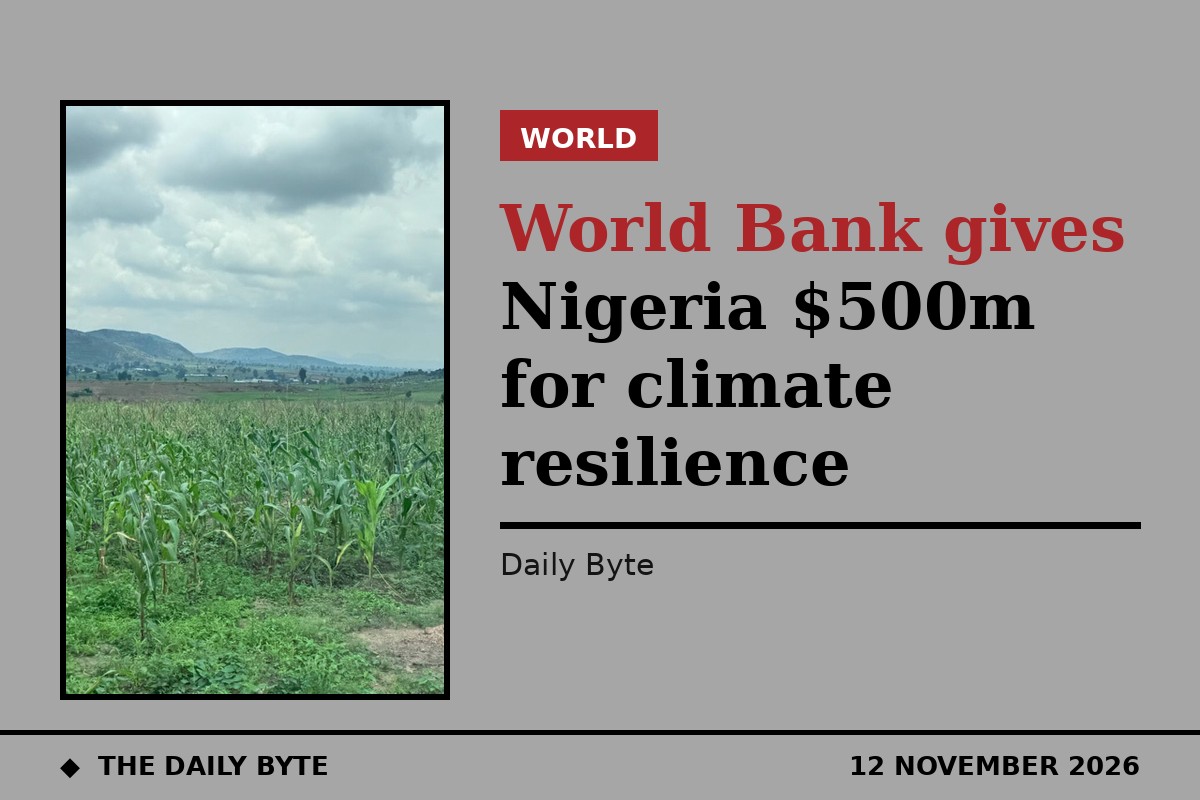
The World Bank has approved US$500 million in additional financing for Nigeria's Agro-Climatic Resilience in Semi-Arid Landscapes (ACReSAL) Project, taking total funding for the programme to US$1.2 billion.
The approval, announced in Abuja on 6 November 2026, will help Nigeria scale up climate resilience, restore degraded landscapes, improve water management and strengthen livelihoods across the country's northern regions.
The additional money comes from the International Development Association (IDA), the World Bank's financing arm for low-income countries. It builds on the original US$700 million credit approved in December 2021.
What the money will do by 2031
By 2031, the expanded programme is expected to restore landscapes, rehabilitate watersheds, improve erosion and flood management, and build more resilient rural livelihoods, reaching 1.4 million hectares and benefiting 6.6 million people.
The Bank said the funding is also expected to lead to higher household incomes, reduced farmer, community and herder conflicts, improved vegetation health, reduced flooding and associated deaths, better soil health and higher agricultural productivity.
ACReSAL operates across the 19 northern states and the Federal Capital Territory. It is implemented by the Federal Ministry of Environment, in collaboration with the Federal Ministry of Water Resources and Sanitation and the Federal Ministry of Agriculture and Food Security.
Progress since 2022
Since 2022, the project has introduced sustainable landscape management practices on about 550,000 hectares, surpassed its target for improved catchment management, and reached more than 4.4 million beneficiaries, according to the World Bank.
"ACReSAL has demonstrated that investments in climate-resilient landscapes can improve livelihoods, strengthen food and water security, and help communities in the parts of Nigeria most vulnerable to climate shocks," said Mathew Verghis, World Bank Country Director for Nigeria. "This additional financing will help scale up proven solutions, restore more degraded land, increase agricultural productivity, and strengthen institutions that can sustain these gains over the long term."
Iganya Joy Agene, the Bank's task team leader for ACReSAL, said the additional financing "reflects the strong results achieved under ACReSAL and will focus on translating the planning and institutional foundations already established under the project into larger-scale investments that improve climate adaptation, food security, water security, jobs, and economic opportunities."
Why northern Nigeria needs it
Northern Nigeria faces growing climate pressures, including erratic rainfall, advancing desert conditions, soil erosion and floods that have damaged farms, roads and homes and displaced communities. Those pressures affect agricultural production, water resources and food security in a region where many families depend on farming and herding.
The programme's work on watersheds, erosion control and flood management is designed to protect farmland and settlements, while its support for rural livelihoods aims to give communities more ways to earn a living as conditions change.
The expanded ACReSAL programme will run through November 2031, with the new financing supporting the next phase of landscape restoration and climate adaptation across the north.
Sources: World Bank and Africa Business Insight.


