World Labs Atlas Opens 3D Worlds to Everyone
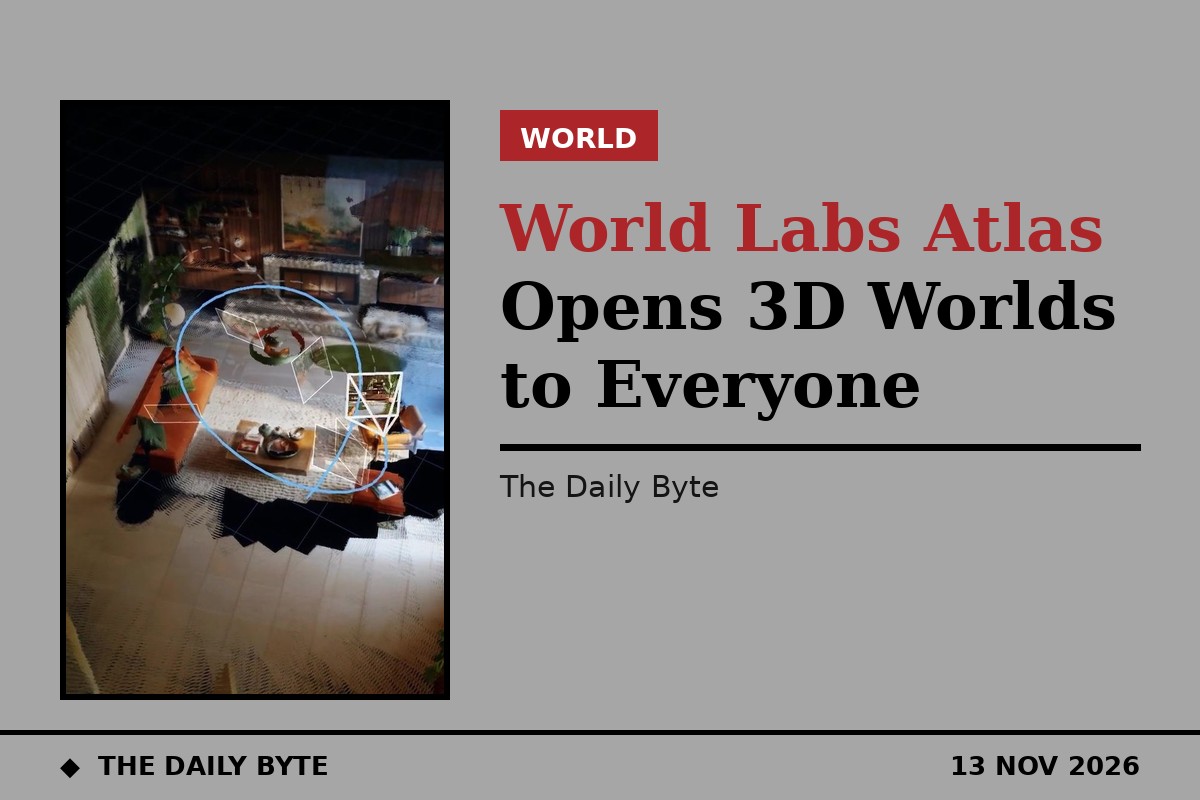
World Labs has opened Atlas, its artificial intelligence world model, to everyone, letting users turn ordinary photos into explorable three-dimensional worlds. The San Francisco company, founded by computer scientist Fei-Fei Li, announced on 12 November 2026 that Atlas was available to all, after a period in early access with selected partners.
Atlas was first unveiled on 1 September as an omni world model that reconstructs scenes as 3D Gaussian splats, clouds of tiny coloured points that render as solid-looking spaces. Since then, splat creation reached customers through the company's Marble Studio and a beta programming interface at the end of October. The public release adds browser apps and developer tools around the same model.
Four tools launch with Atlas
Viewfinder is the starting point for most users. They upload one or more photos, or images made by an AI generator, and Atlas reconstructs the scene so the camera can move through it. Users can explore new viewpoints and render camera paths and video from the reconstruction.
Chisel takes a different approach, letting creators block out a scene from grey boxes, arranging rooms and objects before Atlas fills in the detail. Every camera view updates as objects move, so the layout can be shaped before the final images are generated.
Two further tools handle the output. Splats to Mesh converts a Gaussian splat scene into a mesh with real geometry, ready for games and interactive environments, while Relight changes the lighting on a splat scene. The tools are aimed at film and visual effects, architecture and design, robotics and game development, according to World Labs.
Developers get an API and Blender support
Developers can use the same capabilities through an Atlas programming interface, which returns keyframes, video clips or 3D Gaussian splats. One documented task rebuilds posed photo frames into a refined splat file: a run using between two and 512 frames costs 5,000 credits, or five dollars at the company's rate of 1,000 credits per dollar, while a draft run of up to 32 frames costs 500 credits. Failed runs are free, and runs usually take between 15 and 25 minutes. In one example given by the company, eight frames of a potter's studio became two million splats in 18 minutes.
The results are designed to drop into existing 3D software. Blender 5.3, released on 10 November, can import Gaussian splat files natively, so Atlas output opens without an add-on, and an optional Atlas extension adds generation and editing inside Blender. World Labs also points users to its Spark renderer for viewing splat files.
Still a closed product
What opened on 12 November is access, not the model itself. Atlas remains a hosted product with no published weights, and World Labs has not published a price page, quota table or final rate limits for the service. A separate free demo, Frameboy, released on 5 November, lets anyone explore preset worlds in a browser without signing up, but it does not accept custom uploads.
The release comes weeks after AMD agreed to acquire World Labs, a deal announced on 28 September. On 12 November, Li shared a stage at the Conference on Robot Learning with AMD chief executive Lisa Su, their first public appearance together since the deal, where Li also presented Atlas as a tool for training robots in virtual worlds before they are deployed in the real one.
Atlas is available now through the company's website, with registration required. For creators and developers, the question now is whether a model that builds worlds from a handful of photos can move from impressive demonstrations into everyday production work.