Zambia election results differ by 45,216 votes
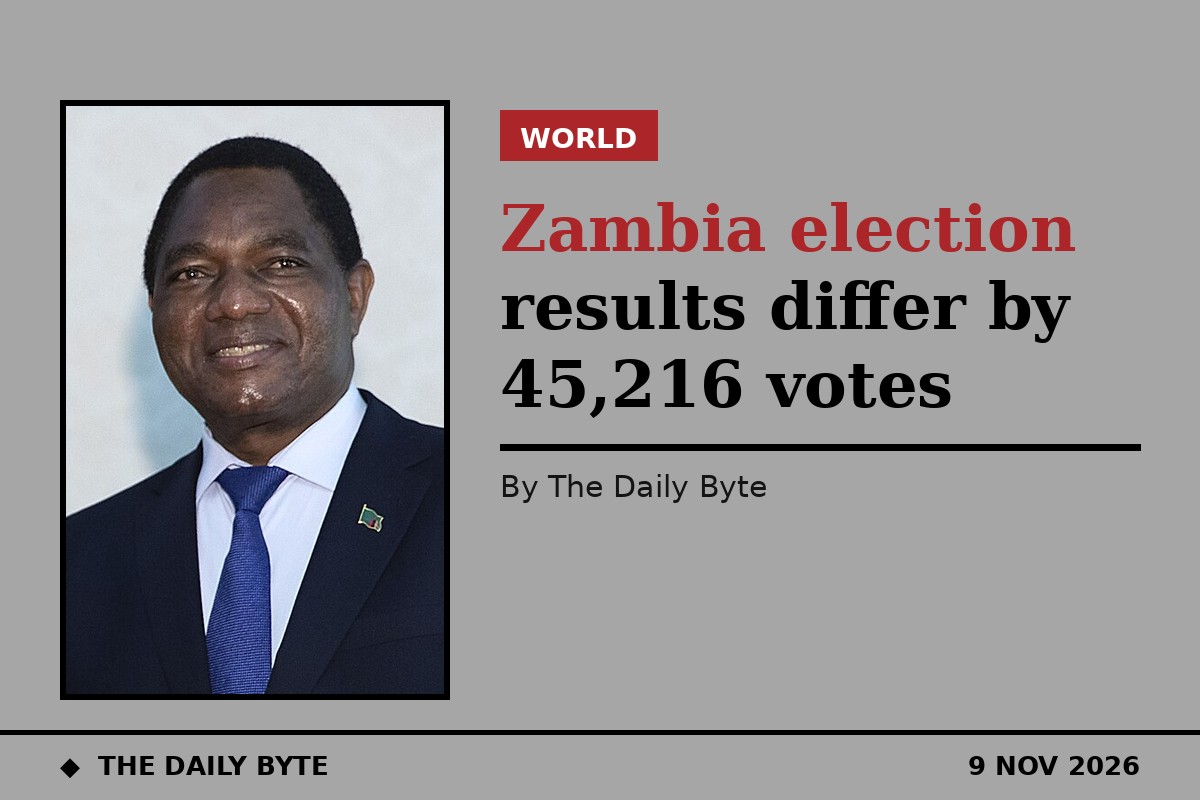
Zambia’s Electoral Commission (ECZ) has published detailed presidential election results that differ from the figures announced when President Hakainde Hichilema was declared the winner of the country’s 13 August 2026 election, raising questions the commission has yet to answer.
The 162-page document, dated 25 August 2026, sets out the presidential results for all 226 constituencies, including votes for each candidate, rejected ballots, total votes cast, registered voters and turnout. It is the first time the commission has released the full constituency-level breakdown of the election.
What the new figures show
According to the national summary in the ECZ publication, President Hichilema received 3,010,542 votes, or 59.13 percent of the national vote. His main challenger, Brian Mundubile of the National Reconciliation Party for Unity and Prosperity, received 1,872,799 votes, or 36.78 percent.
Those totals do not match the figures reported when the result was declared. The declaration figures, as reported by ZNBC, gave Hichilema 2,965,326 votes and Mundubile 1,856,217 votes. The newly published document therefore records 45,216 more votes for Hichilema and 16,582 more for Mundubile than the totals announced at the declaration.
The document also records 127,113 rejected ballots, or 2.50 percent of votes cast, and total votes cast of 5,091,604 against 8,786,300 eligible voters, a turnout of about 57.95 percent. The other candidates recorded far smaller totals, led by Harry Kalaba with 19,227 votes.
No explanation given yet
The publication does not, on its own, explain the reason for the differences. The electoral commission will need to clarify whether the figures reflect an updated reconciliation of the results, corrections to previously announced totals, or another step in the compilation of the constituency returns.
The distinction matters because official election records should provide a clear and consistent account of the votes cast. The outcome itself is not in question: Hichilema won the election by a wide margin under either set of figures, and no party has suggested the difference changes the result. But the public should be able to trace the results from constituency level to the final national declaration, and any corrections should be explained.
The release comes days after the European Union Election Observation Mission presented its final report on the election, which examined the campaign environment, media coverage, the use of social media, the role of public institutions and the handling of election-related complaints. Among its findings were concerns about unequal media coverage and the advantages enjoyed by the incumbent.
Independent observers had already raised concerns
Questions about the accuracy of the official results are not new. In an independent assessment published in August, the Christian Churches Monitoring Group (CCMG) said its parallel vote tabulation, based on results from a nationally representative sample of 1,500 polling stations, estimated Hichilema’s share at 56.0 percent and Mundubile’s at 42.3 percent. The group concluded that Hichilema had cleared the 50 percent threshold to win outright, but found that official results in 30 constituencies were artificially inflated and called on the ECZ to publish all 226 collation records and the GEN20 forms for all 13,529 polling stations, according to its published assessment.
The publication of the constituency document is, in principle, a step towards that transparency, allowing parties, observers, researchers and the public to examine the figures beyond the national announcement. But until the commission explains why its own national totals differ from the declaration figures, the questions raised by the document will remain open, and the focus will stay on whether every official figure can be clearly accounted for.


