Zardari Approves 12 Bills and Five KP Ordinances
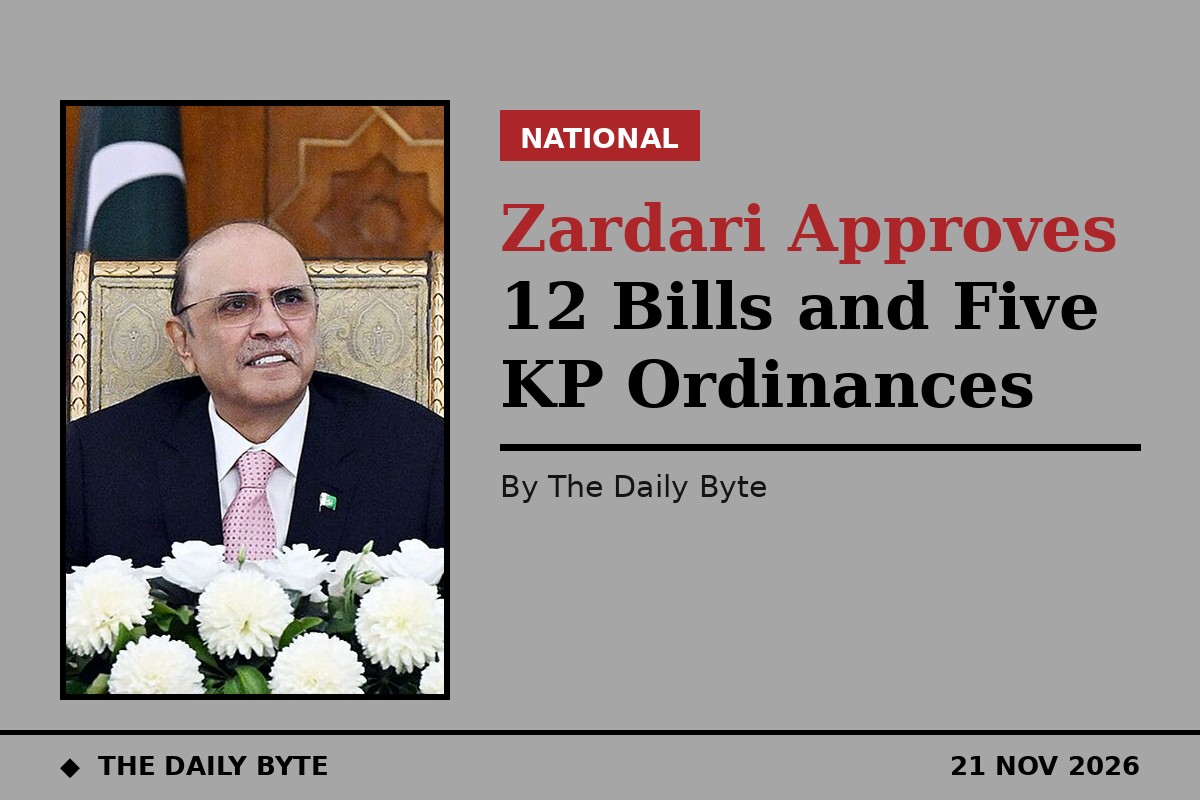
President Asif Ali Zardari has approved 12 amendment bills and five ordinances for Khyber Pakhtunkhwa, the President’s House said on Saturday, in a single day of legislative action covering education, science, tourism and the administration of the province under governor’s rule.
The five ordinances for Khyber Pakhtunkhwa were approved on the advice of the federal government, according to a statement from the President’s House reported by Azaad Digital. The 12 bills were approved in a separate statement issued by the Presidency on X, according to Pakistan Point. Together, the two announcements amount to one of the busiest days of presidential assent in recent weeks.
The five Khyber Pakhtunkhwa ordinances
The ordinances approved for Khyber Pakhtunkhwa are the Khyber Pakhtunkhwa Special Initiatives Ordinance, 2026 (Specified Districts), and the Khyber Pakhtunkhwa Special Initiatives Ordinance, 2026 (Other Than Specified Districts). The president also approved the Khyber Pakhtunkhwa Provincial Assembly (Powers, Immunities and Privileges) (Amendment) Ordinance, 2026, the Khyber Pakhtunkhwa Societies (Registration) (Amendment) Ordinance, 2026, and the Khyber Pakhtunkhwa Speaker and Deputy Speaker (Salaries, Allowances and Privileges) Ordinance, 2026.
The two special initiatives ordinances cover designated districts and the rest of the province separately, while the other three deal with the powers and privileges of the provincial assembly, the registration of societies, and the pay and privileges of the assembly’s speaker and deputy speaker. The President’s House statement did not publish the full text of the ordinances, and no implementation timetable was announced with the approvals.
Twelve bills signed into law
Most of the 12 bills concern education and research. They include the Higher Education Commission (Amendment) Bill, 2026, the Federal Board of Intermediate and Secondary Education (Amendment) Bill, 2026, the National College of Arts Institute (Amendment) Bill, 2026, the Pakistan Study Centres (Amendment) Bill, 2026, the Area of Study Centres (Amendment) Bill, 2026, and the Centres of Excellence (Amendment) Bill, 2026.
The president also approved the National Textile University (Amendment) Bill, 2026, and the NFC Institute of Engineering and Technology Multan (Amendment) Bill, 2026. The remaining approvals were the Archival Material (Preservation and Export Control) (Amendment) Bill, 2026, the National Rehmatul-lil-Alameen and Khatam-un-Nabiyyin Authority (Amendment) Bill, 2026, the Pakistan Council for Science and Technology (Amendment) Bill, 2026, and the Pakistan Tourist Guides (Amendment) Bill, 2026.
Several of the bills had already passed through parliament in late October, including the higher education and study centres measures, which the Senate recorded as passed without amendment. Presidential assent is the final step that turns a bill passed by parliament into law.
Governor’s rule in Khyber Pakhtunkhwa
The ordinances land while Khyber Pakhtunkhwa remains under emergency measures and governor’s rule, imposed on 11 October under Articles 232 and 234 of the Constitution on the federal cabinet’s recommendation, and endorsed by parliament on 15 October. The provincial government headed by Chief Minister Sohail Afridi was suspended, and administrative powers were handed to Governor Faisal Karim Kundi.
The federal government sent the draft ordinance widening the governor’s powers to the president on 15 November, according to government sources cited at the time, with the 12 special districts, including the former tribal districts that merged into the province in 2018, as a particular focus. The two special initiatives ordinances now approved draw the same distinction, one covering specified districts and the other covering the rest of the province.
The approvals come amid continuing disagreement over the emergency arrangements. The Pakistan Tehreek-e-Insaf, whose provincial government was suspended, has opposed the move, and the question of how long governor’s rule will remain in force has not been settled in public. For now, the five ordinances give the governor’s administration a fresh legal footing while that argument continues.