Zardari, Shehbaz Mark World Tolerance Day
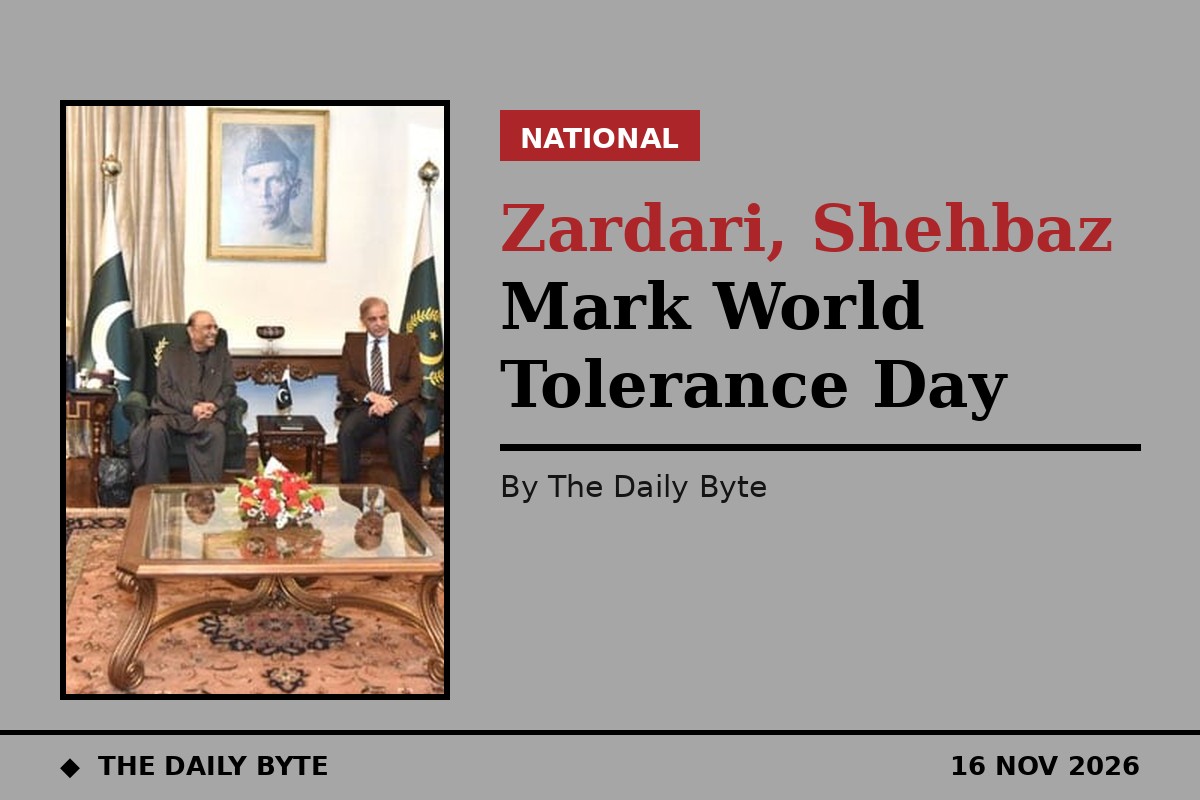
President Asif Ali Zardari and Prime Minister Shehbaz Sharif have issued separate messages on the International Day for Tolerance, calling on Pakistanis to reject prejudice and hatred and to uphold mutual respect, equal rights and peaceful coexistence. The day is observed around the world on 16 November each year.
President Zardari called on all Pakistanis to help build a society where every person can live with dignity, practise their faith without fear and express a different opinion without facing hatred or violence. He said every individual must play their part in building a society based on respect and tolerance, and that every citizen has the right to live with dignity.
The president highlighted the importance of respecting differences in language, culture, faith and political ideology, and said that in a democracy, differences of opinion should always be answered through reason and dialogue. He cited Article 25(1) of the Constitution and the founding vision of Muhammad Ali Jinnah, recalling the Quaid-e-Azam’s historic address of 11 August 1947, in which he declared: “We are starting with this fundamental principle that we are all citizens and equal citizens of one State.”
What the president and prime minister said
In his message, the prime minister said Pakistan joined the international community in reaffirming its commitment to mutual respect, peaceful coexistence and the protection of human dignity. “The true essence of tolerance lies in respecting the beliefs, convictions and rights of others, even in the face of differences,” Shehbaz Sharif said, adding that Islamic teachings provide an enduring guide to patience, tolerance, compassion, justice and respect for humanity.
Shehbaz said the life of the Holy Prophet (Peace Be Upon Him) provided a timeless model of patience, forbearance and kindness towards others. He pointed to the government’s work on minority rights, including the National Commission for Minority Rights Act, 2025, and said the government would advance the National Action Plan on Human Rights to curb hate speech and promote human-rights education.
President Zardari said the principles of tolerance were deeply rooted in the teachings of Islam, which emphasise compassion, justice and respect for all humanity. He said the government was implementing the Interfaith Harmony Policy and the Strategy of Religious Tolerance, both approved by the Federal Cabinet, and noted that Parliament had passed the National Commission for Minorities’ Rights Bill, 2025, and formed a parliamentary Minorities Caucus to safeguard minority rights and promote interfaith harmony.
Why the messages matter now
The messages come at a time of heated political debate in Pakistan, including over the creation of new provinces, and amid continuing concern about sectarian and communal tensions. Both leaders framed tolerance not as a slogan but as a practical requirement for a diverse society, linking it to the Constitution’s guarantees of equality and freedom of religion.
PPP chairman Bilawal Bhutto-Zardari also marked the day, saying the growing tide of intolerance, extremism and hatred posed a grave threat to democracy, social harmony and human dignity. The president, meanwhile, called on all citizens, particularly young people, to stand firm against prejudice, discrimination and hate in every form, and urged religious scholars, minority representatives and the media to educate people about love, tolerance, brotherhood and unity.
The International Day for Tolerance was established by UNESCO following the Declaration of Principles on Tolerance adopted on 16 November 1995, and is marked each year to promote respect and understanding between people of different backgrounds. For Pakistan, the leaders’ messages serve as a reminder that the country’s founding vision, as set out by Jinnah, was of a state where people of every faith could live together in harmony, equality and dignity, and where differences were settled by argument rather than by force.
Sources: The News, reporting the president’s and prime minister’s messages; Daily Imroz, reporting the messages via ARY News; Press Information Department, the official text of the president’s message.